


































How Semi-Automatic Assembly Machines Help Small and Medium Industries Increase Productivity
Discover how semi-automatic assembly machines help small and medium industries improve productivity, reduce labor dependency, enhance quality control, and lower production costs with custom assembly SPM solutions.

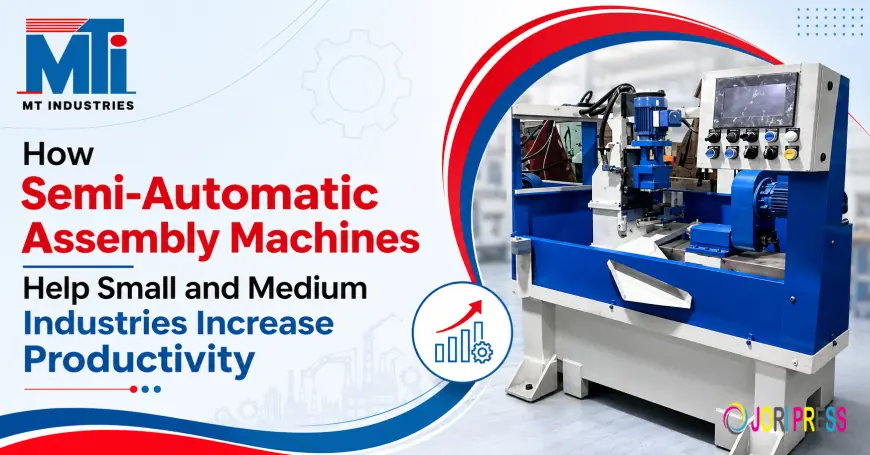
The Productivity Problem Every SME Knows Too Well
Ask any small or medium manufacturer what keeps them up at night, and labour shortages or rising production costs will probably come up before anything else. Output targets keep climbing, but workers are harder to retain and skilled hands cost more every year. So what do you do when manual assembly lines simply cannot keep pace anymore? For a growing number of SMEs across India, the answer has been a Semi-Automatic Assembly Machine.
Unlike a fully automated assembly line that demands huge capital outlay, a Semi-Automatic Assembly Machine sits in a practical middle ground. It takes over the repetitive, error-prone parts of assembly while still letting a human operator handle loading, inspection, or fine adjustments. That balance is exactly why so many mid-sized factories are turning to this kind of equipment instead of jumping straight to a fully automated assembly system.
Why The Numbers Actually Make Sense
Let's talk numbers for a second. A typical SME doesn't have the budget of a large OEM. Importing or building a fully robotic assembly line can run into crores, and the payback period stretches for years. A semi-automatic assembly machine, on the other hand, usually pays for itself within months because it is engineered around the actual process rather than over-engineered for capabilities the unit will never use. That's the whole point of an SPM, a special-purpose machine, built for one job and built to do that job exceptionally well.
Quality Control Gets A Lot Less Stressful
Productivity is the obvious win here, but it isn't the only one. Quality control improves dramatically, too. Manual assembly, however skilled the operator, will always carry some variance from one unit to the next. Fatigue creeps in. Attention drifts after the hundredth repetition of the same task. A well-built Industrial Assembly Machine removes that inconsistency from the equation. Torque gets applied the same way every single time. Components get pressed, riveted, or fastened to the same tolerance, batch after batch. Rejections drop, rework drops with them, and customers stop sending back parts that don't fit quite right.
The Workforce Angle Nobody Talks About Enough
Then there's the workforce angle, which honestly doesn't get talked about enough. Skilled labour in the assembly sector is thinning out, plain and simple. Younger workers don't want repetitive factory jobs the way the previous generation did, and who can blame them? A semi-automatic assembly machine changes the nature of the work itself. Instead of hunching over a workbench doing the same motion eight hours a day, an operator manages a machine, watches output, and handles exceptions when they come up. That's a more attractive job, and it's easier to train someone into that role quickly.
Flexibility Is Just As Important As Speed
Flexibility matters just as much as speed. Most SMEs aren't running one product for the next twenty years. Order books change, client specifications shift, and new SKUs get added all the time. This is where a Custom Assembly SPM earns its reputation. Because the machine is purpose-built around the customer's exact components and process flow, a manufacturer can configure stations for pressing, riveting, screwing, or testing depending on what the job actually demands, rather than forcing a generic machine to fit an unusual product.
The Unsung Hero: Precision Assembly Fixtures
Precision Assembly Fixtures deserve a mention too, because they are really the hidden gems of the whole setup. A machine is only as good as the fixture holding the component in place. Get that wrong, and even the most advanced Assembly Line Machine will produce inconsistent results. Get it right, and you can hold tolerances that manual fixturing simply cannot match, run after run, shift after shift.
Is It Right For Every Business?
Is a Semi-Automatic Assembly Machine the right fit for every SME? Not necessarily. A business producing a handful of units a week probably doesn't need one yet. But for any manufacturer scaling up, juggling multiple product variants, or struggling to find enough skilled hands to keep pace with orders, it's worth a serious look. MT Industries has spent over four decades building SPMs for exactly this kind of challenge, working across the automotive and electrical component space with companies that needed assembly lines built to grow alongside them rather than hold them back.
The Bottom Line
Manufacturing in India is changing fast, and the SMEs that adapt early tend to be the ones still standing a decade from now. A semi-automatic assembly machine isn't a magic fix for every production headache. But for the right application, it's one of the smartest, most cost-effective upgrades a growing business can make.
What's Your Reaction?
 Like
0
Like
0
 Dislike
0
Dislike
0
 Love
0
Love
0
 Funny
0
Funny
0
 Angry
0
Angry
0
 Sad
0
Sad
0
 Wow
0
Wow
0