






































How Can Simulation Software Help Japan’s Aerospace Industry Reach New Heights?
This article explores how simulation software supports Japan’s aerospace industry through aircraft engineering, satellite development, advanced materials, AI-assisted modeling, digital twins, and aerospace manufacturing optimization.

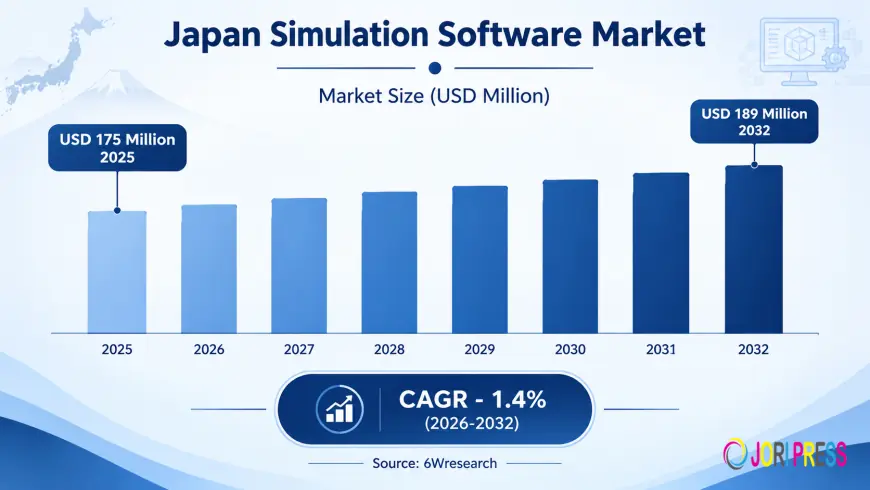
Japan’s aerospace industry is advancing through developments in aircraft engineering, space exploration, satellite technology, and advanced materials. These activities require precise engineering, extensive testing, and careful evaluation of complex systems before physical deployment. Simulation technology enables engineers to investigate designs, assess performance, and identify potential weaknesses in virtual environments. As aerospace organizations seek more efficient development processes, the Japan Simulation Software Market offers opportunities for software providers supporting aircraft design, space systems, structural engineering, and aerospace manufacturing.
Why Is Simulation Essential for Aerospace Engineering?
Aerospace engineering involves complex interactions among aerodynamics, structural forces, temperature, vibration, propulsion, and electronic systems. Even a minor design change can affect several aspects of an aircraft or spacecraft’s performance.
Simulation software helps engineers examine these relationships through computational models. Teams can evaluate different configurations, investigate operating conditions, and identify possible design limitations before committing to physical prototypes.
Although physical testing remains essential for validating aerospace systems, simulation can help engineers prioritize promising designs and use testing resources more efficiently. It also allows specialists to investigate scenarios that may be difficult, expensive, or hazardous to reproduce experimentally.
Key Applications Across Japan’s Aerospace Sector
Simulation technology can support multiple stages of aerospace development and manufacturing.
-
Aerodynamic analysis: Engineers can study airflow, drag, lift, and pressure distribution around aircraft structures.
-
Structural simulation: Models can evaluate stress, deformation, vibration, and fatigue under different loading conditions.
-
Propulsion engineering: Simulation can help examine thermal behavior, fluid movement, and selected engine performance characteristics.
-
Satellite development: Engineers can assess structural behavior, thermal conditions, and component interactions under simulated operating environments.
-
Manufacturing optimization: Aerospace producers can evaluate production workflows, equipment utilization, and manufacturing processes.
-
Flight-system development: Simulation environments can help test control algorithms and investigate selected operational scenarios.
These applications make simulation valuable for both established aerospace manufacturers and companies developing specialized components.
How Simulation Supports Japan’s Space Exploration Ambitions
Spacecraft and satellite development presents unique engineering challenges because equipment must operate under demanding environmental conditions. Temperature variations, vibration during launch, radiation exposure, and limited opportunities for physical repair make reliability particularly important.
Simulation can help engineers investigate thermal management, structural strength, and the behavior of selected spacecraft subsystems. Satellite developers can compare alternative designs and examine how components interact under different operating conditions.
Simulation can also support mission planning and analysis of orbital mechanics, depending on the software’s capabilities. These tools provide opportunities to investigate scenarios before a mission begins, although actual spaceflight performance must be assessed through appropriate engineering verification and testing.
As satellite applications expand across communications, Earth observation, navigation, and scientific research, specialized simulation capabilities may become increasingly relevant to aerospace development.
Advanced Materials Create New Engineering Opportunities
The aerospace sector increasingly uses materials designed to provide specific combinations of strength, weight, thermal resistance, and durability. Evaluating these materials requires an understanding of how they respond to mechanical loads and environmental conditions.
Simulation software can help researchers investigate material behavior and compare alternative component designs. Engineers may examine how composites respond to stress or evaluate the influence of temperature on selected materials.
Computational analysis can also help manufacturers assess production processes involving advanced materials. However, material models must be calibrated and validated against suitable experimental evidence before they can reliably inform critical engineering decisions.
Software providers that offer specialized materials modeling and integration with computer-aided design tools may find opportunities among aerospace research and manufacturing organizations.
Artificial Intelligence and Digital Twins in Aerospace
Artificial intelligence is creating new possibilities for engineering simulation. AI-assisted models can help identify patterns in simulation data, screen design alternatives, and estimate outcomes for selected scenarios. This may reduce repetitive calculations during early-stage development.
Digital twins offer another opportunity by connecting digital representations of aircraft components, manufacturing equipment, or other physical assets with relevant operational data. When combined with simulation, these models can help engineers investigate performance changes and evaluate maintenance strategies.
For example, a manufacturer could use equipment data to investigate unusual operating behavior and simulate possible adjustments to a production process.
However, aerospace applications demand careful validation. AI predictions and digital models must not be treated as substitutes for engineering judgment, appropriate testing, or required safety assessments.
Challenges That Could Affect Market Adoption
Despite its advantages, simulation software adoption can involve significant technical and financial barriers.
-
High implementation costs: Advanced licenses, computing infrastructure, and specialist services can require substantial investment.
-
Technical complexity: Aerospace simulation requires professionals with expertise in engineering disciplines and numerical modeling.
-
Model validation: Inaccurate assumptions or incomplete data can produce misleading results.
-
Cybersecurity: Aerospace designs and technical information require strong protection against unauthorized access.
-
Software integration: Different engineering applications may use incompatible formats or workflows.
-
Regulatory requirements: Aerospace organizations must ensure that simulation activities support applicable verification and certification processes.
These challenges create opportunities for vendors that combine reliable software with implementation assistance, training, and industry-specific expertise.
How Can Simulation Software Providers Capture Opportunities in Japan?
Software companies seeking aerospace customers should focus on clearly defined engineering needs rather than promoting simulation as a general-purpose solution. Demonstrations that illustrate improvements in design evaluation, computational efficiency, or workflow coordination can help customers understand the technology’s practical value.
Providers can strengthen their position through partnerships with aerospace manufacturers, engineering consultancies, research laboratories, and component suppliers. Japanese-language technical support, specialized training, and compatibility with existing engineering platforms may also help reduce implementation difficulties.
Flexible licensing arrangements can enable organizations to evaluate selected applications before committing to broader deployments. Vendors should also provide tools for model verification, documentation, and reproducibility.
What Is the Future of Japan’s Simulation Software Market?
Japan’s aerospace ecosystem offers potential opportunities across aircraft engineering, satellite development, advanced materials, and aerospace manufacturing. As engineering systems become more complex, simulation can help organizations evaluate alternatives and investigate technical risks earlier in the development process.
Future adoption will depend on research investment, customer requirements, computing capabilities, software reliability, and the availability of skilled professionals. AI-assisted engineering and digital twins may expand selected applications, while physical validation will remain essential.
For software providers, the strongest opportunities are likely to emerge from specialized solutions that address measurable engineering challenges and integrate effectively into existing aerospace workflows.
About 6Wresearch
About 6Wresearch: 6Wresearch is a commercial strategy and growth advisory firm founded in 2011 and headquartered in New Delhi, India, with partners across Southeast Asia and the Middle East & Africa. The firm has delivered over 20,000 commercial engagements for over 2,000 organizations, including Fortune 500 companies, government agencies, and multilateral institutions such as the World Bank and the Asian Development Bank. Backed by proprietary market research and advanced analytics, 6Wresearch combines sector expertise with data-driven intelligence to help organizations navigate market complexity and drive sustainable growth. These capabilities explain why organizations trust 6Wresearch Global Market Research & Consulting Firm for reliable commercial insights and confident decision-making.
Our Proprietary Platform: 6W Export GTM
6W Export GTM is 6Wresearch's proprietary trade intelligence and go-to-market platform, built on UN Comtrade data and enhanced with 6Wresearch's in-house analytical and simulation models, including system dynamics-based forecasting. Unlike broad, sector-level market sizing tools, 6W Export GTM operates at the individual product level down to specific HS codes and micro-segments to identify precise, actionable export opportunities by country and product pair, including markets where trade currently does not exist. This granular, simulation-driven approach allows 6W Export GTM to surface opportunities that sector-wide analysis typically misses, positioning it among a small number of platforms globally offering this depth of product-and-country-specific export intelligence.
What's Your Reaction?
 Like
0
 Dislike
0
 Love
0
 Funny
0
 Angry
0
 Sad
0
 Wow
0