









































Guide to CNC Turning and Milling Cutting Inserts

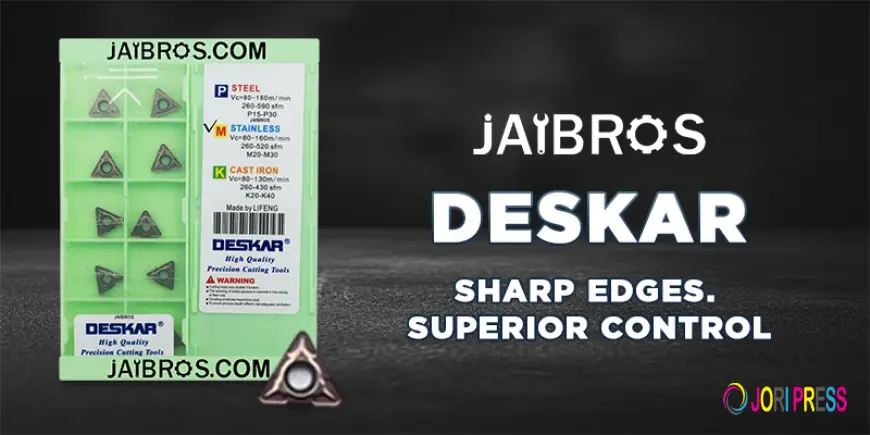
Explore how modern carbide inserts improve machining accuracy, chip control, surface finish, and productivity in CNC operations.
How Deskar Inserts Work in CNC Turning and Milling
Precision, speed, and accuracy are the key factors in modern machining processes. In this context, cutting tools contribute greatly towards meeting these requirements. In addition to being reliable and precise, one of the most common cutting tools used by various industries are Deskar inserts. which are not only tough but are also able to cut precisely and efficiently and can work with different materials in machining processes.
CNC machining involves replacing the cutting tip, called an insert, of the tool in order to do things such as turning, facing, boring, grooving, and milling. These inserts have been designed to make it possible to replace the cutting edge alone rather than the whole tool. Due to the carbides used in these inserts, a higher level of surface finish, stable cutting, and improved tool life is made possible.
Understanding CNC Turning and Milling Operations
CNC machining mainly includes turning and milling processes, both of which require highly accurate cutting edges for efficient material removal.
CNC Turning
In the process of turning, the work is rotated whereas the tool is held stationary. This type of machining process is mainly carried out for making cylindrical components such as shafts, bushes, and screws. An efficient CNC tool should be used in this process to obtain accurate results.
CNC Milling
Milling uses rotating tools to remove metal from a stationary part. Milling operations are ideal for making slots, contours, pockets, and any complex shape. Milling operations require inserts that can handle interrupted cutting, vibrations, and cutting at high temperatures.
The effectiveness of these machining processes depends greatly on insert geometry, coating, chip control, and cutting parameters.
How Inserts Perform During Machining
Cutting inserts work by shearing material from the workpiece through controlled cutting action. Their shape, edge preparation, and coating determine how effectively they remove material while minimizing heat and wear.
1. Material Removal Mechanism
During machining, the insert edge penetrates the workpiece and creates chips. Proper chip formation is important because uncontrolled chips can damage the workpiece surface and reduce machining efficiency. Insert geometries are specifically designed to guide chips away from the cutting zone.
2. Heat Resistance
Machining generates extreme heat due to friction between the insert and the workpiece.This helps prevent premature wear and edge deformation.
3. Wear Protection
Modern inserts feature protective coatings such as TiN, TiAlN, or CVD coatings. These coatings improve resistance against abrasion, oxidation, and chemical wear, extending tool life significantly.
4. Stability During Cutting
Stable cutting reduces vibration and improves surface finish quality. Proper insert seating and rigid clamping systems ensure that the cutting edge remains secure during heavy machining operations.
Key Features That Improve Machining Efficiency
Several design elements contribute to the performance of inserts in turning and milling applications.
Strong Carbide Structure
Carbide-based inserts offer excellent hardness and toughness. This combination allows them to handle both roughing and finishing operations efficiently.
Precision Edge Geometry
Different edge geometries are designed for specific applications. Sharp edges are suitable for finishing operations, while stronger edge preparations handle heavy roughing cuts.
Multiple Cutting Edges
Most inserts are indexable, meaning they can be rotated to use multiple cutting edges.
Coating Technology
Advanced coating layers reduce friction and heat generation. This leads to smoother machining and better surface quality.
Compatibility With Different Materials
These inserts can machine steel, stainless steel, cast iron, aluminum, and hardened materials with proper grade selection.
Applications in Industrial Manufacturing
The use of inserts extends across various manufacturing industries because of their versatility and productivity advantages.
Automotive Industry
Automotive manufacturers use inserts for machining engine blocks, shafts, brake components, and transmission parts where precision is critical.
Aerospace Components
Aircraft parts require high dimensional accuracy and excellent surface finishes. Inserts help achieve these standards while machining difficult materials like titanium and superalloys.
Mold and Die Manufacturing
Complex mold cavities and hardened steel components demand stable cutting performance during finishing operations.
General Engineering
From small workshops to large production facilities, inserts are used in routine machining tasks to improve production speed and accuracy.
In many workshops, operators prefer deskar carbide inserts because they offer a balance between wear resistance, cutting stability, and cost-effectiveness for daily machining operations.
Importance of Insert Selection
Selecting the correct insert is essential for maximizing machining efficiency and achieving desired results.
Insert Shape
Different insert shapes are suitable for specific operations. Round inserts provide strength for heavy cuts, while diamond-shaped inserts are better for finishing and precision work.
Grade Selection
Insert grades vary according to material hardness and machining conditions. Tough grades resist chipping, while harder grades provide better wear resistance.
Coating Type
The coating determines how the insert performs under high-speed or high-temperature conditions.
Cutting Parameters
Proper speed, feed rate, and depth of cut help improve insert life and machining quality.
Choosing the wrong insert can lead to tool failure, poor surface finish, and increased production costs.
Benefits of Using High-Quality Inserts
Manufacturers prefer advanced inserts because they improve overall machining productivity.
Improved Surface Finish
Sharp and stable cutting edges produce smoother surfaces with minimal imperfections.
Reduced Downtime
Indexable inserts reduce machine stoppage because operators can quickly replace worn edges.
Higher Productivity
Efficient chip removal and stable cutting allow higher machining speeds and feeds.
Lower Tooling Costs
Multiple usable edges help reduce overall tooling expenses in long production runs.
Better Dimensional Accuracy
Consistent cutting performance ensures precise component dimensions throughout production.
Many buyers also compare the deskar inserts price with performance and tool life before selecting inserts for industrial applications, as long-term productivity often matters more than initial cost.
Role of Inserts in Modern CNC Machining
Modern advanced manufacturing entails a need for tools that are able to withstand automation, tolerances, and repetitive production processes. Inserts have proved to be an important component of modern-day machining system due to their reliability and ability to perform at fast speeds with great efficiency.
In today's machining system, there has been a need for increased production efficiencies without wastage and inconsistent performances. Manufacturers concentrate on setting the most effective cutting conditions, use of coolants, and proper insert designs to ensure maximum performance. With a selected cnc tool and high-quality inserts, the manufacturing process becomes much more efficient.
Due to the rising demands of precise components in the market, there has been an increasing demand for highly efficient cutting tools. Deskar inserts prove to be efficient in providing reliable machining performances whether in turning or milling processes with soft and hardened materials.
The availability of inserts in several types and geometries has enabled manufacturers to use appropriate machining approaches. Whether for rough machining or finishing processes, the use of the right insert leads to improved performance.
It helps in minimizing vibrations, improving chip clearance, and prolonging the lives of tools during high-speed machining operations.
Conclusion
The function of cutting inserts is indispensable when it comes to increasing the accuracy, productivity, and effectiveness of CNC turning and milling operations. The use of carbide material, advanced coatings, and the replaceable cutting edge makes them necessary for today’s manufacturing industries. Be it automotive machining or aerospace machining, the use of inserts ensures accuracy along with minimizing down time and expenses.
In today's age of advanced machining technologies, choosing the right cutting insert has become even more critical to ensure steady cuts as well as efficiency in the long run. Companies searching for effective industrial machining tools may try jaibros machining products.
FAQ
1. What are CNC inserts used for?
CNC inserts are used for cutting, shaping, and removing material during turning, milling, drilling, and boring operations.
2. Why are carbide inserts preferred in machining?
Carbide inserts offer high hardness, wear resistance, and heat resistance, making them suitable for high-speed machining.
3. How do inserts improve productivity?
They reduce downtime, allow faster cutting speeds, and provide multiple cutting edges for extended usage.
4. Can inserts be used for both roughing and finishing?
Yes, different insert geometries and grades are designed specifically for roughing and finishing applications.
5. How often should inserts be replaced?
Replacement depends on wear level, machining conditions, and material type, but inserts should be changed once cutting quality decreases.
What's Your Reaction?
 Like
0
Like
0
 Dislike
0
Dislike
0
 Love
0
Love
0
 Funny
0
Funny
0
 Angry
0
Angry
0
 Sad
0
Sad
0
 Wow
0
Wow
0