







































Clinical Trial Data Management in India 2026: Cost, Compliance, and CRO Benefits Explained
In 2026, sponsors are increasingly turning to Clinical Trial Data Management Services in India to manage rising data complexity while controlling costs and maintaining compliance with global regulatory standards.
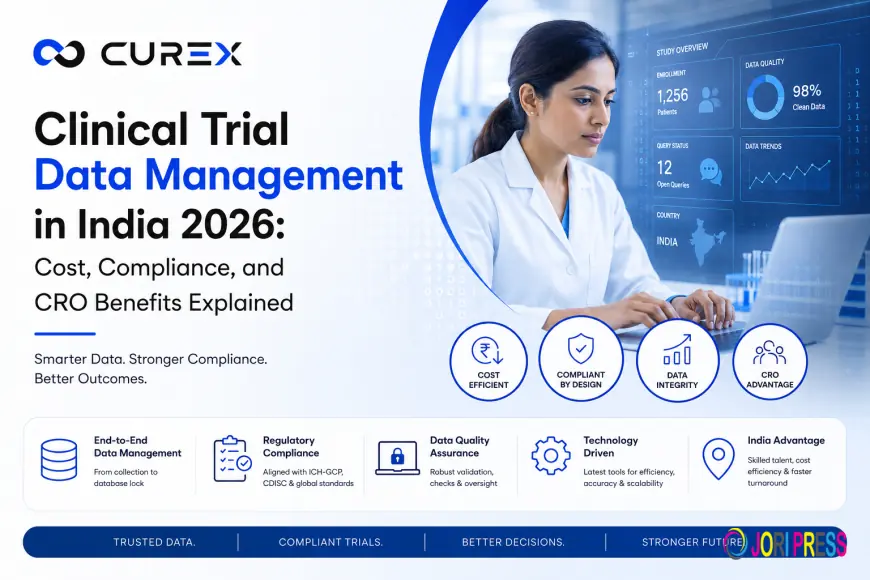
How Strategic Data Management Services Help Sponsors Improve Trial Efficiency, Regulatory Compliance, and Submission Readiness.
Clinical trials generate enormous volumes of data. From patient enrollment and site activities to laboratory results, safety reports, electronic patient-reported outcomes (ePROs), and wearable device data, modern studies depend on accurate and reliable information to support critical development decisions.
As clinical research becomes increasingly complex, sponsors face growing pressure to ensure data quality, maintain regulatory compliance, and accelerate development timelines. These challenges have made Clinical Trial Data Management (CDM) one of the most important functions within modern clinical research.
In 2026, sponsors are increasingly turning to Clinical Trial Data Management Services in India to manage rising data complexity while controlling costs and maintaining compliance with global regulatory standards.
India has emerged as a preferred destination for clinical data management outsourcing due to its highly skilled workforce, strong clinical research ecosystem, advanced technology capabilities, and experience supporting global clinical trials.
This article explores the role of clinical trial data management, current industry trends, outsourcing benefits, compliance considerations, and why India continues to be a strategic choice for sponsors worldwide.
Why Clinical Trial Data Management Is Critical in Modern Research
Clinical trials rely on data to evaluate safety, efficacy, and overall study outcomes.
Every regulatory submission ultimately depends on the quality of the collected data.
If data is inaccurate, incomplete, inconsistent, or poorly managed, the consequences can be severe.
Potential risks include:
- Regulatory delays
- Protocol deviations
- Increased audit findings
- Delayed database lock
- Additional monitoring requirements
- Submission rejection risks
Think of clinical trial data as the foundation of a building.
No matter how impressive the structure appears from the outside, weaknesses in the foundation create long-term problems.
Similarly, even well-designed studies can encounter significant challenges if data management processes fail to maintain quality and integrity.
This is why sponsors increasingly invest in professional Clinical Data Management Services to ensure every data point supports reliable decision-making.
What Is Clinical Trial Data Management?
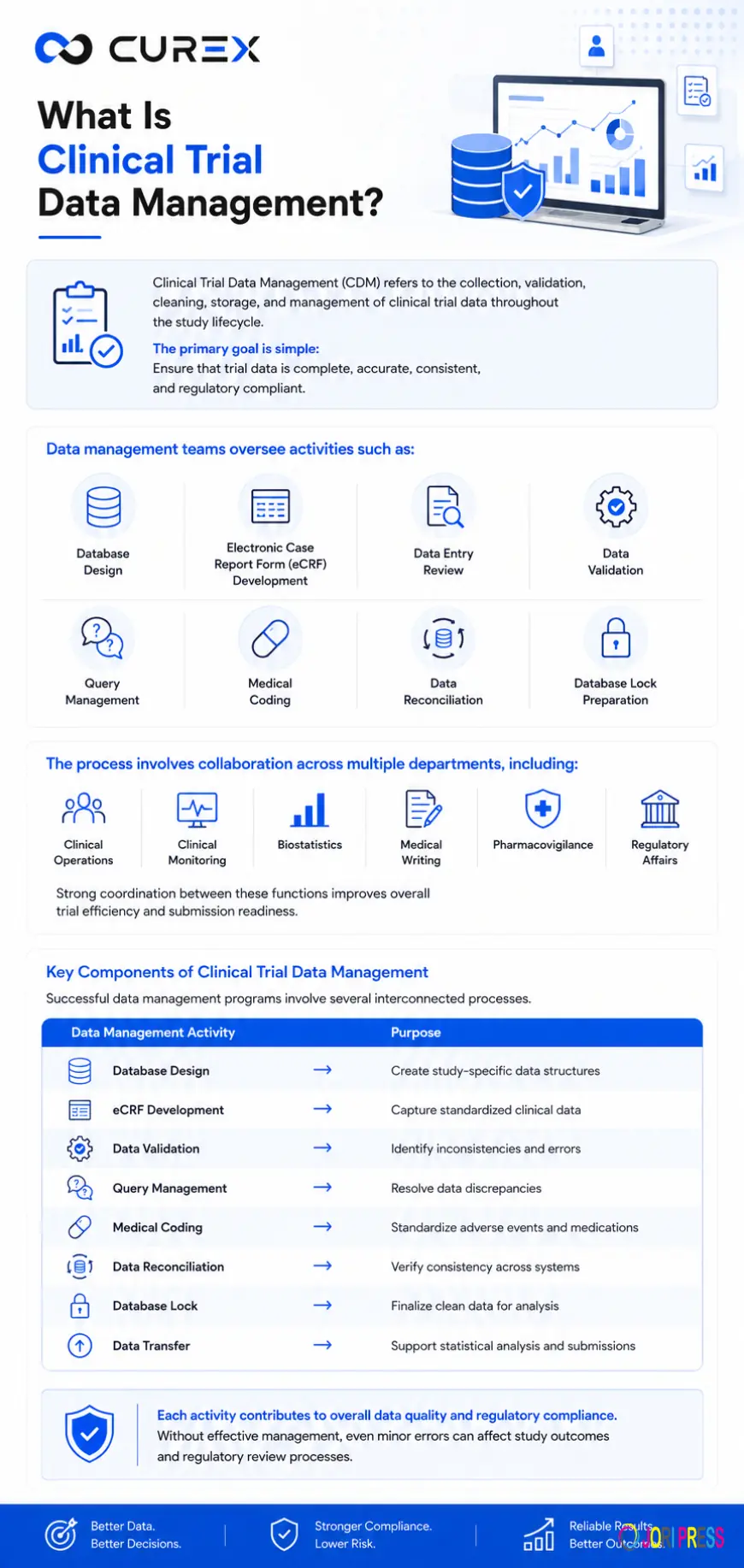
Clinical Trial Data Management (CDM) refers to the collection, validation, cleaning, storage, and management of clinical trial data throughout the study lifecycle.
The primary goal is simple:
Ensure that trial data is complete, accurate, consistent, and regulatory compliant.
Data management teams oversee activities such as:
- Database design
- Electronic Case Report Form (eCRF) development
- Data entry review
- Data validation
- Query management
- Medical coding
- Data reconciliation
- Database lock preparation
The process involves collaboration across multiple departments, including:
- Clinical operations
- Clinical monitoring
- Biostatistics
- Medical writing
- Pharmacovigilance
- Regulatory affairs
Strong coordination between these functions improves overall trial efficiency and submission readiness.
Key Components of Clinical Trial Data Management
Successful data management programs involve several interconnected processes.
| Data Management Activity | Purpose |
| Database Design | Create study-specific data structures |
| eCRF Development | Capture standardized clinical data |
| Data Validation | Identify inconsistencies and errors |
| Query Management | Resolve data discrepancies |
| Medical Coding | Standardize adverse events and medications |
| Data Reconciliation | Verify consistency across systems |
| Database Lock | Finalize clean data for analysis |
| Data Transfer | Support statistical analysis and submissions |
Each activity contributes to overall data quality and regulatory compliance.
Without effective management, even minor errors can affect study outcomes and regulatory review processes.
Why Sponsors Are Outsourcing Clinical Trial Data Management to India
The outsourcing landscape continues evolving in 2026.
Sponsors increasingly seek flexible, scalable solutions that support both operational efficiency and regulatory compliance.
India has become one of the leading destinations for outsourced clinical data management due to several competitive advantages.
Access to Skilled Clinical Research Professionals
India offers a large talent pool of:
- Data managers
- Clinical researchers
- Biostatisticians
- Regulatory specialists
- Medical coders
These professionals support global studies across multiple therapeutic areas.
Cost Efficiency Without Compromising Quality
Outsourcing to India allows sponsors to optimize operational costs while maintaining high-quality standards.
This is particularly valuable for:
- Emerging biotech companies
- Mid-sized pharmaceutical organizations
- Global CRO partnerships
Scalability
Clinical trial workloads fluctuate significantly.
Outsourcing enables sponsors to scale resources based on:
- Study size
- Recruitment rates
- Database complexity
- Submission timelines
Regulatory Compliance and Data Integrity Requirements
Regulatory authorities place significant emphasis on data integrity.
Agencies such as:
- FDA
- EMA
- MHRA
- CDSCO
- PMDA
expect sponsors to demonstrate that data remains:
- Accurate
- Complete
- Traceable
- Consistent
- Secure
The ALCOA+ principles continue serving as the foundation of clinical data integrity.
These principles emphasize that data should be:
| ALCOA+ Principle | Meaning |
| Attributable | Source identified |
| Legible | Readable and understandable |
| Contemporaneous | Recorded at the time of activity |
| Original | Authentic source record |
| Accurate | Correct and error-free |
| Complete | Entire data set maintained |
| Consistent | Uniform across systems |
| Enduring | Properly preserved |
| Available | Accessible for review |
Maintaining these standards requires strong data governance and quality control procedures.
Technology Trends Transforming Clinical Data Management in 2026
Clinical trial technology continues advancing rapidly.
Modern studies generate data from multiple sources:
- EDC systems
- Wearable devices
- Remote monitoring tools
- ePRO platforms
- Laboratory systems
- Imaging systems
Managing these data streams requires advanced technologies and integrated workflows.
Artificial Intelligence and Automation
AI increasingly supports:
- Query detection
- Data review
- Risk identification
- Workflow automation
AI does not replace data managers but helps improve efficiency and reduce manual effort.
Decentralized Clinical Trials
Hybrid and decentralized studies continue growing.
These models introduce additional data sources and increase complexity.
Effective data management ensures information remains standardized and submission-ready.
Risk-Based Data Management
Risk-based approaches focus oversight on critical data elements.
Benefits include:
- Improved efficiency
- Faster issue detection
- Better resource allocation
- Enhanced compliance
CRO Benefits of Outsourced Clinical Data Management
Partnering with an experienced CRO provides benefits beyond operational support.
Faster Database Development
Experienced teams can rapidly configure and validate study databases.
Improved Data Quality
Dedicated quality controls reduce discrepancies and improve data reliability.
Better Regulatory Readiness
Professional data management supports inspection readiness and submission compliance.
Access to Specialized Expertise
Sponsors gain access to professionals with experience across:
- Oncology
- Rare diseases
- Vaccines
- Medical devices
- Generic pharmaceuticals
Enhanced Collaboration
Integrated CRO services improve coordination between data management and other clinical functions.
Integrated Clinical Research Support Creates Better Outcomes
Clinical trial success depends on more than data management alone.
Organizations increasingly benefit from integrated service models.
Clinical Monitoring Services
Monitoring teams identify protocol deviations and verify source data accuracy.
Common Data Management Challenges in Clinical Trials
Despite technological advancements, several challenges remain.
Increasing Data Volume
Modern studies generate significantly more data than traditional trials.
Multiple Data Sources
Integrating data from different systems increases complexity.
Query Resolution Delays
Slow query management can affect database lock timelines.
Regulatory Expectations
Data integrity requirements continue evolving globally.
Resource Limitations
Many organizations lack sufficient internal expertise to manage large-scale studies.
Professional data management services help address these challenges through structured processes and experienced teams.
Why Choose CurexBio for Clinical Trial Data Management Services
CurexBio provides comprehensive clinical research support tailored to sponsor needs.
Our capabilities include:
- Database design
- eCRF development
- Data validation
- Query management
- Medical coding
- Data reconciliation
- Database lock support
- Submission-ready datasets
By integrating clinical data management with monitoring, biostatistics, medical writing, pharmacovigilance, and regulatory affairs services, CurexBio helps sponsors improve efficiency and accelerate development timelines.
Read Full article here : curexbio.com/clinical-trial-data-management-india/
What's Your Reaction?
 Like
0
Like
0
 Dislike
0
Dislike
0
 Love
0
Love
0
 Funny
0
Funny
0
 Angry
0
Angry
0
 Sad
0
Sad
0
 Wow
0
Wow
0