


































Global Adhesive Tapes Market Analysis and Industry Trends
Explore the global adhesive tapes market analysis, industry trends, growth drivers, applications, sustainability, regional demand, and future opportunities.

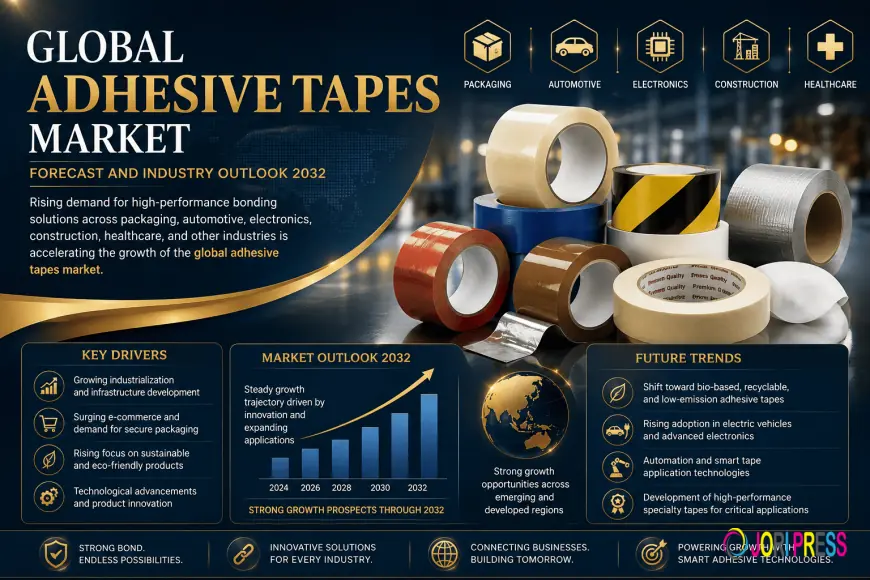
The Global adhesive tapes market is experiencing steady transformation as manufacturers increasingly seek lightweight, efficient, durable, and versatile bonding solutions. According to 6Wresearch, the market was valued at approximately USD 75 billion in 2025 and is projected to reach USD 105 billion by 2032, registering a CAGR of 4.90% during 2026–2032. Automotive, packaging, healthcare, construction, electronics, appliances, and consumer products are supporting demand, while sustainability, electric mobility, automation, and advanced adhesive technologies are reshaping the industry's future.
Advantages of Investing in the Global Adhesive Tapes Market
The global adhesive tapes market offers promising opportunities because adhesive products have become increasingly important in modern manufacturing. Their multifunctional nature allows them to perform bonding, mounting, sealing, insulation, cushioning, and surface protection tasks within a wide variety of applications.
A diverse end-use base provides stability to the industry. Automotive manufacturers use adhesive tapes for component attachment and lightweight assembly, while packaging producers rely on them for secure sealing and product protection. Healthcare, construction, electronics, appliances, and consumer goods provide additional sources of demand.
Automotive is one of the most significant application areas. According to 6Wresearch, automotive accounted for approximately 21% of market demand in 2025. The shift toward electric vehicles and lightweight vehicle designs is encouraging manufacturers to adopt specialized adhesive solutions.
For investors, this combination of established applications and emerging technologies creates opportunities across multiple industry segments.
Why Businesses Prefer Adhesive Tapes for Future Growth
Businesses increasingly prefer adhesive tapes because they can simplify assembly and provide flexibility in product design. A specialized tape can sometimes perform several functions simultaneously, such as bonding, sealing, insulation, or surface protection.
The availability of different adhesive chemistries makes the technology suitable for a wide range of requirements. Acrylic, rubber-based, silicone, epoxy, and polyurethane adhesives can be engineered to provide varying levels of strength, flexibility, temperature resistance, and durability.
Sustainability is also becoming an important consideration. Manufacturers are developing recyclable, biodegradable, and bio-based adhesive products to help businesses reduce environmental impact. This shift is creating opportunities for companies that can combine sustainability with reliable performance.
As manufacturing processes become more automated and environmentally focused, adhesive tapes are expected to gain further importance.
Search Visibility Through Global Adhesive Tapes Market Trends
The global adhesive tapes market is being shaped by several important industry trends. One of the strongest is the increasing demand for application-specific products capable of operating under challenging conditions.
Industrial customers are looking for tapes that can withstand heat, moisture, chemicals, vibration, and mechanical stress. This is encouraging manufacturers to invest in advanced formulations designed for specialized applications.
Hot-melt adhesive technology is also becoming increasingly relevant because of its quick-curing characteristics and processing efficiency. These properties make it attractive for packaging and other high-speed manufacturing applications.
Automation is another major trend. Automated tape application, precision dispensing, digital inspection, and real-time process monitoring can improve manufacturing consistency while reducing waste.
As these trends continue, competition is expected to focus increasingly on performance, innovation, customization, sustainability, and production efficiency.
Demand and Benefits Across Major Industries
Demand throughout the global adhesive tapes market is supported by a broad range of industries. Automotive remains an important contributor because manufacturers increasingly require lightweight materials and efficient assembly solutions.
Electric vehicles are creating additional opportunities for adhesive technologies. Adhesive tapes can be used in battery-related applications, insulation, component attachment, and lightweight assembly. Increasing EV production can therefore translate into greater demand for specialized adhesive products.
Packaging is another important market driver. The growth of e-commerce has increased the volume of goods requiring secure packaging during transportation and delivery. Adhesive tapes support efficient sealing and can be adapted to different packaging formats.
Healthcare provides another source of demand. Adhesive products are used in medical products, healthcare packaging, equipment assembly, and specialized manufacturing processes. Continued investment in healthcare infrastructure can contribute to market expansion.
Enhance User Experience with Advanced Adhesive Solutions
The global adhesive tapes market is increasingly supporting products that prioritize functionality, appearance, and convenience. Adhesive technologies can help manufacturers reduce visible mechanical fasteners and create cleaner, more streamlined product designs.
Consumer electronics represent an important application. Adhesive tapes can support compact component integration while helping manufacturers maintain sleek designs. Appliances can use tapes for mounting and insulation, while automotive manufacturers can apply specialized solutions to interior and exterior components.
Packaging can also benefit from user-friendly adhesive products. Easy-to-apply solutions can simplify packaging processes and improve handling convenience.
As consumers and businesses increasingly prioritize convenience and product aesthetics, adhesive technologies that provide reliable performance while supporting cleaner designs can gain greater adoption.
Lifestyle Benefits from Adhesive Tape Innovation
Although adhesive tapes are mainly industrial products, their applications have a direct influence on everyday life. Smartphones, automobiles, appliances, furniture, healthcare products, packaged goods, and household items can incorporate adhesive technologies.
The growth of online shopping has increased the importance of reliable packaging. Products shipped directly to consumers require secure closures capable of withstanding transportation and handling. Adhesive tapes help businesses package products efficiently while supporting package integrity.
Environmental awareness is also creating new opportunities. Recyclable and bio-based adhesive solutions can help brands address consumer concerns about waste and sustainability.
As environmentally responsible consumption becomes more influential, adhesive tape innovation can support brands seeking to balance performance with sustainability.
Infrastructure Development Strengthens Market Demand
Infrastructure development is another important contributor to the global adhesive tapes market. Construction applications use adhesive tapes for mounting, sealing, insulation, surface protection, and installation requirements.
Urbanization and industrialization are generating new residential, commercial, industrial, and transportation projects. These developments create direct opportunities for construction-related adhesive solutions.
Infrastructure investment also supports connected manufacturing industries. New factories, warehouses, and commercial facilities can increase demand for electronics, appliances, automotive products, packaging, and other goods that use adhesive technologies.
Asia-Pacific remains the largest regional market because of its strong manufacturing and industrial base. According to 6Wresearch, the region accounted for approximately 48% of global market share in 2025. Emerging regions can also provide opportunities as infrastructure and industrial investment expands.
Sustainability Becomes a Key Industry Trend
Sustainability is increasingly influencing the global adhesive tapes market analysis. Manufacturers are under pressure to reduce environmental impacts without compromising adhesion, durability, and reliability.
This is encouraging investment in bio-based adhesives, recyclable backing materials, biodegradable products, and resource-efficient manufacturing. Companies that successfully combine sustainability with strong technical performance may gain competitive advantages.
Raw-material volatility remains a challenge. Petroleum-based inputs can expose manufacturers to commodity price fluctuations, potentially affecting production costs and profitability.
This challenge is encouraging manufacturers to explore alternative raw materials and improve production efficiency. As a result, sustainability and cost optimization are increasingly interconnected areas of innovation.
Technology Innovation Expands Market Opportunities
Technology is expanding the performance range and application potential of adhesive tapes. Advanced formulations can provide greater resistance to heat, moisture, chemicals, vibration, and other demanding conditions.
Hot-melt technologies can support faster processing because of their quick-curing properties. Packaging, electronics, and high-volume industrial applications can benefit from improved production efficiency.
Automation is also becoming more influential. Automated application systems can improve placement accuracy, while digital quality monitoring can help maintain consistency throughout manufacturing.
Research and development will therefore remain a major competitive factor. Manufacturers that develop customized products for specific technical requirements can capture opportunities in high-value applications.
Regional Industry Trends Shape Future Growth
Regional diversification will remain important to the global adhesive tapes market. Asia-Pacific's leadership is supported by automotive manufacturing, electronics production, construction, consumer goods, and industrial development.
North America and Europe remain important markets due to their established manufacturing infrastructure and increasing demand for high-performance and sustainable products. Emerging economies can provide further opportunities as urbanization, industrialization, and infrastructure investment continue.
Manufacturers seeking international growth can strengthen their positions by developing regional distribution networks, adapting products to local requirements, and complying with environmental standards.
Wrapping Up
The global adhesive tapes market is positioned for continued expansion as industries seek lightweight, efficient, sustainable, and multifunctional bonding solutions. The projected increase from approximately USD 75 billion in 2025 to USD 105 billion by 2032 highlights the scale of opportunity across automotive, packaging, healthcare, construction, electronics, and consumer applications.
For investors and businesses, buying into the market now can be a smart strategic decision because several structural trends are developing simultaneously. Electric mobility, e-commerce, sustainable manufacturing, infrastructure development, healthcare expansion, and automation are broadening the applications of adhesive tapes.
Companies that invest in advanced formulations, sustainable materials, specialized applications, and efficient manufacturing technologies can position themselves to capture future demand. As adhesive tapes continue to evolve from conventional bonding materials into sophisticated multifunctional solutions, the global adhesive tapes market is expected to remain an important part of industrial growth.
FAQs
1. What are the key trends in the global adhesive tapes market?
The key trends include electric vehicle adoption, lightweight manufacturing, sustainable adhesive technologies, e-commerce packaging, automation, and specialized high-performance products. These trends are expanding adhesive tape applications across automotive, electronics, construction, healthcare, packaging, and consumer goods while encouraging manufacturers to develop more advanced solutions.
2. What is the projected growth of the global adhesive tapes market?
The global adhesive tapes market was valued at approximately USD 75 billion in 2025 and is projected to reach USD 105 billion by 2032. It is expected to register a CAGR of 4.90% during 2026–2032, supported by diversified applications and technology development.
3. Why is automotive an important adhesive tape application?
Automotive represented approximately 21% of market demand in 2025. Lightweight vehicle designs, electric mobility, insulation requirements, and component integration are increasing adhesive tape usage, making automotive manufacturing an important contributor to global adhesive tapes market growth.
4. How are electric vehicles affecting the adhesive tape industry?
Electric vehicles require adhesive products for insulation, battery-related applications, component attachment, and lightweight assembly. As EV manufacturing expands, demand for specialized and durable adhesive solutions is expected to increase, creating significant opportunities for manufacturers serving the global adhesive tapes market.
5. How does sustainability influence adhesive tape development?
Sustainability is encouraging manufacturers to develop recyclable, biodegradable, and bio-based adhesive solutions. Companies are also exploring alternative raw materials and efficient production processes. These developments can help businesses reduce environmental impact while maintaining the adhesion, durability, and reliability required for industrial applications.
6. How does e-commerce support adhesive tape demand?
E-commerce increases the need for secure packaging that can protect goods throughout storage, transportation, and delivery. Adhesive tapes provide efficient sealing and support various packaging formats. Continued online retail expansion is therefore expected to strengthen packaging demand within the global adhesive tapes market.
7. Which region currently dominates the adhesive tapes market?
Asia-Pacific currently dominates the global adhesive tapes market because of its extensive automotive, electronics, construction, consumer goods, and industrial manufacturing base. The region accounted for approximately 48% of global market share in 2025, supporting its continued importance in industry development.
8. What challenges could affect adhesive tape market growth?
Raw-material price fluctuations, environmental regulations, and changing sustainability requirements can influence market growth. Petroleum-based materials can expose manufacturers to commodity price volatility. Companies must manage costs, explore alternative inputs, improve material efficiency, and maintain product performance to remain competitive.
9. What technologies are shaping adhesive tape market trends?
Advanced formulations, hot-melt technologies, automated application equipment, precision dispensing, and digital quality monitoring are shaping industry trends. These technologies can improve curing speed, durability, application accuracy, production efficiency, and quality consistency across different adhesive tape applications.
10. What is the future outlook for the global adhesive tapes market?
The future outlook remains positive because several structural trends are supporting demand simultaneously. Electric mobility, sustainable manufacturing, e-commerce, infrastructure development, healthcare expansion, and automation are creating new applications and opportunities for manufacturers developing innovative and environmentally responsible adhesive tape solutions.
What's Your Reaction?
 Like
0
Like
0
 Dislike
0
Dislike
0
 Love
0
Love
0
 Funny
0
Funny
0
 Angry
0
Angry
0
 Sad
0
Sad
0
 Wow
0
Wow
0