






































From Research Idea to Published Paper: A Practical Guide for Technology Researchers

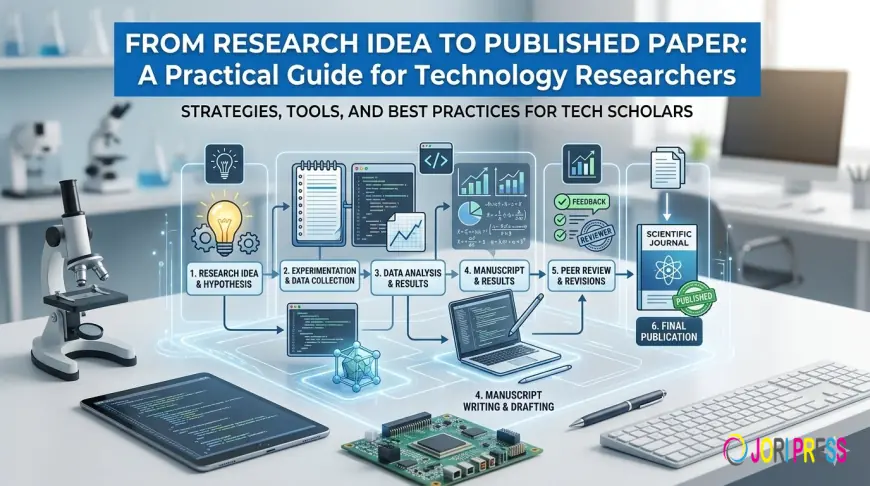
Technology research often begins with a simple observation: a problem that could be solved more efficiently, a limitation in an existing system, or a question that has not been fully answered. Turning that initial idea into a complete research paper, however, requires considerably more than writing down the idea.
Researchers need to understand existing work, define a clear research problem, select an appropriate methodology, analyze results, and present their findings in a way that other researchers can evaluate.
Start With a Clearly Defined Research Problem
A common mistake is starting with a very broad topic.
For example, artificial intelligence, cybersecurity, and cloud computing are areas rather than research problems. A research project becomes more manageable when the researcher identifies a specific issue within one of these areas.
Instead of choosing “artificial intelligence in healthcare,” a researcher might investigate the performance of a particular machine-learning approach for a defined medical image classification task.
A focused problem makes it easier to determine what information is needed and what the research is actually trying to discover.
Review Existing Literature
Once the problem has been identified, researchers should investigate what has already been published.
Journal articles, conference papers, review articles, and other scholarly sources can help establish the current state of knowledge. The purpose of this stage is not simply to collect citations. Researchers should compare methods, findings, datasets, and limitations across previous studies.
A good literature review should help answer questions such as:
- What is already known about the problem?
- Which approaches have researchers used?
- Where do previous findings disagree?
- What limitations have been reported?
- What questions remain unanswered?
This process can also prevent researchers from unknowingly repeating work that has already been completed.
Identify a Research Gap
A research gap does not necessarily mean discovering a subject that nobody has studied.
A gap can occur when an existing method has only been tested in a particular environment, when researchers have used an outdated dataset, or when two approaches have not been adequately compared.
For example, a machine-learning algorithm may have been evaluated using one dataset. A new study could examine whether the method produces similar results with a newer or more diverse dataset.
The important consideration is whether the proposed study can add useful knowledge to the existing literature.
Select an Appropriate Methodology
The research question should influence the methodology.
Quantitative studies may require experiments, surveys, datasets, or statistical analysis. Qualitative research may involve interviews, observations, or thematic analysis. Technology research can also involve software development, simulations, benchmarking, or controlled experiments.
The methodology should be explained clearly enough that another researcher can understand how the study was conducted.
Researchers who need structured support while developing a manuscript can also review resources about research paper writing services, particularly when they are working through the organization and presentation of a technical study.
Organise the Research Paper
Although structures vary between disciplines and journals, technology research papers commonly contain several major sections.
The introduction explains the problem and why it matters. The literature review establishes the existing body of knowledge. The methodology describes how the study was conducted. Results present the findings, while the discussion explains what those findings mean in relation to previous research.
The conclusion should return to the research objectives and summarize the main contribution without introducing substantial new evidence.
Researchers should always check the target journal's author guidelines because section names, formatting requirements, and manuscript structures can differ.
Present Results Clearly
Technical research can contain large amounts of data, but including every result does not necessarily make a paper stronger.
Tables and figures should have a clear purpose. Researchers should select information that directly supports the research question and explain important patterns in the results.
For experimental studies, it is also useful to describe relevant evaluation measures and provide enough methodological detail for readers to understand how the reported results were obtained.
Consider Review Papers Separately
Not every research project produces a new experiment or dataset. A review paper can examine and synthesize findings from existing research.
However, a review paper should do more than summarize one paper after another. A useful review compares studies, identifies patterns, discusses differences, and highlights areas where further research may be needed.
Researchers preparing this type of manuscript can explore guidance on review paper writing services to better understand the structure and expectations of review-based academic work.
Choose the Right Journal
The final stage is selecting a journal whose scope matches the research.
Researchers should examine recent articles published by the journal, its subject areas, manuscript requirements, and publication policies. Checking these details before submission can prevent avoidable problems.
It is also important to follow the journal's formatting, referencing, figure, and ethical requirements carefully.
What's Your Reaction?
 Like
0
Like
0
 Dislike
0
Dislike
0
 Love
0
Love
0
 Funny
0
Funny
0
 Angry
0
Angry
0
 Sad
0
Sad
0
 Wow
0
Wow
0