






































ERP Implementation Rescue – A Strategic Approach to Recovering Business-Critical Projects
A delayed or underperforming ERP initiative does not have to result in project failure. Through a structured ERP implementation rescue approach, organizations can regain control, address root causes, and move toward a successful deployment. By focusing on governance, user adoption, process optimization, and strategic planning, businesses can recover their investment and realize the full value of their ERP system.

Why ERP Projects Sometimes Struggle
Enterprise Resource Planning systems are designed to unify business operations, enhance productivity, and provide actionable insights. However, ERP implementations are often complex undertakings that involve multiple departments, technologies, and stakeholders. Even highly anticipated projects can encounter difficulties due to changing requirements, unrealistic timelines, inadequate planning, or insufficient organizational readiness. Studies and industry experience indicate that many ERP projects fail to fully achieve their original objectives because of process and governance challenges rather than technology limitations.
When projects begin falling behind schedule or exceeding budget expectations, organizations often benefit from an ERP implementation rescue strategy that focuses on identifying issues early and implementing corrective actions before further disruption occurs.
Key Causes Behind ERP Project Failures
Understanding why projects struggle is the first step toward successful recovery.
Unclear Business Requirements
When project goals are not well-defined, teams can end up configuring solutions that fail to support actual business processes.
Ineffective Project Governance
Lack of accountability and decision-making authority can lead to confusion, scope creep, and delayed execution.
Incomplete Data Migration
Poor-quality data migration often creates reporting inaccuracies, process breakdowns, and user dissatisfaction after deployment.
Insufficient User Engagement
ERP systems succeed only when employees embrace new workflows. Limited training and communication frequently result in low adoption rates.
Over-Customization
Excessive customization can increase project complexity, delay delivery, and create maintenance challenges.
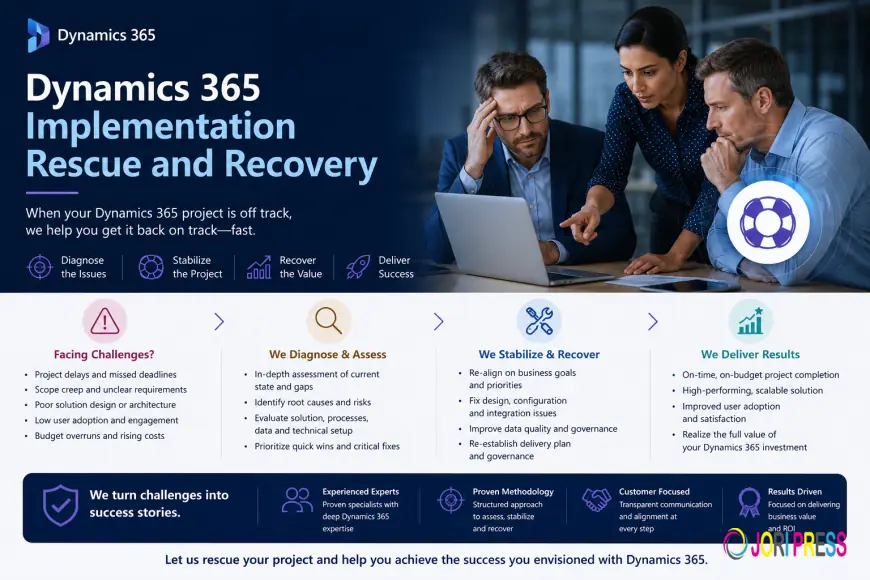
Essential Steps in an ERP Implementation Rescue
A successful ERP implementation rescue initiative follows a structured methodology aimed at restoring project health and organizational confidence.
Evaluate the Current Environment
A comprehensive assessment should review project documentation, solution design, integrations, business processes, testing outcomes, and stakeholder concerns.
Identify Root Causes
Rather than addressing symptoms alone, organizations must determine the underlying reasons for project delays, budget overruns, and performance challenges.
Develop a Corrective Roadmap
The recovery plan should include realistic milestones, prioritized deliverables, resource allocation strategies, and risk mitigation measures.
Strengthen Stakeholder Alignment
Regular communication and executive sponsorship are critical for maintaining momentum and ensuring organizational support throughout the recovery effort.
Focus on Business Outcomes
Recovery efforts should prioritize measurable business goals instead of simply completing technical tasks. This approach helps ensure the ERP solution delivers tangible value to the organization.
Creating a Sustainable Path Forward
An effective rescue strategy does more than solve immediate project concerns. It establishes stronger governance structures, increases user confidence, and improves operational alignment. Organizations can also use the recovery process to refine workflows, eliminate inefficiencies, and prepare for future growth.
With a disciplined approach and experienced guidance, businesses can transform struggling ERP projects into successful operational platforms that support long-term business objectives.
What's Your Reaction?
 Like
0
Like
0
 Dislike
0
Dislike
0
 Love
0
Love
0
 Funny
0
Funny
0
 Angry
0
Angry
0
 Sad
0
Sad
0
 Wow
0
Wow
0