







































Japan Vertical Farming Market Trends, Technology Adoption, and Agricultural Growth Outlook 2026-2034
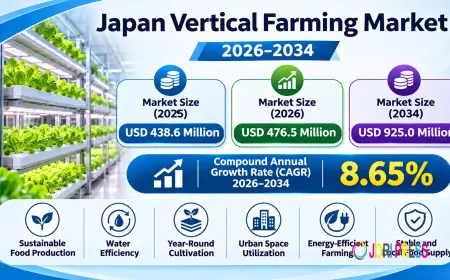
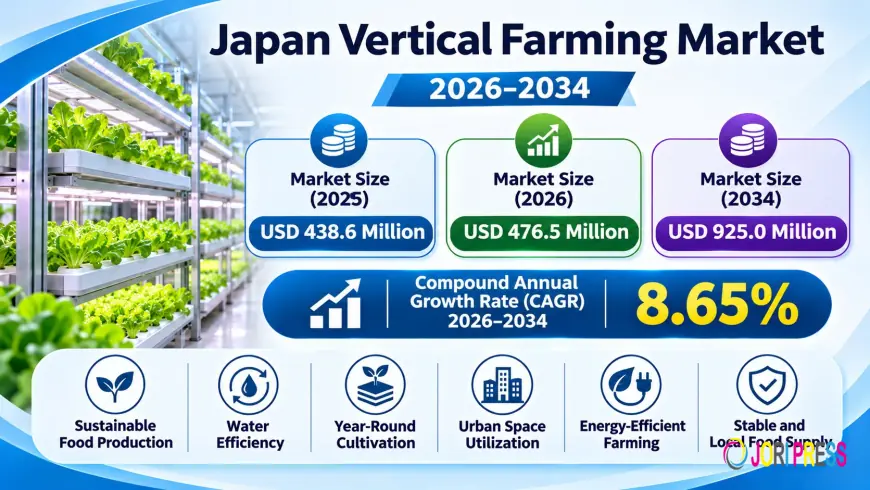
Japan vertical farming market size increased from USD 438.6 Million in 2025 to USD 476.5 Million in 2026. Looking forward, IMARC Group expects the market to reach USD 925.0 Million by 2034, exhibiting a growth rate (CAGR) of 8.65% during 2026-2034.

Japan Vertical Farming Market Report 2026
Market Size in 2025: USD 438.6 Million
Market Size in 2026: USD 476.5 Million
Market Forecast in 2034: USD 925.0 Million
Market Growth Rate: 8.65% (2026-2034)
According to the latest report by IMARC Group, titled “Japan Vertical Farming Market: Industry Trends, Share, Size, Growth, Opportunity and Forecast 2026-2034,” the Japan vertical farming market size reached USD 438.6 Million in 2025 to USD 476.5 Million in 2026. Looking forward, the market is expected to reach USD 925.0 Million by 2034, exhibiting a CAGR of 8.65% during the forecast period from 2026 to 2034.
Japan Vertical Farming Market Trends & Drivers
The Japan vertical farming market in 2026 benefits from pressure on conventional agriculture, including limited arable land, a shrinking farm workforce, and a growing urban population. Growers are using stacked, climate-controlled systems to produce leafy greens, herbs, and other high-value crops close to cities, shortening the distance between harvest and consumer. Retailers and food service buyers value the consistent quality, predictable supply, and low need for chemical pesticides that controlled environments offer. Building-based and container-based formats are broadening the ways in which farms can be installed, from purpose-built facilities to repurposed urban spaces. Demand for produce with tailored taste, nutrition, and freshness is also supporting premium positioning.
Technology is the main force improving farm economics. Advances in LED lighting, sensors, climate control, and automation are reducing energy use per unit of output, while AI-based monitoring supports tighter control of growing conditions. Hydroponics remains a widely used cultivation approach, and interest in aeroponics and aquaponics reflects the search for lower water and nutrient use. Growing environmental awareness and concern over the carbon footprint of conventional farming are encouraging investment, and resilience against climate variability and disease outbreaks supports the case for a steadier food supply. New pilot facilities in 2026 are raising the profile of the sector, although electricity cost and capital intensity remain factors that growers manage carefully.
How AI is Reshaping the Future of the Japan Vertical Farming Market
- Climate and Growth Optimization: Artificial intelligence analyzes data from sensors tracking light, temperature, humidity, and nutrient levels. Machine learning models identify the growing conditions that maximize yield and quality. Predictive systems adjust lighting and climate control to lower energy use.
- Computer Vision for Crop Monitoring: AI-powered imaging systems assess plant health, growth stage, and harvest readiness. Machine learning algorithms detect disease and nutrient deficiency symptoms early. Predictive systems support timely intervention and reduce crop losses.
- Yield Forecasting and Labor Automation: Artificial intelligence forecasts production volumes aligned with retail and food service demand. Machine learning supports robotic handling, seeding, and harvesting tasks. Predictive analytics helps farm operators plan output and reduce labor dependence.
Japan Vertical Farming Market Segmentation
The market report offers a comprehensive analysis of the segments, highlighting those with the largest Japan vertical farming market share. It includes forecasts for the period 2026-2034 and historical data from 2020-2025 for the following segments.
Component Insights:
- Irrigation Component
- Lighting
- Sensor
- Climate Control
- Building Material (Glass Greenhouse, Plastic Greenhouse)
- Others
The report has provided a detailed breakup and analysis of the market based on the component. This includes irrigation component, lighting, sensor, climate control, building material (glass greenhouse and plastic greenhouse), and others.
Structure Insights:
- Building-Based Vertical Farms
- Container-Based Vertical Farms
A detailed breakup and analysis of the market based on the structure has also been provided in the report. This includes building-based vertical farms and container-based vertical farms.
Growth Mechanism Insights:
- Hydroponics
- Aeroponics
- Aquaponics
A detailed breakup and analysis of the market based on the growth mechanism has also been provided in the report. This includes hydroponics, aeroponics, and aquaponics.
Application Insights:
- Indoor
- Outdoor
A detailed breakup and analysis of the market based on the application has also been provided in the report. This includes indoor and outdoor.
Regional Insights:
- Kanto Region
- Kansai/Kinki Region
- Central/Chubu Region
- Kyushu-Okinawa Region
- Tohoku Region
- Chugoku Region
- Hokkaido Region
- Shikoku Region
Competitive Landscape
Key Players:
- Spread Co., Ltd.
- PLANTX
- Oishii Farm
Recent News and Developments in Japan Vertical Farming Market
- August 2026: Oishii opened an Open Innovation Center in Hamura, Tokyo, a research hub focused on scalable farming systems, productivity, crop quality, and cultivation technology for new fruit and vegetable varieties.
- July 2026: PLANTX opened a pilot facility in Koto Ward, Tokyo, for what it describes as the world’s first fully sealed vertical farming system, with stacked modules that control light, air, and water separately.
Note: If you need specific information that is not currently within the scope of the report, we will provide it to you as a part of the customization.
About Us:
IMARC Group is a global management consulting firm that helps the world's most ambitious changemakers to create a lasting impact. The company provides a comprehensive suite of market entry and expansion services. IMARC offerings include thorough market assessment, feasibility studies, company incorporation assistance, factory setup support, regulatory approvals and licensing navigation, branding, marketing and sales strategies, competitive landscape and benchmarking analyses, pricing and cost research, and procurement research.
Contact Us:
Street: 563-13 Kamien
Country: Tokyo, Japan
Postal Code: 4380111
Email: sales@imarcgroup.com
Source: IMARC Group
What's Your Reaction?
 Like
0
 Dislike
0
 Love
0
 Funny
0
 Angry
0
 Sad
0
 Wow
0