





































Enterprise Access Control Systems for Industrial Facilities in Saudi Arabia

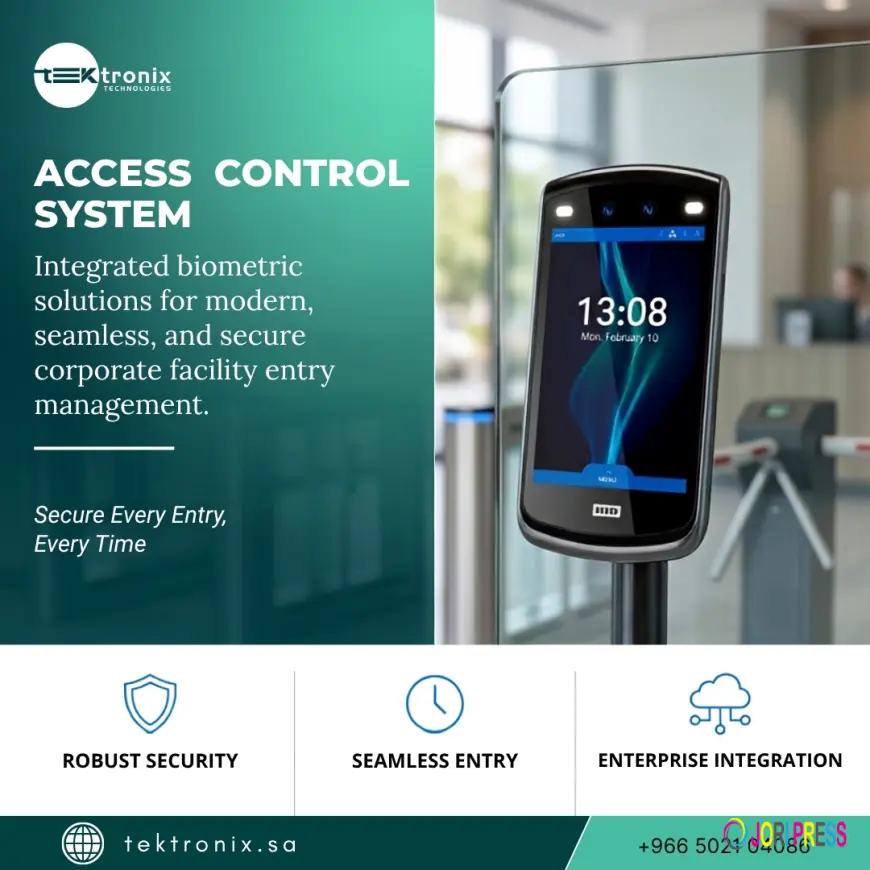
Petrochemical plants, manufacturing facilities, and industrial parks across Saudi Arabia are standardizing on an enterprise-grade Access Control System to restrict who can physically reach control rooms, hazardous storage, and critical infrastructure. As industrial developments aligned with Vision 2030 scale up, access control has become a foundational safety and security requirement rather than an operational afterthought.
Why Saudi Industrial Facilities Need Enterprise-Grade Access Control
Industrial sites carry a distinct risk profile compared to a standard commercial building: a single unauthorized entry into a control room or hazardous storage area can carry safety consequences well beyond a typical office security breach. Facilities across industrial hubs such as Jubail and Yanbu, along with giga-projects like NEOM, are increasingly expected to demonstrate documented, auditable access policies rather than relying on manned checkpoints alone.
Tektronix has implemented access control infrastructure across developments linked to G42, DIFC, RTA Dubai, and EXPO 2020, giving the company direct experience with the compliance expectations and operational realities of Gulf industrial and commercial facilities. That regional deployment history shapes how projects across the Kingdom are specified today, treating access control as one coordinated layer within a broader safety and security strategy.
Core Components of a Modern Access Control System
A contemporary platform ties together readers at every door, a controller layer enforcing policy, and centralized software managing credentials, schedules, and reporting across an entire plant or portfolio of industrial sites.
Readers, Controllers, and Central Software
Readers capture a credential, controllers make the real-time grant-or-deny decision, and software ties every device into a single, auditable policy engine that safety and security teams manage from one console rather than reprogramming individual doors by hand.
Zoned Access for Plant Safety
Industrial sites typically segment access into zones by hazard level, restricting control rooms, chemical storage, and utility areas to a narrower, named list of personnel than general administrative or warehouse areas receive.
Biometric Access Control System for High-Consequence Areas
For control rooms and other high-consequence zones, a Biometric Access Control System ties every entry to a verified individual rather than a shared badge, closing a common failure mode in facilities where credentials sometimes circulate informally among shift workers.
Fingerprint and Facial Verification for Control Rooms
Fingerprint readers remain a reliable choice where gloves or protective equipment make facial capture impractical, while facial verification suits administrative and office-adjacent areas where hands-free entry is more valuable.
Anti-Spoofing for Industrial Environments
Liveness detection and anti-spoofing checks confirm a genuine, present individual is requesting access, an important safeguard in facilities where the consequence of a bypassed credential check extends beyond a simple security incident.
Security Access Control System Design for Critical Infrastructure
Where the consequence of unauthorized entry is especially severe, a Security Access Control System layers physical and procedural controls well beyond a single door reader.
Layered Perimeter and Interior Zones
Critical infrastructure sites segment access into progressively restricted zones, from the outer perimeter fence line to the most sensitive control rooms, so a single compromised credential does not grant access to the entire facility.
Integration with CCTV and Intrusion Detection
Tying access control into the same platform as CCTV and intrusion detection means a denied entry attempt automatically raises an alarm and pulls live camera footage for the response team.
Door Access Control and Mobile Access Control for Industrial Sites
At the point of entry, Door Access Control determines exactly which lock hardware is paired with which credential type, while Mobile Access Control increasingly gives staff and approved contractors a credential-free option using their smartphone.
Rugged Door Hardware for Plant Environments
Industrial doors need hardware rated for dust, heat, and heavy daily cycling, a durability requirement that differs meaningfully from the lighter-duty locks suited to an air-conditioned office lobby.
Mobile Credentials for Contractors and Visiting Staff
A mobile credential can be issued for the exact duration of a contractor's site visit and revoked automatically afterward, avoiding the administrative overhead of issuing and collecting physical badges for short-term site access.
Selecting the Right Access Control Device and Solutions
Hardware selection is where many industrial projects succeed or fail. An Access Control Device chosen for an exposed outdoor gatehouse needs different environmental ratings than one destined for an air-conditioned control room, and evaluating complete Access Control Solutions rather than individual components helps ensure hardware, software, and support are coordinated from a single accountable vendor.
Environmental Ratings for Harsh Industrial Conditions
Devices installed at exposed entrances need dust and heat-rated enclosures suited to the Kingdom's climate extremes, while indoor units can prioritize a more compact form factor since they are shielded from direct sun and sand.
Vendor Evaluation Criteria
Procurement teams should weigh matching accuracy under real site conditions, integration flexibility with existing plant safety systems, and a vendor's demonstrated experience with comparable industrial deployments rather than selecting on hardware price alone.
Compliance and Regional Regulatory Fit
Regulated industrial facilities across Saudi Arabia increasingly expect documented proof of access control policy, including encrypted credential storage and clear data retention rules for any biometric information collected. Working with an integrator experienced in regional compliance expectations shortens the path from design to handover and reduces the risk of costly rework after a site inspection flags a gap.
Deployment Roadmap: What to Expect
A site survey confirms door hardware compatibility, environmental conditions, and network availability at every proposed entry point before equipment is ordered. Installation typically proceeds alongside commissioning testing that confirms fail-safe behaviour and credential response at every door before the system goes live. Facilities exploring a rollout can review Tektronix's access control solutions to see how readers, controllers, and mobile credentialing are typically packaged for a single, coordinated industrial deployment, backed by ongoing remote firmware updates and local support.
Common Mistakes to Avoid
The most frequent misstep is specifying a single hardware model across every door type regardless of environment, leading to inconsistent performance between a control room and an exposed outdoor gate. A second common issue is neglecting integration planning, leaving access control isolated from existing plant safety and visitor management systems. A third is underestimating fire-safe egress requirements during design, creating compliance issues that are considerably more expensive to resolve after installation than during initial planning.
Regional Adoption: Access Control System KSA and Riyadh Deployments
Demand for a properly integrated Access Control System KSA wide has grown alongside the pace of Vision 2030-aligned industrial developments, with new plants and facilities increasingly specifying biometric and mobile-ready infrastructure at the design stage. An Access Control System Riyadh organization deploy frequently combines head-office administrative buildings with remote industrial sites under a single, standardized access policy rather than managing each location independently.
Conclusion
Saudi industrial facilities are standardizing on enterprise-grade Access Control System platforms, layering Biometric Access Control System verification with a dedicated Security Access Control System for the highest-consequence zones. Precise Door Access Control paired with Mobile Access Control and the right Access Control Device keeps every entry point secured and audit-ready. Organizations evaluating Access Control System Riyadh or wider Access Control System KSA projects can review Tektronix's full Access Control Solutions lineup on the access control solutions page.
FAQS
1. Can biometric access control work in industrial environments where staff wear gloves?
Yes. Facilities in these environments commonly favour facial verification over fingerprint readers, or use multimodal systems that fall back to an alternate credential when gloves are worn.
2. Is mobile access control secure enough for restricted industrial zones?
Mobile credentials use encrypted Bluetooth or NFC communication and can be revoked instantly, making them suitable for many industrial applications, though the highest-consequence zones often still pair mobile credentials with a biometric check.
3. How does access control handle a plant emergency or evacuation?
Properly designed systems default to a fail-safe, unlocked state during an emergency alarm trigger, allowing free egress without requiring a credential check, in line with regional civil defense requirements.
4. What happens to contractor credentials after a project ends?
Mobile and card credentials issued for a specific contract duration can be set to expire automatically or be revoked instantly from a central platform once the engagement concludes.
5. How long does a typical industrial access control rollout take?
For a single facility with a moderate number of doors, installation and commissioning is commonly completed within a few weeks, while larger multi-site industrial portfolios can extend the timeline to a couple of months.
What's Your Reaction?
 Like
0
Like
0
 Dislike
0
Dislike
0
 Love
0
Love
0
 Funny
0
Funny
0
 Angry
0
Angry
0
 Sad
0
Sad
0
 Wow
0
Wow
0