






































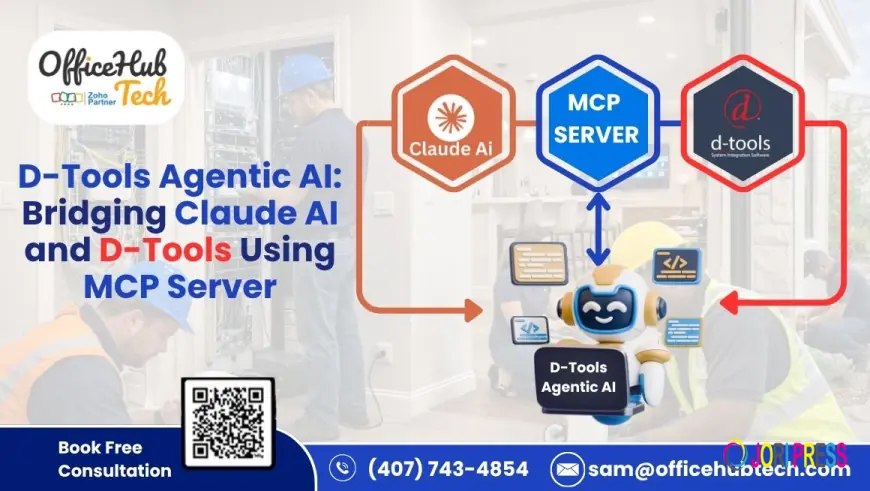
D-Tools Agentic AI: Bridging Claude AI and D-Tools Using MCP Server
Discover how D-Tools Agentic AI automates projects, proposals, and workflows for AV system integrators. Download your D-Tools AI Agent for FREE!

How D-Tools Agentic AI Removes Workflow Bottlenecks in AV System Integration
What if AV workflows could be executed just by describing the outcome? Instead of navigating multiple screens, imagine instructing a system to create a project, pull product data, and generate outputs automatically. With D-Tools Agentic AI powered by Claude AI and enabled through a Model Context Protocol (MCP) server—this is now a practical reality, not just a concept.
Even with advanced tools like D-Tools SI, many AV and low-voltage operations still depend on manual steps. Tasks such as project creation, client data handling, product selection, and inventory checks require continuous interaction within the platform. As project complexity grows, this manual effort creates friction. D-Tools Agentic AI introduces an intelligent layer that minimizes these dependencies by shifting execution from manual input to intent-driven actions.
The challenge becomes more visible at scale. Teams often struggle to balance speed and accuracy, leading to inconsistencies and slower decision-making. Retrieving data across systems takes time, and coordinating workflows becomes increasingly difficult. By using Agentic AI, these inefficiencies are reduced through automation that responds directly to user intent.
The limitation isn’t the capability of D-Tools—it’s the absence of a system that can understand instructions and act on them. By combining Claude AI for reasoning with MCP for execution, D-Tools Agentic AI transforms workflows from manual processes into AI-driven operations where systems respond to commands instead of clicks.
This shift is quickly becoming the new standard for modern system integrators.
Why Traditional Workflows Struggle at Scale
At a smaller scale, D-Tools workflows function effectively. Projects are manageable, teams stay aligned, and processes appear controlled. However, as project volume increases and integrations expand, the limitations of manual workflows become clear.
The issue is not capability—it’s scalability.
While D-Tools serves as a strong system of record, it depends heavily on user actions. Projects must be manually created and updated. Product selection requires navigating large catalogs. Data must be repeatedly searched, verified, and entered across different stages.
As businesses grow, these tasks create inefficiencies. Teams spend more time operating the system than delivering results. Proposal timelines increase, inconsistencies arise, and reliance on skilled resources grows—making scaling more complex and costly.
When additional systems like CRM, inventory, and finance tools are involved, the problem intensifies. Data synchronization becomes manual or dependent on fragile integrations, leading to delays and errors.
Traditional workflows are not built for high-volume, dynamic environments. They lack the ability to interpret intent, automate execution, and adapt in real time.
Adding an intelligent layer powered by Claude AI and orchestrated through MCP transforms this limitation into an opportunity—enabling scalable, intelligent execution instead of manual coordination.
The Rise of Agentic AI in System Integration
The shift from traditional automation to Agentic AI marks a major change in how enterprise systems operate. Conventional software responds only to direct commands, while Agentic AI can understand intent, decide actions, and execute workflows independently.
This is especially valuable for AV system integrators using platforms like D-Tools, where workflows are complex and interconnected.
From Passive Tools to Intelligent Systems
Traditional tools require users to navigate interfaces, input structured data, and trigger actions manually. Agentic AI changes this by converting natural language into executable commands, allowing systems to act proactively.
Key Capabilities of Agentic AI
- Understands context beyond structured inputs
- Dynamically selects actions without fixed workflows
- Executes tasks across multiple systems
- Adapts in real time based on changing data
Impact on D-Tools Workflows
With Agentic AI, D-Tools environments can:
- Automatically create projects from simple instructions
- Retrieve product and inventory data intelligently
- Streamline proposal and estimation processes
This goes beyond traditional automation. It represents a shift toward autonomous systems where Claude AI handles reasoning and MCP enables execution.
Agentic AI is redefining enterprise operations—transforming systems from passive tools into active collaborators that drive efficiency and scalability.
Understanding MCP (Model Context Protocol) in Depth
At the core of this architecture is MCP (Model Context Protocol)—a standardized framework that allows large language models like Claude AI to interact securely and intelligently with external systems. In the context of D-Tools Agentic AI, MCP functions as the execution layer that converts AI intent into structured actions within platforms like D-Tools.
While LLMs are strong in reasoning and context understanding, they don’t execute tasks on their own. MCP fills this gap by offering a consistent interface through which AI can identify, interpret, and trigger system-level operations.
MCP as an Execution Framework
Unlike traditional middleware that mainly handles data transfer, MCP is designed specifically for AI-led execution. It enables:
- Business actions to be exposed as callable tools
- Standardized input and output formats for AI interaction
- Secure, real-time execution across connected systems
Each MCP tool represents a specific function—such as creating a project in D-Tools or retrieving product details—structured so that Claude AI can use it reliably.
How MCP Organizes System Interaction
MCP introduces a scalable, modular structure:
- Tool Layer: Business functions are defined as reusable tools
- Execution Layer: Tools connect with systems like D-Tools through APIs or automation
- Response Layer: Outputs are formatted for both AI processing and user readability
This setup ensures consistency, scalability, and easier management of complex workflows.
Why MCP Matters in Claude AI + D-Tools Integration
When a user gives a command, Claude AI doesn’t directly control D-Tools. Instead:
- Claude AI interprets the request
- MCP presents available tools
- The right tool is selected and triggered
- The action runs inside D-Tools
- Results are returned in a structured format
This approach ensures accuracy, flexibility, and controlled execution.
Strategic Benefits
Using MCP within D-Tools Agentic AI provides:
- Separation between AI logic and operational systems
- Centralized control over workflow execution
- Scalable integration across CRM, inventory, finance, and project tools
In simple terms, MCP turns AI from a thinking engine into an action-driven system—allowing businesses to operate D-Tools through intent instead of manual steps.
Connecting Intelligence and Execution: Claude AI + MCP + D-Tools
The real strength of this setup lies in how Claude AI, MCP, and D-Tools work together—creating a system where instructions are instantly translated into actions.
From Input to Execution
- User provides a natural language instruction
- Claude AI interprets the intent
- MCP maps the request to the correct tool
- The tool executes the action in D-Tools
- Results are returned to the user
This removes the need to manually navigate the platform.
Role of Each Component
- Claude AI: Understands intent and decision logic
- MCP Server: Bridges intent to execution
- D-Tools SI: Executes actual business operations
Each layer operates independently but works together seamlessly, ensuring both flexibility and control.
Operational Impact
This model changes how teams interact with D-Tools:
- Projects can be created without opening the system
- Product data can be retrieved instantly through queries
- Workflows can run without predefined scripts
What once required multiple steps is now completed with a single instruction—making operations faster, simpler, and more scalable.
Why This Matters
This goes beyond simple automation—it enables coordinated execution at scale. By combining Claude AI’s intelligence with MCP-driven actions and D-Tools operations, businesses can shift from reactive processes to proactive, AI-powered workflows.
Designing an MCP Server for D-Tools: Architecture and Principles
An effective MCP implementation goes beyond simple connectivity—it functions as a structured execution engine. The way an MCP server is designed directly impacts how accurately Claude AI can convert intent into dependable actions within D-Tools.
Core Design Principles
To ensure performance and scalability, the MCP server should be built on:
- Modularity: Each capability is defined as an independent tool
- Predictable Execution: Every action delivers consistent and reliable results
- Scalability: New tools and integrations can be added without affecting existing workflows
- Security: Access and operations are controlled through defined validation rules
Layered Architecture Model
A well-designed MCP server typically follows a structured, multi-layer approach:
1. Tool Abstraction Layer
Business functions are exposed as reusable tools, such as:
- Create or update projects
- Retrieve project details
- Search products
- Access inventory data
Each tool contains its own inputs, logic, and expected outputs.
2. API Orchestration Layer
This layer connects MCP tools with D-Tools SI APIs by:
- Managing authentication and requests
- Ensuring data consistency and handling errors
- Translating tool actions into API calls
3. Execution Control Layer
This layer maintains operational accuracy by:
- Validating inputs
- Applying business rules
- Structuring responses for AI interpretation
Why This Architecture Matters
Without a defined structure, AI-led execution can become inconsistent. A well-architected MCP server enables:
- Controlled automation across D-Tools workflows
- Smooth scalability across teams and projects
- A strong foundation for broader system integrations
This structured approach elevates MCP from a connector to a reliable execution framework.
Implementing MCP Tools for D-Tools Operations
The success of an MCP-based system depends on how effectively its tools are designed. Each tool should represent a clear business function, allowing Claude AI to execute tasks accurately and contextually.
Focus on Business Outcomes
Tools should be built around real business needs rather than UI actions. This ensures that user prompts translate directly into meaningful operations.
Key Tool Categories
- Project Management Tools: Create, update, and retrieve project data using structured inputs like client, scope, and budget
- Client & Opportunity Tools: Search clients, access contact details, and link them to projects dynamically
- Product & Catalog Tools: Query product data by brand, model, or category with real-time filtering
- Inventory Tools: Provide stock availability, summaries, and insights
Execution Logic and Structure
Each tool should include:
- Clearly defined input parameters (e.g., project name, budget, client ID)
- Validation rules to prevent incorrect actions
- Standardized outputs for consistent AI interpretation
This ensures even complex requests are handled accurately.
Intelligent Tool Selection
When a user provides a prompt, Claude AI interprets the intent and selects the appropriate tool. For example:
- A request to create a project triggers the project tool
- A product query activates catalog tools
This dynamic mapping enables efficient and context-aware execution.
Operational Benefits
With well-designed MCP tools, businesses can achieve:
- Faster task execution
- Reduced reliance on manual processes
- Greater consistency and accuracy
Ultimately, the strength of MCP lies not in the number of tools, but in how well they reflect real-world business workflows.
Connecting Claude AI: From Prompts to Execution
Integrating Claude AI with an MCP server shifts operations from fixed workflows to intent-driven execution. Instead of relying on rigid interfaces or predefined scripts, the system becomes adaptive, context-aware, and operationally intelligent.
Converting Language into Action
Claude AI serves as the decision-making layer in this setup. When a user submits a prompt, it performs:
- Intent Identification: Determines the user’s objective
- Context Analysis: Extracts key details like project type, budget, or product category
- Tool Mapping: Selects the relevant MCP tool
- Execution Initiation: Triggers the action through the MCP server
This process enables real-time interaction with D-Tools without manual navigation.
Setting Up Claude with MCP
To activate this functionality:
- The MCP server is connected to Claude
- Tool permissions are enabled
- Claude automatically identifies available tools and their functions
Once configured, AI and systems operate as a unified environment capable of executing tasks directly.
Real-World Interaction Examples
A prompt like:
“Create a commercial AV project with a $100K budget including conferencing systems”
can instantly trigger project creation, data structuring, and system updates.
Similarly:
“Show Sony products for conference rooms”
retrieves filtered product data immediately.
Why It Matters
This integration enables advanced AI workflow automation where:
- Actions are driven by intent rather than manual input
- Workflows adjust dynamically
- System interaction becomes conversational yet precise
Claude AI, combined with MCP, evolves into an execution engine capable of handling complex operations within D-Tools with minimal human effort.
Real-World Workflow Transformation for AV Integrators
The real value of this architecture is seen in everyday operations. When Claude AI, MCP, and D-Tools work together, workflows become faster, simpler, and more efficient.
From Manual Tasks to Intelligent Execution
Traditional workflows involve multiple steps—logging in, navigating, entering data, and verifying outputs. With MCP-powered AI, these steps are reduced to a single instruction.
System integrators can now work based on intent rather than interface.
Key Workflow Improvements
- Project Setup: A single prompt defines scope, budget, and client, instantly creating structured projects
- Proposal Creation: Proposals are generated automatically with aligned data in real time
- Product & Inventory Access: Users can query product details conversationally without browsing catalogs
- Cross-System Coordination: Integration with CRM, finance, and inventory creates a unified workflow environment
Measurable Benefits
- Faster project setup
- Quicker proposal turnaround
- Higher data accuracy
- Reduced operational workload
Strategic Impact
This is more than efficiency—it establishes a new way of working. With AI-driven execution, AV integrators can scale operations without increasing manual effort, achieving greater speed, precision, and control.
Extending Beyond D-Tools: Full Ecosystem Integration
While Claude AI and MCP significantly enhance D-Tools operations, the real advantage comes from extending this model across the entire business ecosystem.
AV businesses rely on multiple systems—CRM, finance, inventory, and project tools—each adding complexity. MCP brings all of them under a single execution layer.
Eliminating System Silos
Traditional integrations often create fragile, disconnected workflows. MCP replaces this with centralized orchestration:
- CRM platforms manage leads and opportunities
- Finance tools handle billing and reporting
- Inventory systems track stock in real time
- Project tools manage execution and timelines
All these systems can function as MCP tools, allowing Claude AI to operate across them seamlessly.
Unified Workflow Execution
A single command can trigger multiple actions, such as:
- Creating a project in D-Tools
- Linking it to a CRM opportunity
- Checking inventory availability
- Initiating financial processes
This level of orchestration defines advanced business automation.
Operational Outcomes
- Complete visibility across workflows
- Elimination of duplicate data entry
- Real-time synchronization between systems
- Scalable automation across departments
Strategic Perspective
This approach goes beyond basic integration—it delivers control. By centralizing execution through MCP, businesses can function as a unified system instead of disconnected tools, enabling smoother operations and better scalability.
Case Study: From Manual Complexity to Intelligent Operations
To see the real impact of this architecture, it’s important to look at how it performs in actual business environments. Moving from manual workflows to MCP-driven execution is not just an improvement—it fundamentally changes how operations run.
Case Study 1: VisionTech AV Solutions
VisionTech, a mid-sized AV integrator, struggled with delays in proposal generation and project setup. Although they used D-Tools extensively, their workflows depended heavily on manual inputs at every stage.
After implementing MCP integration with Claude AI:
- Project setup time dropped by more than 60%
- Proposal turnaround became much faster
- Data accuracy improved across teams
- Dependence on senior staff for routine tasks decreased
Instead of navigating multiple screens, the team began using simple prompts, with Claude AI executing tasks through MCP tools.
Case Study 2: SecureWave Integrators
SecureWave, focused on security and low-voltage systems, handled a high volume of projects across various clients. Their main challenge was synchronizing data between D-Tools, CRM, and inventory systems.
With an Agentic AI framework in place:
- CRM and D-Tools workflows became fully aligned
- Inventory checks were performed instantly
- Data synchronization across systems improved
- Overall operational efficiency increased
Key Takeaways
- Automation significantly reduced workflow friction
- AI-driven execution improved both speed and accuracy
- Cross-system orchestration removed operational silos
These examples show how D-Tools automation moves beyond theory into real, measurable outcomes—helping system integrators work with greater efficiency, accuracy, and scalability.
Strategic Challenges and How to Address Them
While combining Claude AI, MCP, and D-Tools delivers strong operational benefits, successful implementation requires thoughtful planning and a solid architecture. Without a structured approach, organizations may face avoidable challenges.
Challenge 1: API Complexity and System Limitations
APIs in platforms like D-Tools can differ in structure and capability. Direct integrations without abstraction often result in inflexible and error-prone workflows.
Approach:
Introduce an MCP abstraction layer that standardizes inputs and outputs. This allows Claude AI to interact through a consistent interface, regardless of backend API differences.
Challenge 2: Data Accuracy and Validation
Automation at scale increases the risk of processing incomplete or incorrect data.
Approach:
Build validation checks into the MCP execution layer. Each tool should enforce input validation, business rules, and fallback mechanisms to maintain data integrity.
Challenge 3: User Adoption and Transition
Teams used to manual processes may hesitate to adopt AI-driven workflows due to unfamiliarity or lack of trust.
Approach:
Roll out implementation in phases. Start with high-impact areas like project creation or product lookup, then expand gradually. Training and clear guidelines are essential.
Challenge 4: Security and Access Control
Allowing AI to perform system-level actions raises concerns about access and data protection.
Approach:
Implement role-based permissions, secure authentication, and audit logs within the MCP framework to ensure controlled and traceable operations.
Challenge 5: Scalability Across Multiple Systems
As integrations expand to CRM, finance, and inventory platforms, maintaining consistency becomes more complex.
Approach:
Design MCP as a centralized orchestration layer that can manage interactions across systems, forming a scalable automation architecture.
Strategic View
These are not barriers but design considerations. When handled correctly, they strengthen the system—ensuring automation remains reliable, secure, and scalable.
The Future: Autonomous AV Workflows with Agentic AI
Integrating Claude AI with D-Tools through MCP is just the beginning. It signals a broader move toward autonomous operations, where human involvement shifts from execution to supervision.
From Assisted to Autonomous Workflows
Today, AI executes tasks based on user prompts. The next stage will enable systems to:
- Make proactive decisions using historical data
- Trigger workflows automatically without manual input
- Continuously optimize timelines and resource allocation
This evolution turns workflows into intelligent, self-managing systems.
A Unified Intelligence Layer
Future architectures will extend across the entire AV ecosystem, including:
- D-Tools for projects and proposals
- CRM systems for opportunity tracking
- Inventory platforms for real-time stock visibility
- Financial tools for billing and cost management
This creates a connected intelligence layer across the full business lifecycle.
Predictive and Context-Aware Operations
With advanced AI capabilities, systems will move beyond execution to anticipation. For example:
- Suggesting products based on project requirements
- Recommending budget changes using past data
- Identifying potential delays before they occur
This marks the rise of AI-driven enterprise workflows where systems actively support decision-making.
Strategic Impact
Early adopters of this model gain a clear advantage—operating with greater speed, accuracy, and flexibility while others remain limited by manual processes.
The future of AV system integration lies not in better tools, but in smarter, adaptive systems.
Conclusion
Integrating D-Tools with Claude AI through MCP represents a major shift—from manual, interface-driven work to intelligent, execution-based operations. With MCP acting as the bridge, AI can move beyond understanding intent to actually performing tasks—creating projects, retrieving data, managing workflows, and coordinating across systems.
This approach reduces operational friction, minimizes repetitive work, and builds a scalable foundation for modern AV businesses.
At OfficeHub Tech, this concept is implemented through D-Tools Agentic AI for AV system integrators—a solution designed to help AV, low-voltage, and security companies operate more efficiently. By combining AI intelligence, MCP execution, and system integration, businesses can move toward faster, smarter, and more scalable workflows.
Custom Agentic AI Solutions Across Business Functions
The next phase of business efficiency is driven not by individual tools, but by intelligent systems that operate across the entire organization. Custom Agentic AI plays a key role in enabling this shift.
At OfficeHub Tech, the focus is on building AI-driven solutions aligned with real business needs, delivering measurable results across departments.
Key Solutions
- CRM Management AI: Enhances customer engagement, pipeline visibility, and lead tracking
- Sales Management AI: Improves deal execution, forecasting, and sales efficiency
- Finance Management AI: Enables real-time financial tracking, reporting, and better decision-making
- Project Management AI: Streamlines coordination, automates tasks, and ensures timely delivery
- Inventory Management AI: Provides clear visibility into stock, availability, and procurement processes
What sets this approach apart is the ability to unify all systems into a single architecture—connecting platforms, automating workflows, and enabling AI-driven decisions across the organization. Recognized as a leading Custom Agentic AI Developer and Implementation Provider across USA, India, UAE, and KSA , OfficeHub Tech delivers solutions that move beyond automation—creating intelligent ecosystems that empower businesses to operate with speed, precision, and control.
What's Your Reaction?
 Like
0
Like
0
 Dislike
0
Dislike
0
 Love
0
Love
0
 Funny
0
Funny
0
 Angry
0
Angry
0
 Sad
0
Sad
0
 Wow
0
Wow
0