






































Commercial vs Residential Solar Systems: Key Differences Every Business Owner Should Know
Solar adoption in India is growing fast, but many business owners still wonder whether commercial solar is just a larger version of home solar.
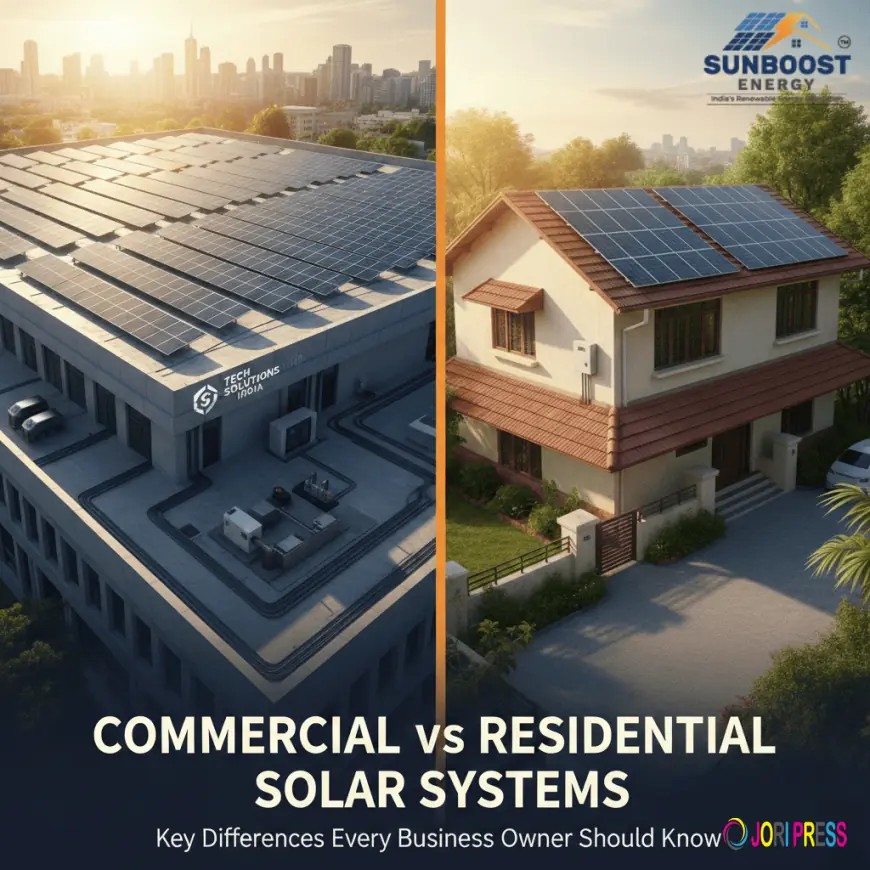
Solar adoption in India is growing fast, but many business owners still wonder whether commercial solar is just a larger version of home solar. The truth is, commercial solar systems and residential setups serve very different needs, and understanding those differences helps you make smarter decisions before investing.
If you’re running a factory, office, warehouse, school, or retail outlet or even planning solar for your home, this comparison will clear up the confusion.
1. Purpose & Energy Usage Patterns
Residential solar is designed for predictable daily consumption of lights, fans, appliances, and air conditioning. A residential rooftop solar system usually supports morning and evening loads with moderate daytime use.
Commercial solar systems, on the other hand, are built for heavy and consistent daytime demand. Manufacturing units, offices, malls, and hospitals consume power when the sun is strongest, which makes commercial solar systems more efficient in terms of real-time usage and savings.
This difference alone is why businesses often see faster financial benefits compared to homes.
2. System Size & Design Complexity
Residential installations are usually smaller and simpler, based on roof size and household units consumed.
Commercial systems are engineered on a much larger scale. Load profiling, transformer capacity, shadow analysis, and future expansion planning all come into play. This is where professional commercial solar solutions matter because system sizing errors can directly affect savings and operational reliability.
For businesses, solar is not just an installation of its infrastructure.
3. Financial Planning & ROI Expectations
Homes often focus on reducing electricity bills and achieving long-term savings.
For businesses, solar energy is a financial strategy. Commercial users look at demand for charge reduction, tax benefits, depreciation advantages, and predictable energy costs. That’s why many decision-makers actively research solar for businesses before finalizing vendors.
The goal isn’t just savings it’s cost control and energy independence.
4. Approval Process & Documentation
Residential approvals are relatively straightforward and handled at the local DISCOM level.
Commercial solar projects involve more documentation, electrical approvals, and sometimes coordination with internal compliance teams. This complexity is also why businesses prefer working with experienced EPCs or even exploring opportunities as a solar channel partner when they see long-term growth potential in the sector.
5. Maintenance & Performance Monitoring
Residential systems need basic cleaning and periodic checks.
Commercial installations require structured maintenance schedules, remote monitoring, performance audits, and fast issue resolution. Even a small downtime can impact business operations, so reliability becomes a top priority.
This is another key difference many businesses owners underestimated at the beginning.
6. Scalability & Future Expansion
Residential systems usually remain fixed after installation.
Commercial solar systems are often planned with expansion in mind. Businesses grow, operations scale, and energy demand changes. A well-designed commercial system allows capacity upgrades without redesigning the entire setup something residential systems rarely need.
7. Decision Impact: Home vs Business Solar
Choosing residential solar is usually a household decision.
Choosing commercial solar involves management teams, finance heads, and sometimes board approvals. It’s a strategic move, not an impulse decision, which is why education matters before committing.
Final Takeaway: Know What Fits Your Reality
Residential and commercial solar may use similar panels, but their purpose, planning, and impact are completely different. What works perfectly for a home may fall short for a business. That’s why experienced installers like Sunboost Energy focus on understanding real usage before recommending any system.
If you’re evaluating solar for commercial use, clarity comes from understanding your energy profile, not assumptions. And if you’re comparing both options, knowing these differences helps you move forward with confidence instead of confusion, with guidance from a team that’s handled both residential and commercial projects across India.
The right system isn’t the biggest one; it’s the one designed for how you actually use power, and that’s exactly how Sunboost Energy approaches every solar installation.
What's Your Reaction?
 Like
0
Like
0
 Dislike
0
Dislike
0
 Love
0
Love
0
 Funny
0
Funny
0
 Angry
0
Angry
0
 Sad
0
Sad
0
 Wow
0
Wow
0