




































AI-Powered Conversational Solutions for Better Business Communication
AI-Powered Conversational Solutions for Better Business Communication

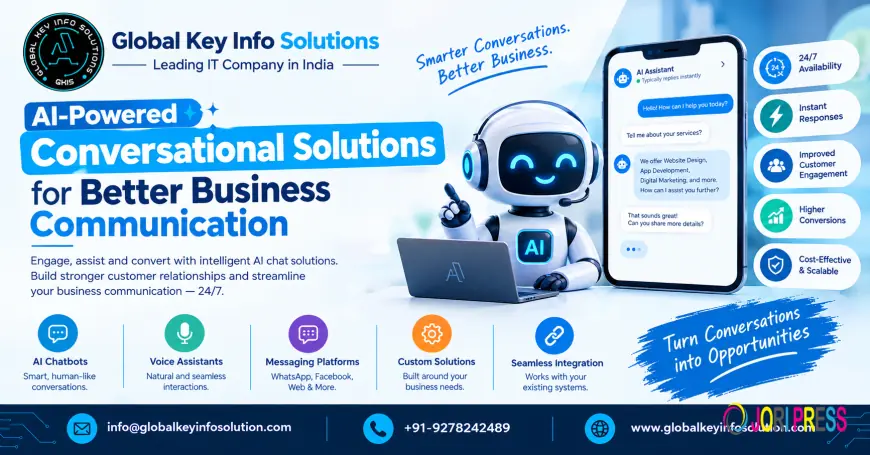
Business communication has changed significantly with the growth of artificial intelligence. Customers now expect quick responses, personalized interactions, and support across multiple digital channels. Traditional communication methods often struggle to meet these expectations, especially when businesses receive a high volume of inquiries.
AI-powered conversational solutions are helping businesses address this challenge. By combining artificial intelligence, natural language processing, and automation, these solutions can understand customer questions and provide relevant responses in real time. From customer support to lead generation, conversational AI can improve how businesses interact with their audiences.
What Are AI-Powered Conversational Solutions?
AI-powered conversational solutions are software systems designed to communicate with users through natural language. They can be integrated into websites, mobile applications, messaging platforms, and other digital channels.
Unlike basic rule-based chatbots, modern conversational AI systems can understand different ways of asking the same question, identify user intent, and provide contextually relevant responses. Some solutions can also connect with business databases and applications to provide more personalized assistance.
These capabilities make conversational AI useful for businesses that want to improve communication without increasing their support workload.
Why Businesses Need Better Digital Communication
Customers often look for immediate answers before making a purchase or using a service. Delayed responses can result in missed opportunities and poor customer experiences.
Businesses also have to manage repetitive questions related to pricing, services, order status, appointments, product information, and account support. Handling these queries manually can consume considerable time for employees.
AI-powered conversational systems can automate many routine interactions while allowing human teams to focus on more complex customer requirements.
Key Benefits of Conversational AI for Businesses
1. Faster Customer Responses
AI conversational systems can respond to customer questions almost instantly. Customers do not have to wait for business hours or remain in a support queue for simple queries.
This can create a smoother communication experience and help businesses remain responsive throughout the day.
2. 24/7 Customer Support
Businesses can use conversational AI to provide assistance outside traditional working hours. Customers can ask questions at any time and receive automated support for common requirements.
For global businesses operating across different time zones, this can be particularly useful.
3. Personalized Conversations
Modern AI systems can use available customer and business data to make conversations more relevant. For example, an AI assistant may recommend suitable services based on a customer's requirements or provide information related to an existing interaction.
Personalized communication can make digital experiences more useful and engaging.
4. Lead Generation and Qualification
Conversational AI can also support sales teams by interacting with website visitors. An AI assistant can ask relevant questions, understand a visitor's requirements, collect contact information, and identify potential leads.
Qualified leads can then be transferred to sales representatives for further discussion.
5. Reduced Repetitive Work
Customer service teams frequently handle the same questions repeatedly. Automating these routine conversations can reduce the workload on employees.
Teams can spend more time solving complicated problems, building customer relationships, and handling situations that require human judgment.
6. Consistent Business Communication
AI-powered systems can follow predefined business information, communication guidelines, and workflows. This helps maintain consistency when answering frequently asked questions.
Businesses can also update the underlying knowledge base as their services, products, or policies change.
Common Applications of Conversational AI
Conversational AI can be used across multiple business functions.
Customer Support: AI assistants can answer common questions, troubleshoot basic issues, and guide customers toward relevant resources.
Sales Assistance: Conversational systems can engage website visitors, understand their needs, and assist with lead qualification.
E-commerce: AI assistants can help customers discover products, compare options, check order information, and receive basic purchasing guidance.
Appointment Scheduling: Businesses can automate appointment requests, confirmations, and reminders through conversational interfaces.
Internal Communication: Employees can use AI assistants to find company information, access resources, or complete routine internal tasks.
Marketing: Conversational systems can engage visitors with personalized messages and collect useful information for marketing campaigns.
How AI Conversational Solutions Work
A conversational AI system generally combines several technologies to understand and respond to users.
Natural language processing helps the system interpret human language. Machine learning can help improve its ability to recognize patterns and user intent. AI models can then generate or select suitable responses based on the conversation and available information.
Businesses can also integrate conversational AI with CRM platforms, databases, customer support software, APIs, and other applications. This allows the system to perform useful actions rather than simply answering questions.
For example, a conversational assistant could receive a customer's request, retrieve relevant information from a business system, and provide the result directly within the conversation.
Building an Effective Conversational AI Strategy
Implementing conversational AI requires more than simply adding a chatbot to a website. Businesses should first identify the communication problems they want to solve.
The next step is to determine which conversations are suitable for automation. Frequently asked questions and repetitive processes are often good starting points.
Businesses should also define escalation paths. When an AI system cannot appropriately handle a request, the conversation should be transferred to a human representative.
Regular monitoring is equally important. Reviewing conversations can help businesses identify gaps, improve responses, and enhance the overall customer experience.
Why Businesses Should Focus on Human-AI Collaboration
Conversational AI does not necessarily replace human communication. Instead, it can support human teams by handling routine interactions and providing information quickly.
Complex complaints, sensitive situations, strategic discussions, and unusual requests may still require human involvement. A combination of AI automation and human expertise can therefore create a more flexible communication process.
The goal should be to use AI where it adds value while keeping human support available when it matters.
Choosing the Right AI Development Partner
Businesses planning to implement conversational AI should consider several factors when selecting a technology partner. Experience with AI development, natural language processing, integrations, security, scalability, and ongoing support can all influence the success of a project.
The right solution should also be designed around the company's specific workflows instead of relying on a generic chatbot approach.
Global Key Info Solutions provides AI development and conversational technology solutions designed around business requirements. Its services can help organizations explore AI-powered chatbots, intelligent automation, and customized conversational experiences for different business use cases.
Conclusion
AI-powered conversational solutions are changing how businesses communicate with customers and employees. Faster responses, automated support, personalized interactions, and improved lead management are some of the practical benefits businesses can achieve.
However, successful implementation depends on choosing the right use cases, integrating AI with existing systems, and maintaining a balance between automation and human support.
As conversational technologies continue to evolve, businesses that adopt them strategically can create more responsive and efficient communication experiences while giving their teams more time to focus on higher-value activities.
What's Your Reaction?
 Like
0
Like
0
 Dislike
0
Dislike
0
 Love
0
Love
0
 Funny
0
Funny
0
 Angry
0
Angry
0
 Sad
0
Sad
0
 Wow
0
Wow
0