





































Multi-Location VPS Architecture: Setting up GeoDNS for Globally Distributed Audiences — What Actually Works
Multi-location VPS architecture uses GeoDNS to route users toward suitable regional VPS nodes, helping improve global access and availability. The article covers GeoDNS setup, health checks, failover, DNS TTL, and multi-region server management.
Serving a website or application from a single VPS is often sufficient when most users are concentrated in one geographic region. The architecture becomes more complicated when visitors are distributed across continents. A user in Asia may be connected to infrastructure in Europe, while another user in North America is reaching the same origin server.
The physical location of the VPS can influence network round-trip time, routes, and the time required for requests to reach the application. A multi-location VPS architecture addresses this challenge by placing application nodes in different regions and using DNS-based routing to direct users toward an appropriate regional endpoint.
GeoDNS can form an important part of this design. However, it is not simply a matter of adding several IP addresses to DNS. The application, data, health monitoring, failover strategy, certificates, and DNS catching behavior all need to be considered.
What Is Multi-Location VPS Architecture?
A multi-location VPS architecture uses two or more VPS instances deployed in different geographic regions. Each node can host the same application or a regional component of the application.
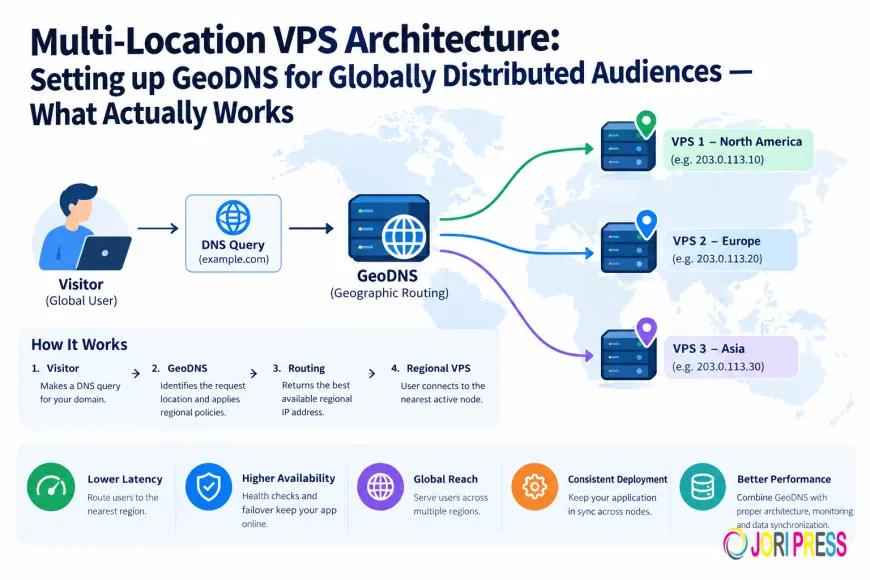
A simplified traffic flow looks like this:
Visitor → DNS Query → Geographic Routing → Regional VPS Node
For example, an organization serving customers across North America, Europe, and Asia could deploy:
- VPS 1 — North America
- VPS 2 — Europe
- VPS 3 — Asia
The objective is not simply to create three copies of a website. The infrastructure must be designed so that the application behaves consistently regardless of which regional node receives the request.
This means deployment processes, application configuration, databases, uploaded files, sessions, SSL certificates, monitoring, and recovery procedures may need to work across all locations.
Why VPS Location Latency Matters
Network latency doesn't depend on how far a visitor is from a server. Many other things play a role. The path the data takes over the internet, the networks it passes through how much traffic is on the lines how servers connect to each other, how busy the server is and how fast the application runs all impact response time.
For teams looking at VPS setups knowing how latency works based on VPS location helps explain why placing an app closer to users can make a difference.
Being close doesn’t always mean faster. A server nearby might have a processor, slow database responses, bad routing or poorly written code. Then it could perform worse than a server that’s farther away but has better connections and smoother operations. So, proximity alone doesn't guarantee speed.
This is why geographic routing should be considered as one part of an overall performance strategy.
How GeoDNS Works?
GeoDNS extends conventional DNS by allowing DNS responses to vary according to geographic or regional routing policies.
When a visitor requests a domain, the request eventually reaches a recursive DNS resolver. The authoritative DNS infrastructure can use geographic information associated with the DNS query to determine which configured response should be returned.
For example, a simplified policy might be:
|
Geographic Region |
DNS Response |
|
North America |
North American VPS IP |
|
Europe |
European VPS IP |
|
Asia |
Asian VPS IP |
|
Other regions |
Default VPS IP |
The important detail is that GeoDNS does not directly proxy the visitor's application connection. It controls the DNS response that helps determine which IP address the visitor's system will connect to.
GeoDNS also does not necessarily know the exact physical location of an individual user. Geographic decisions can depend on the location information available to the DNS provider and recursive resolver. Consequently, geographic routing should be treated as an approximation rather than a precise measurement of every visitor's physical position.
Geographic routing also differs from latency-based routing. GeoDNS can associate regions with specific servers, while latency-based systems may select an endpoint according to measured network performance from locations.
Basic GeoDNS Setup With Multiple VPS Nodes
Consider a fictional domain:
example.com
The application is deployed on three VPS nodes:
VPS 1 → North America → 203.0.113.10
VPS 2 → Europe → 203.0.113.20
VPS 3 → Asia → 203.0.113.30
These IP addresses are illustrative documentation addresses, not production endpoints.
A GeoDNS provider could be configured with regional policies such as:
North America → 203.0.113.10
Europe → 203.0.113.20
Asia → 203.0.113.30
Default → 203.0.113.20
The exact configuration interface and record syntax varies between DNS providers, so this should be treated as an architectural example rather than a universal DNS configuration.
The DNS zone may still contain conventional records such as:
example.com A GeoDNS Policy
IPv6 should also be considered where the application supports it:
example.com AAAA Regional IPv6 Policy
The key objective is that the DNS policy returns an appropriate active endpoint instead of blindly distributing every request across every server.
GeoDNS Setup Multiple VPS: What Actually Needs to Be Configured
A functional multi-location design requires more than multiple VPS IP addresses.
1. Regional VPS Nodes:-
2. Consistent Application Deployment:-
A deployment system can help distribute application releases without manually updating each VPS.
3. Geographic DNS Policies:-
Regional rules should include a default or fallback destination for traffic that does not match a specific geographic policy.
4. A and AAAA Records:-
5. Health Checks:-
Health checks can monitor HTTP endpoints, TCP connectivity, or application-specific responses.
6. Monitoring:-
- CPU utilization
- Memory pressure
- Storage capacity
- Network errors
- Application response time
- HTTP status codes
- Database health
- Service availability
7. DNS TTL
TTL influences how long DNS responses may remain cached. It therefore affects how quickly routing changes can become visible to different users.
8. SSL/TLS
Every regional node serving HTTPS traffic needs an appropriate certificate configuration.
9. Data Synchronization
If users can upload files or modify application data, those changes must be available to the appropriate nodes.
10. Session Management
Applications using local server sessions need special consideration. A user routed to Europe should not unexpectedly lose a session because the next request reaches another region.
Shared session storage, stateless application design, or an appropriate session architecture can help address this problem.
How to Load Balance Servers by Geography?
Geographic DNS routing is sometimes described as geographic load balancing, but it is different from conventional load balancing.
DNS round-robin can return multiple IP addresses without necessarily considering the visitor's geographic region or the actual health of each application node.
GeoDNS can return different DNS responses according to geographic policies.
Traditional load balancers generally operate closer to the application traffic path and can distribute requests among backend servers according to configured algorithms and health status.
Anycast uses the same IP address from multiple network locations, with routing protocols determining which network location receives traffic.
CDNs can distribute cached content and, depending on the service, route dynamic requests toward appropriate origins.
Therefore, the choice depends on the application. GeoDNS can be useful when regional origin selection is the main requirement, while applications needing detailed request-level balancing may require a different architecture.
Building a Multi-Server Architecture for Global Applications
A multi-server architecture global deployment needs to account for application state.
Stateless applications are generally easier to distribute because individual VPS nodes do not need to retain important user state locally.
Stateful applications require additional planning.
Common components include:
- Shared or replicated databases
- Object storage
- Distributed session storage
- Centralized logging
- Shared configuration management
- Deployment synchronization
- Cross-region monitoring
- Backup and recovery systems
For example, if a customer uploads an image while connected to the European VPS, the image cannot remain accessible only from that server if the same customer may later be routed to the Asian node.
Similarly, database writes introduce another layer of complexity. Multi-region database replication can introduce consistency, conflict, and replication-lag considerations.
This demonstrates why adding multiple VPS servers does not automatically produce a reliable global application architecture.
Health Checks and Automatic Failover
Health monitoring is particularly important when the goal is to route visitors toward the nearest active VPS node.
Suppose the European VPS normally serves visitors from Europe. A health-check system could periodically request an application endpoint such as:
onliveserver.com/cheap-vps/
The endpoint might verify that essential application components are functioning.
A basic health-check strategy can include:
- HTTP status monitoring
- TCP connection checks
- Application-level health checks
- Database dependency checks
- Failed-node detection
- Recovery detection
- DNS fallback policies
If the European node fails its health check, the DNS routing system can stop returning that node for new DNS resolutions and use a configured fallback.
However, this does not mean every active connection immediately moves to another server.
DNS responses may already be cached by recursive resolvers, operating systems, browsers, or other network components. Existing connections also remain separate from future DNS lookups.
Consequently, DNS failover improves future routing decisions but cannot guarantee instantaneous traffic migration.
DNS TTL and Routing Changes
TTL, or Time to Live, controls how long DNS information can remain cached.
A relatively low TTL can allow routing changes to be recognized sooner, but it can also increase DNS query frequency.
Higher TTL can reduce repeated DNS lookups but may leave older routing information caught for longer.
For example:
example.com → VPS Europe
If the European VPS becomes unavailable and the DNS policy changes to:
example.com → VPS North America
a resolver that already caught the previous answer may continue using it until its cache period expires.
This is why lowering TTL does not guarantee instant global traffic movement. Different resolvers and clients can behave differently, and cached responses can continue to influence routing.
TTL should therefore be selected according to the application's availability and operational requirements rather than simply choosing the lowest possible value.
What Happens When the Nearest VPS Goes Down?
Consider a visitor from Germany who normally receives the European VPS address.
Under normal conditions:
German visitor
↓
GeoDNS
↓
European VPS
If the European node fails, its health check:
German visitor
↓
GeoDNS
↓
Fallback VPS
The fallback might be another European node, a North American server, or another available location depending on the architecture.
There are four separate considerations here:
DNS failover: Determines which address future DNS responses should contain.
Existing connections: Already-established connections do not automatically change servers because DNS changed.
Cached DNS responses: Some users may continue receiving or using the previous IP until their cached DNS information expires.
Application-level failover: The application itself may need mechanisms to preserve sessions, data access, and transaction continuity.
A well-designed system considers all four rather than treating DNS as the entire failover mechanism.
How to Test GeoDNS Routing?
Testing should be performed from multiple geographic locations. Testing only from the administrator's own workstation can produce a misleading picture.
Basic DNS tools include:
dig example.com
and:
nslookup example.com
For HTTP-level testing, curl can help verify which endpoint is responding:
curl - xyz123.com
If the infrastructure adds a response header identifying the regional node, testing becomes easier:
X-Region: Europe
A more comprehensive test should include DNS queries from different geographic networks and independent monitoring locations.
The goal is to verify:
- The correct region receives the intended DNS response.
- The application is running on that regional node.
- Failed nodes are removed from routing.
- Recovery causes the node to become eligible again.
- IPv4 and IPv6 behave consistently.
- The fallback policy works as expected.
Common GeoDNS Configuration Mistakes
Several problems repeatedly appear in multi-region deployments.
Using the Same IP for Every Region
If every geographic policy returns the same address, there is no meaningful regional routing.
Forgetting IPv6
An IPv6-capable user may follow an AAAA record instead of the intended IPv4 path. IPv6 therefore needs to be included in the architecture.
No Health Checks
GeoDNS without health monitoring may continue directing users toward an unavailable node.
Incorrect Fallback Rules
Every deployment should have a clear answer for what happens when a regional node becomes unavailable.
Excessively High TTL
Long caching periods can make infrastructure changes slower to reach users.
Assuming DNS Equals Load Balancing
DNS routing happens before the application connection is established. It does not provide the same request-level control as an application load balancer.
Unsynchronized Application Data
Multiple application servers can produce inconsistent user experiences if files, configuration, or data are not synchronized appropriately.
Regional Database Conflicts
Distributed writing require careful database architecture. Simply placing a database on every VPS does not create reliable replication.
Ignoring SSL Certificates
Every regional HTTPS endpoint must have valid TLS configuration.
Testing Only from One Location
A GeoDNS policy can appear correct from one network and behave differently from another. Regional testing is therefore essential.
When Multi-Location VPS Architecture Makes Sense
Multi-location VPS infrastructure can be useful when users are distributed across multiple geographic regions and network distance is a meaningful part of the application's performance profile.
Potential use cases include:
- Global SaaS applications
- International eCommerce platforms
- APIs serving users across continents
- Content-heavy websites
- Regional business applications
- Applications with latency-sensitive workloads
The architecture can also be useful when organizations need regional redundancy, if application and data failover have been designed appropriately.
When GeoDNS May Not Be Necessary?
Not every website requires multiple VPS locations.
If most visitors are concentrated in one region, a single well-connected VPS may be sufficient. A CDN or caching layer may also address much of the latency associated with static content without requiring multiple application origins.
Adding regional servers introduces additional operational requirements, including deployment synchronization, monitoring, security management, backups, DNS policies, and data consistency.
The architecture should therefore be based on actual traffic distribution and application requirements rather than adding regions simply because multiple locations are available.
Practical Multi-Location VPS Architecture Checklist
Before deploying GeoDNS, infrastructure teams should verify:
- ✓ Regional VPS nodes are properly sized
- ✓ Application deployments remain consistent
- ✓ GeoDNS policies are correctly configured
- ✓ Health checks monitor application availability
- ✓ A fallback node or fallback policy exists
- ✓ DNS TTL is appropriate for the operational requirements
- ✓ SSL/TLS configuration covers every active region
- ✓ Monitoring covers all VPS locations
- ✓ Application and user data are synchronized appropriately
- ✓ Session’s work across regional nodes
- ✓ Database architecture supports the intended deployment model
- ✓ GeoDNS is tested from multiple geographic locations
- ✓ IPv4 and IPv6 routing have both been evaluated
- ✓ Backup and recovery procedures are documented
Conclusion
Multi-location VPS architecture can provide a practical way to distribute application endpoints across geographic regions. GeoDNS can then help return different DNS responses according to configured geographic policies, allowing users to be directed toward an appropriate regional VPS.
Reliable deployment combines regional VPS nodes with consistent application releases, appropriate DNS policies, health checks, monitoring, data synchronization, session management, SSL/TLS configuration, and a defined fallback strategy.
Teams implementing this model should also account for DNS coaching and TTL behavior. A failed node can be removed from future DNS responses, but users with cached DNS information may continue attempting to connect to the previous endpoint.
What's Your Reaction?
 Like
0
Like
0
 Dislike
0
Dislike
0
 Love
0
Love
0
 Funny
0
Funny
0
 Angry
0
Angry
0
 Sad
0
Sad
0
 Wow
0
Wow
0