



































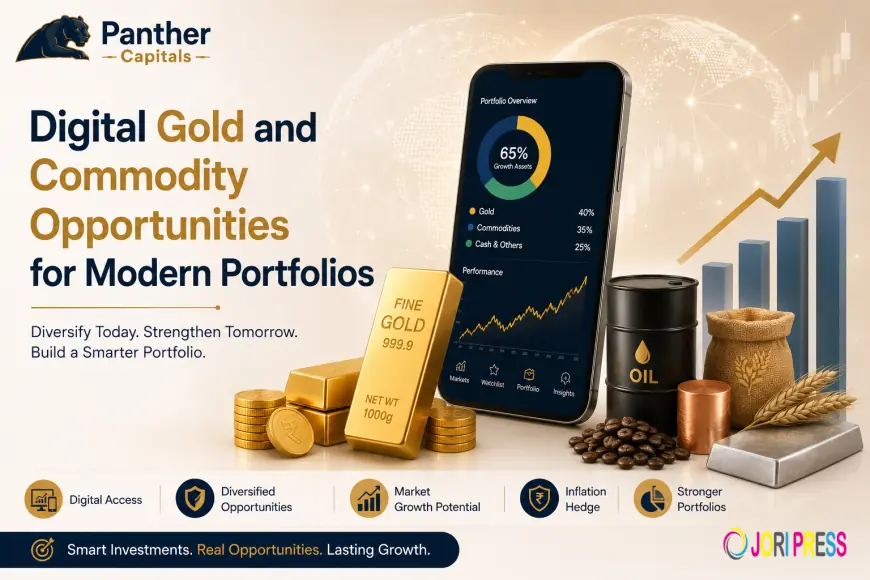
Digital Gold and Commodity Opportunities for Modern Portfolios
At Panther Capitals, we provide access to gold and commodity opportunities while focusing on informed portfolio decisions. Understanding digital gold, commodity derivatives, market drivers, diversification, price movements, and risk management can help investors evaluate how different assets may fit their financial objectives, time horizons, and overall investment strategies effectively.

Building a Broader Investment Approach
Modern investors have access to a wider range of assets than traditional portfolios once offered. Gold, equities, fixed-income instruments, currencies, and commodities can each respond differently to changing economic conditions.
At Panther Capitals, we believe portfolio decisions should begin with clear financial objectives rather than short-term market excitement. Gold and commodities can provide exposure to different economic forces, but they also carry individual risks that need careful consideration.
Gold prices can respond to interest rates, currencies, inflation expectations, central-bank activity, physical demand, and geopolitical developments. Other commodities may be influenced more directly by production, consumption, inventories, weather, industrial activity, and transportation.
Understanding these differences can help investors decide whether an asset complements their broader portfolio rather than simply adding another position.
Understanding Digital Gold
Digital technology has changed how individuals can gain exposure to gold. Instead of purchasing jewellery, coins, or bars and personally arranging storage, some providers allow investors to purchase gold through digital channels.
When investors buy digital gold, the transaction generally represents a specified quantity of physical gold held under arrangements established by the provider. The investor receives a digital record representing the purchased quantity rather than immediately taking possession of the metal.
The model can appeal to people who prefer convenient transactions and do not want to personally manage physical storage.
However, digital access should not be confused with the absence of risk. Investors should consider the provider, custody arrangements, pricing, buy-sell spreads, applicable taxes, redemption conditions, and regulatory status before making a decision.
Digital Gold and Regulated Gold Products
Understanding product structure is particularly important in India because different gold products operate under different frameworks.
Digital gold offered by online providers is different from exchange-traded commodity derivatives, Gold ETFs, and Electronic Gold Receipts.
The underlying exposure may relate to the same precious metal, but ownership structure, trading mechanisms, costs, liquidity, investor protections, and regulatory arrangements can differ.
At Panther Capitals, we believe investors should identify exactly what they are purchasing before committing capital.
Someone seeking longer-term gold exposure may evaluate products differently from an active trader interested in market price movements. Similarly, an investor who values physical redemption may have different priorities from someone who prefers an exchange-traded instrument.
Product selection should therefore reflect individual requirements rather than treating every form of gold exposure as identical.
Using Online Channels for Gold Exposure
Convenience is one of the main reasons investors increasingly use digital financial services. The ability to monitor holdings and transact electronically can simplify the process of managing portfolio exposure.
Those considering whether to buy digital gold online should look beyond convenience and examine how the product operates.
Important considerations can include
-
Purity and underlying gold arrangements
-
Storage and custody structure
-
Purchase and selling prices
-
Applicable charges and taxes
-
Redemption conditions
-
Provider-related risks
-
Regulatory framework
-
Liquidity and exit process
Price remains another important consideration. Gold can experience both sustained trends and shorter periods of significant volatility.
A convenient purchasing process does not guarantee that the asset will increase in value. Investors should consider how much exposure is appropriate for their financial position and portfolio objectives.
What Drives Gold Prices
Gold has characteristics that distinguish it from many other assets.
International prices can be influenced by monetary policy and interest-rate expectations. Currency movements, particularly changes involving the US dollar, can also affect market behaviour.
Inflation expectations may influence investor sentiment, while geopolitical uncertainty can cause market participants to reassess their asset allocations.
Physical-market conditions remain relevant as well. Jewellery demand, investment purchases, central-bank activity, mining production, and recycling contribute to the wider supply-and-demand environment.
These forces often interact rather than operating independently.
For example, an economic announcement may simultaneously affect interest-rate expectations, currency markets, and investment sentiment. Gold prices can respond as participants interpret what those changes may mean for future conditions.
We believe considering multiple factors provides a more balanced perspective than relying on one indicator.
Why Investors Consider Commodities
Gold represents only one part of the broader commodity universe. Energy resources, industrial metals, precious metals, and agricultural products provide exposure to different areas of global economic activity.
When investing in commodities, individuals may be seeking diversification, exposure to particular economic themes, or participation in changing supply-and-demand conditions.
For example, industrial metals can be affected by manufacturing, infrastructure, construction, mining supply, and international economic growth.
Energy commodities can respond to production decisions, inventories, transportation requirements, geopolitical developments, and consumption patterns.
Agricultural resources introduce another set of factors, including rainfall, temperature, crop conditions, harvest expectations, exports, and government policies.
These differences mean commodity exposure should be evaluated asset by asset rather than viewed as a single investment category.
Commodities and Portfolio Diversification
Diversification involves spreading exposure across assets rather than depending excessively on one source of returns.
Commodities may behave differently from equities or fixed-income assets during certain economic environments. This can make them relevant when investors consider broader portfolio allocation.
Potential reasons for including commodity exposure can include
-
Access to different economic sectors
-
Exposure to global resource demand
-
Participation in inflation-sensitive assets
-
Diversification beyond conventional securities
-
Exposure to energy and industrial activity
-
Allocation across different market cycles
Diversification does not eliminate investment risk. Multiple commodities may sometimes move in similar directions because they are responding to the same economic development.
The size of an allocation therefore matters as much as the decision to diversify.
At Panther Capitals, we believe investors should consider overall portfolio exposure, financial objectives, time horizon, and tolerance for market fluctuations before allocating capital.
Understanding Commodity Derivatives
Modern commodities trading frequently involves derivatives such as futures and options rather than purchasing and storing the underlying physical resource.
A futures contract establishes predefined terms for buying or selling an underlying commodity. Important contract characteristics can include quantity, expiry, settlement method, and margin requirements.
Options operate differently and involve specific rights and obligations based on the position taken.
Commodity derivatives also contribute to price discovery. Buyers and sellers continuously respond to changing information about supply, demand, economic conditions, and expectations, helping establish market prices.
Commercial participants can also use derivatives for hedging. A business exposed to changing raw-material prices may use an appropriate contract to manage some of that price risk.
Traders, investors, producers, and consumers may therefore participate in the same market for different reasons.
Supply and Demand Across Commodity Markets
Physical supply and demand remain central to commodity pricing.
When demand increases faster than available production, supply can become tighter. When production significantly exceeds consumption, the market may experience different pricing pressure.
Inventory data can provide additional information about the relationship between availability and consumption.
Unexpected events can alter these conditions quickly.
A mining disruption may affect metal production. Geopolitical developments can interfere with energy supply. Severe weather can influence agricultural output, while stronger industrial activity may increase demand for raw materials.
Government decisions can also affect markets through import restrictions, export policies, taxes, environmental regulations, and production rules.
Investors should therefore consider both domestic and international developments when evaluating commodity opportunities.
Using Fundamental and Technical Analysis
Market analysis can help participants organise information and assess potential scenarios.
Fundamental analysis focuses on the economic forces affecting an asset. In commodity markets, this can involve supply, demand, production, inventories, consumption, currencies, economic activity, and policy decisions.
Technical analysis focuses more directly on price behaviour.
Traders may review charts to assess trends, momentum, volatility, previous highs and lows, and potential support or resistance areas.
Different timeframes can produce different perspectives. A commodity may remain in a longer-term upward trend while experiencing a shorter-term decline.
Neither approach can predict market prices with certainty.
We believe combining relevant fundamental information with price analysis can provide a broader basis for decision-making while keeping expectations realistic.
Understanding Risk Before Allocating Capital
Gold and commodities can experience significant price fluctuations. Risk management should therefore be part of the portfolio process from the beginning.
Investors can start by deciding how much capital they are prepared to allocate to a particular asset or market category.
Active commodity positions may introduce additional considerations such as leverage, margin requirements, contract expiry, and settlement conditions.
A structured process can include
-
Establishing the purpose of the investment
-
Determining an appropriate allocation
-
Understanding the underlying product
-
Reviewing potential downside
-
Monitoring total portfolio exposure
-
Considering liquidity requirements
-
Reassessing the position when conditions change
Emotional decisions can become particularly costly during volatile periods. Rapid price increases may encourage investors to enter without sufficient analysis, while sudden declines may result in decisions that conflict with longer-term objectives.
A predefined process can provide greater consistency.
Gold and Commodities Within Modern Portfolios
Gold and broader commodities provide exposure to economic forces that differ from those affecting many conventional financial assets.
Gold is influenced by monetary conditions, currencies, investment sentiment, physical demand, and global uncertainty. Other commodities connect portfolios more directly with energy consumption, industrial activity, infrastructure, agriculture, and physical supply chains.
At Panther Capitals, we view these markets as potential components of a broader financial strategy rather than isolated opportunities.
The appropriate allocation depends on the individual.
Longer-term investors may focus more heavily on portfolio structure and economic cycles, while active traders may place greater emphasis on market timing, technical conditions, and shorter-term developments.
Understanding the distinction between different products is equally important. Digital forms of gold, exchange-traded instruments, and commodity derivatives can have different structures and risks even when they provide exposure to related underlying assets.
By evaluating product structure, market conditions, allocation size, time horizon, and risk before committing capital, investors can build a more disciplined approach to gold and commodity exposure within modern portfolios.
What's Your Reaction?
 Like
0
Like
0
 Dislike
0
Dislike
0
 Love
0
Love
0
 Funny
0
Funny
0
 Angry
0
Angry
0
 Sad
0
Sad
0
 Wow
0
Wow
0