



































SailPoint IdentityNow Training: Build Expertise in Modern Identity Governance

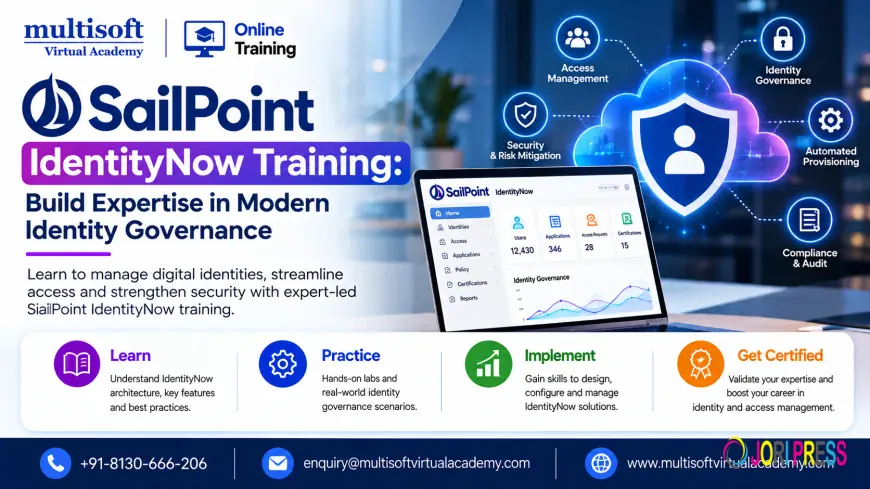
As businesses expand their digital infrastructure, protecting user identities and managing application access have become essential parts of enterprise cybersecurity. Organizations need reliable ways to control permissions, simplify user onboarding and ensure that employees access only the resources required for their responsibilities.
SailPoint IdentityNow addresses these challenges through cloud-based identity governance capabilities. It helps organizations manage digital identities, streamline access-related processes and improve visibility into user permissions across connected applications.
SailPoint IdentityNow Training introduces professionals to the principles, tools and implementation concepts involved in modern Identity Governance and Administration (IGA). Through structured learning and practical exercises, participants can develop an understanding of identity profiles, access provisioning, certification campaigns and lifecycle automation.
Understanding SailPoint IdentityNow
SailPoint IdentityNow Training is associated with SailPoint's cloud identity security portfolio, now widely represented by SailPoint Identity Security Cloud. The platform supports organizations in governing digital identities and managing access to business applications.
Instead of relying entirely on manual administration, organizations can use identity governance capabilities to establish consistent access policies and automate selected identity management activities.
These capabilities are particularly relevant to enterprises that operate across cloud platforms, on-premises applications and hybrid IT environments.
Professionals pursuing SailPoint IdentityNow Online Training learn how identity information is collected, how access permissions are assigned and how organizations review whether those permissions remain appropriate.
Why Is Identity Governance Essential for Modern Businesses?
Identity governance plays a central role in reducing unnecessary access and maintaining accountability across enterprise systems.
Strengthening Access Security
Employees frequently require access to multiple applications. Without effective governance, permissions can accumulate over time and create unnecessary security exposure.
Identity governance helps organizations review access rights and apply the principle of least privilege.
Simplifying Employee Lifecycle Processes
Businesses regularly hire employees, change job responsibilities and manage departures. Each event can require several application access changes.
Automated identity lifecycle processes can help coordinate these changes and reduce repetitive administrative work.
Improving Compliance Visibility
Organizations need to demonstrate that access permissions are reviewed and managed according to internal policies and applicable regulatory requirements.
Identity governance capabilities support access reviews, decision records and audit preparation.
Supporting Digital Transformation
As organizations adopt additional cloud applications, centralized identity governance becomes increasingly valuable. SailPoint skills can help IT teams understand how identity information and access policies operate across interconnected systems.
Important Features Covered in SailPoint IdentityNow Training
A comprehensive SailPoint Identity Security Cloud Training program should cover the platform's core governance capabilities and their practical applications.
Identity Lifecycle Administration
Identity lifecycle management governs access from onboarding through role changes and eventual offboarding.
Learners explore identity states, attribute changes and the relationship between authoritative identity information and access assignments.
Source Integration and Account Aggregation
Sources connect identity governance processes with directories, HR systems and business applications.
Training introduces source configuration, account aggregation, identity correlation and connectivity considerations.
Participants learn why accurate source data is important for reliable identity governance.
Identity Profiles and Attribute Mapping
Identity profiles help define how identities are created and managed from authoritative data.
This area covers identity attributes, mappings, transformations and configuration principles.
Understanding these components helps learners investigate identity data inconsistencies and improve provisioning accuracy.
Access Profiles and Entitlements
Access profiles organize permissions that users may need for particular business activities. Entitlements represent permissions or access rights within connected systems.
Learners examine how these components contribute to access management and how permissions can be organized into manageable structures.
Automated Provisioning
Provisioning involves creating, modifying or removing accounts and permissions.
SailPoint training introduces provisioning workflows, access assignment processes and troubleshooting approaches for unsuccessful operations.
Access Requests and Approvals
Access request processes allow users to request additional permissions through defined approval procedures.
Training explores request eligibility, approval responsibilities and access assignment workflows.
Access Certifications
Certification campaigns help managers, application owners or other designated reviewers evaluate existing access.
Participants learn how certification decisions contribute to identifying inappropriate permissions and maintaining governance oversight.
SailPoint IdentityNow Training Curriculum
An effective training curriculum should combine foundational concepts with implementation-oriented exercises.
Module 1: Identity Governance Fundamentals
Learn identity management terminology, authentication, authorization, access controls and governance principles.
Module 2: Platform Architecture
Understand the cloud platform, administrative interfaces, identity data flows and integration concepts.
Module 3: Source Configuration
Explore supported connectors, source setup, aggregation and account correlation.
Module 4: Identity Profiles
Study identity attributes, profile configuration, mappings and transformations.
Module 5: Access Management
Understand entitlements, access profiles, roles and access request policies.
Module 6: Provisioning and Lifecycle Automation
Explore account provisioning, employee lifecycle events and automated access changes.
Module 7: Access Certifications
Learn certification campaign configuration, reviewer decisions, remediation and governance reporting.
Module 8: APIs and Workflow Automation
Discover supported REST APIs, workflow concepts and integration approaches for extending identity governance processes.
Module 9: Troubleshooting and Administration
Practice investigating aggregation errors, reviewing configuration problems and validating access changes.
The precise curriculum depends on the training provider, platform version and available laboratory environment.
Practical Exercises for Better Learning Outcomes
Practical exercises help transform theoretical knowledge into useful technical skills.
One example is a simulated employee onboarding process. Participants can explore how identity information from an authoritative source influences account creation and access assignments.
A second exercise can involve an employee changing departments. Learners examine how revised attributes and access policies affect existing permissions.
Another scenario involves employee offboarding, where participants study the steps required to remove or disable access through supported workflows.
Additional exercises may include reviewing access certifications, configuring access profiles and investigating failed provisioning activities.
These exercises help learners understand dependencies between identity data, connected applications and governance policies.
Access to a suitable demonstration tenant or laboratory is important for hands-on practice. Some advanced capabilities may require particular licensing or configuration.
SailPoint IdentityNow vs. IdentityIQ
Professionals considering SailPoint Certification Training often evaluate IdentityNow alongside SailPoint IdentityIQ.
IdentityNow is associated with SailPoint's cloud-based identity security approach, whereas IdentityIQ is commonly used in customer-managed enterprise deployments.
The distinction influences administration, infrastructure responsibilities, configuration approaches and maintenance requirements.
Organizations selecting between these solutions should consider existing applications, integration needs, security requirements and long-term operational strategy.
For learners, understanding the distinction can help identify which platform aligns with their intended career path.
Who Can Benefit From SailPoint Training?
SailPoint IdentityNow Training can benefit several categories of IT professionals.
- IAM administrators: Strengthen knowledge of identity provisioning, access policies and account governance.
- Cybersecurity professionals: Expand expertise in access controls, identity risks and compliance processes.
- IAM developers: Explore APIs, integrations and workflow automation.
- Cloud engineers: Understand identity governance in cloud and hybrid environments.
- IT consultants: Develop knowledge relevant to identity security implementation and support.
- Aspiring professionals: Build foundational knowledge before pursuing specialized identity governance responsibilities.
Familiarity with directories, networking, cloud applications and general security principles can make the learning process easier.
Certification and Career Development
SailPoint provides official learning resources and certification pathways through its learning ecosystem. Candidates should verify current certification names, eligibility requirements and examination details before making a preparation plan.
Completing a training program does not automatically mean that a learner has earned an official vendor certification.
With suitable technical preparation and relevant experience, professionals may pursue roles such as IAM Administrator, SailPoint Developer, Identity Governance Analyst, SailPoint Implementation Consultant and Identity Security Engineer.
Career requirements differ between employers. Some positions emphasize platform administration, while others require programming, enterprise integration or solution design experience.
Building practical knowledge alongside formal learning can help professionals prepare for technical interviews and implementation responsibilities.
Best Practices for Learning SailPoint IdentityNow
Start with identity governance fundamentals before moving to complex configurations. Understand how identities, accounts, entitlements and access profiles relate to one another.
Practice common onboarding, transfer and offboarding scenarios. These workflows demonstrate how identity changes can affect application permissions.
Learn how to investigate configuration errors and provisioning failures rather than relying exclusively on successful demonstrations.
Use official SailPoint documentation to stay informed about product changes and current platform terminology.
Finally, document practical exercises and review the reasons behind each configuration decision. This approach encourages systematic problem-solving and supports long-term skill development.
Emerging Trends in Identity Security
Cloud adoption, distributed workforces and increasing automation continue to influence enterprise identity security.
Organizations must manage access across SaaS applications, hybrid environments and increasingly complex digital ecosystems. They also need better visibility into non-human identities, including service accounts and machine identities.
These developments increase the importance of consistent identity governance, access reviews and automated controls.
Professionals who combine platform knowledge with an understanding of security principles, integration requirements and compliance responsibilities can adapt more effectively to changing enterprise needs.
Conclusion
SailPoint IdentityNow Training offers a structured way to understand cloud identity governance, access management, automated provisioning and identity lifecycle administration. By developing knowledge of these areas, professionals can prepare for technical responsibilities in the evolving identity security field. Multisoft Virtual Academy provides professional training opportunities for learners seeking to strengthen their understanding of enterprise technologies and develop practical skills relevant to identity governance and cybersecurity.
What's Your Reaction?
 Like
0
Like
0
 Dislike
0
Dislike
0
 Love
0
Love
0
 Funny
0
Funny
0
 Angry
0
Angry
0
 Sad
0
Sad
0
 Wow
0
Wow
0