




































Automated Data Lineage Tools Improve Data Governance Across Modern Systems
Automated Data Lineage Tools improve data governance by providing end-to-end visibility, tracking data movement across modern systems, supporting compliance, and enabling faster, more accurate analytics decisions.

Introduction
Organizations collect information from cloud applications, business software, customer platforms, connected devices, and internal databases every day. While data continues to grow, understanding where it comes from, how it changes, and where it is used has become increasingly difficult. This challenge often creates confusion for analytics teams, compliance officers, and business leaders who rely on trusted information for strategic decisions.
This is where automated data lineage tools play a critical role. They provide complete visibility into the movement of data across multiple systems without requiring manual documentation. Businesses can trace every transformation, identify data dependencies, and improve confidence in reports, dashboards, and AI models.
As digital transformation accelerates, organizations are placing greater importance on reliable data governance, regulatory compliance, and operational transparency. Modern enterprises need intelligent solutions that simplify complex environments while reducing the effort required to manage growing data ecosystems.
Why Automated Data Lineage Tools Matter for Modern Enterprises
Businesses often manage hundreds of applications and thousands of data assets. Every integration, migration, or transformation introduces additional complexity. Without visibility into these processes, identifying data quality issues becomes time-consuming and expensive.
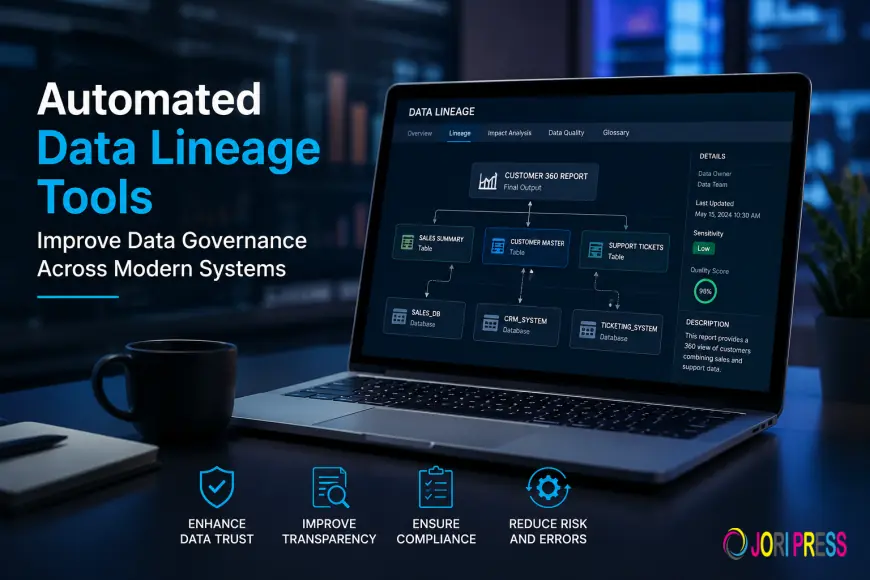
Automated data lineage tools continuously capture metadata from databases, ETL pipelines, cloud platforms, analytics environments, and business intelligence applications. Instead of relying on spreadsheets or manually created documentation, these solutions automatically map relationships between datasets.
This automated approach helps organizations understand how information flows from source systems to reporting layers. Teams gain confidence that every report is based on accurate and traceable information, making decision-making faster and more reliable.
Building Stronger Data Governance Across Every Department
Data governance succeeds only when organizations understand the complete lifecycle of their information. Missing documentation often leads to inconsistent reporting, duplicated datasets, and uncertainty regarding data ownership.
Using automated data lineage tools allows governance teams to establish clear accountability across business units. Every dataset can be traced back to its original source, helping organizations verify accuracy while maintaining consistent governance standards.
When business users request changes to reports or analytics models, data teams can immediately identify upstream dependencies before making modifications. This reduces operational risk and minimizes unexpected disruptions across enterprise systems.
Organizations also improve collaboration because technical teams and business stakeholders work from the same transparent view of enterprise data.
Improving Data Quality for Better Business Decisions
Poor data quality affects every department. Finance, marketing, operations, healthcare, manufacturing, and retail all depend on accurate information to make informed decisions.
Automated data lineage tools simplify the process of identifying where errors begin. Instead of searching across multiple systems, teams can follow a visual lineage path that highlights transformations, integrations, and processing steps.
When inaccurate values appear in reports, analysts quickly locate the source of the issue. Correcting problems becomes significantly faster because every relationship between datasets is already documented automatically.
Higher data quality also improves customer experiences, operational efficiency, forecasting accuracy, and executive reporting across the organization.
Supporting Cloud Migration and Hybrid Data Environments
Many enterprises now operate in hybrid environments that combine on-premises infrastructure, cloud storage, SaaS applications, and modern data warehouses.
Managing data movement across these platforms can quickly become overwhelming without proper visibility.
Automated data lineage tools provide centralized tracking regardless of where information resides. Whether data moves between cloud services, enterprise applications, or analytics platforms, organizations maintain a complete record of every transformation.
This visibility simplifies migration projects because technical teams understand existing dependencies before moving workloads to new environments.
Businesses can modernize their infrastructure while reducing migration risks and avoiding unexpected disruptions to business operations.
Helping Regulatory Compliance Become Easier
Compliance requirements continue expanding across industries. Organizations must demonstrate how sensitive information is collected, transformed, stored, and shared.
Manual documentation rarely keeps pace with changing systems.
By implementing automated data lineage tools, compliance teams gain continuous visibility into regulated data assets. Auditors can review complete lineage records instead of requesting manually prepared documentation.
This transparency simplifies regulatory reporting while reducing preparation time during audits.
Organizations also strengthen data privacy initiatives because they understand exactly where sensitive customer information exists throughout the enterprise.
Supporting Artificial Intelligence and Advanced Analytics
Artificial intelligence depends on trustworthy data. Machine learning models perform better when training datasets are accurate, complete, and fully understood.
Automated data lineage tools provide the transparency needed for responsible AI initiatives. Data scientists can verify the origin of training datasets while understanding every transformation applied before model development.
This improves confidence in AI predictions and supports explainable artificial intelligence practices.
Organizations also reduce model bias because they maintain greater visibility into data preparation processes.
As AI adoption continues growing, lineage becomes an essential component of enterprise data management strategies.
Reducing Operational Costs Across Data Teams
Many organizations spend countless hours documenting integrations, investigating data issues, and validating reporting accuracy.
Automation significantly reduces these repetitive tasks.
Automated data lineage tools eliminate much of the manual effort required to maintain documentation. Instead of updating diagrams after every system change, metadata is automatically collected and refreshed.
Technical teams spend less time searching for problems and more time delivering valuable analytics, innovation, and business improvements.
The result is increased productivity, lower maintenance costs, and faster project delivery across data engineering teams.
Choosing the Right Solution for Long-Term Success
Selecting the right automated data lineage tools involves more than comparing technical features. Organizations should evaluate scalability, metadata discovery capabilities, cloud compatibility, governance integration, security standards, visualization quality, and ease of implementation.
An effective solution should connect seamlessly with existing databases, ETL platforms, analytics systems, cloud environments, and business intelligence applications.
It should also support expanding data ecosystems without requiring constant manual maintenance.
When businesses choose scalable lineage technology, they establish a stronger foundation for future analytics, compliance initiatives, and AI-driven innovation.
Conclusion
Modern organizations depend on trusted information to compete in increasingly data-driven markets. As enterprise environments become more complex, understanding how information moves across systems is no longer optional.
Automated data lineage tools provide the transparency needed to improve governance, strengthen compliance, enhance data quality, and support advanced analytics. They eliminate manual documentation while giving organizations complete visibility into their data ecosystem.
Businesses that invest in automated data lineage tools today position themselves for greater operational efficiency, stronger regulatory readiness, improved collaboration, and more reliable business intelligence tomorrow. As digital transformation continues evolving, automated lineage will remain one of the most valuable capabilities for organizations seeking trusted, well-governed, and future-ready data.
What's Your Reaction?
 Like
0
Like
0
 Dislike
0
Dislike
0
 Love
0
Love
0
 Funny
0
Funny
0
 Angry
0
Angry
0
 Sad
0
Sad
0
 Wow
0
Wow
0