






































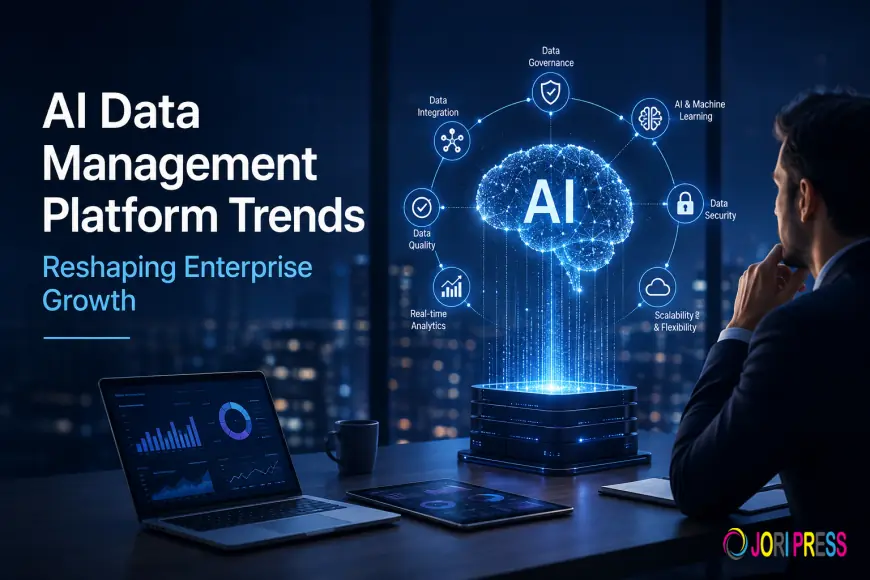
AI Data Management Platform Trends Reshaping Enterprise Growth
This is the exact problem that a well-designed AI data management platform is built to solve. Rather than treating data as a static asset that sits in a warehouse, these systems treat it as a living resource that can be cleaned, classified, connected, and put to work automatically.

Introduction
Every organization today generates more information than it can realistically process on its own. Spreadsheets multiply, cloud storage bills climb, and teams spend hours hunting for a single accurate record instead of acting on it. This is the exact problem that a well-designed AI data management platform is built to solve. Rather than treating data as a static asset that sits in a warehouse, these systems treat it as a living resource that can be cleaned, classified, connected, and put to work automatically. Companies that once relied on manual spreadsheets and disconnected databases are now turning to intelligent systems that learn from usage patterns and surface insights before a human even asks the question. This shift is not a passing trend; it reflects a fundamental change in how businesses think about information as a competitive asset rather than a back-office chore.
The Shift Toward Intelligent Data Ecosystems
A decade ago, data management largely meant storage and backups. Today, the expectation is far higher. Decision makers want systems that can ingest information from dozens of sources, reconcile inconsistencies, and present a single trustworthy version of the truth. An AI data management platform achieves this by combining machine learning models with traditional governance rules, so the system does not just store records but actively improves their quality over time. Duplicate entries get flagged automatically, missing fields get suggested based on historical patterns, and anomalies that once required a dedicated analyst are caught within seconds. This is why so many mid-sized and large enterprises are rebuilding their data infrastructure around intelligent automation rather than bolting a few scripts onto legacy databases.
Why Smarter Data Strategies Matter Now
Regulatory pressure, customer expectations, and the sheer volume of digital interactions have made sloppy data practices too costly to ignore. A single inaccurate customer record can trigger a failed marketing campaign, a compliance violation, or a lost sale. Businesses that adopt a modern ai data management platform gain the ability to trace where every piece of information originated, how it was transformed, and who accessed it along the way. That level of transparency used to require entire compliance teams working around the clock. Now, much of that oversight happens continuously in the background, freeing employees to focus on strategy instead of spreadsheet forensics. Investors and boardrooms have also started asking harder questions about data readiness, particularly as more companies experiment with generative tools that depend entirely on clean, well-labeled inputs.
Core Capabilities That Define Modern Systems
What separates a genuinely useful platform from a glorified database is the depth of intelligence built into everyday operations. Strong systems can classify sensitive information automatically, apply retention policies without manual intervention, and route data to the right team based on context rather than rigid folder structures. Natural language search has also become a baseline expectation, allowing non-technical staff to ask plain questions and receive accurate answers instead of navigating complicated query builders. Predictive quality scoring is another feature gaining traction, where the system estimates how reliable a dataset is before anyone builds a report on top of it. Together these capabilities turn what used to be a passive storage layer into an active partner in daily decision making, which is precisely the value proposition behind a capable ai data management platform.
Choosing the Right Solution for Long Term Success
Selecting a system is rarely just a technical decision; it is a strategic one that affects every department that touches customer or operational data. Leaders should look closely at how well a vendor's architecture integrates with existing tools, since a platform that requires ripping out established workflows often creates more disruption than value. Scalability matters just as much, because the data volume a company handles today is rarely what it will handle in three years. Security certifications, audit trails, and clear documentation on how models are trained deserve equal attention, particularly for industries bound by strict privacy regulations. Organizations that take the time to pilot a solution with a real, messy dataset rather than a polished demo tend to make far better long-term choices, since that approach reveals how the system behaves under genuine operational pressure.
Real World Impact Across Industries
Healthcare providers use intelligent data systems to reconcile patient records across multiple facilities, reducing errors that once stemmed from fragmented charts. Retailers rely on similar technology to unify inventory and customer behavior data, allowing for pricing and stocking decisions that respond to demand in near real time. Financial institutions apply these platforms to detect irregular transaction patterns long before a manual audit would catch them. Even smaller businesses are finding accessible entry points, since many providers now offer modular pricing that scales with company size rather than demanding an enterprise-level commitment from day one. Across every sector, the common thread is the same: organizations that trust their data make faster, more confident decisions than those still second-guessing spreadsheets.
Looking Ahead
The next phase of this evolution will likely blur the line between data management and everyday business intelligence entirely. As models become better at understanding context, the tools people use to store information will increasingly double as the tools they use to act on it. Companies that invest early in a dependable data foundation will be far better positioned to adopt future innovations without costly rework. Those still relying on manual processes may find themselves spending more time cleaning data than actually using it. For any organization serious about staying competitive, building around a capable data platform is no longer optional groundwork; it is becoming the operational backbone that everything else depends on.
What's Your Reaction?
 Like
0
Like
0
 Dislike
0
Dislike
0
 Love
0
Love
0
 Funny
0
Funny
0
 Angry
0
Angry
0
 Sad
0
Sad
0
 Wow
0
Wow
0