





































Why Industries Are Upgrading to RS232 & RS485 to Ethernet Converters
Learn why industries are choosing the RS232 RS485 Ethernet Converter to connect legacy serial devices with modern Ethernet networks efficiently.

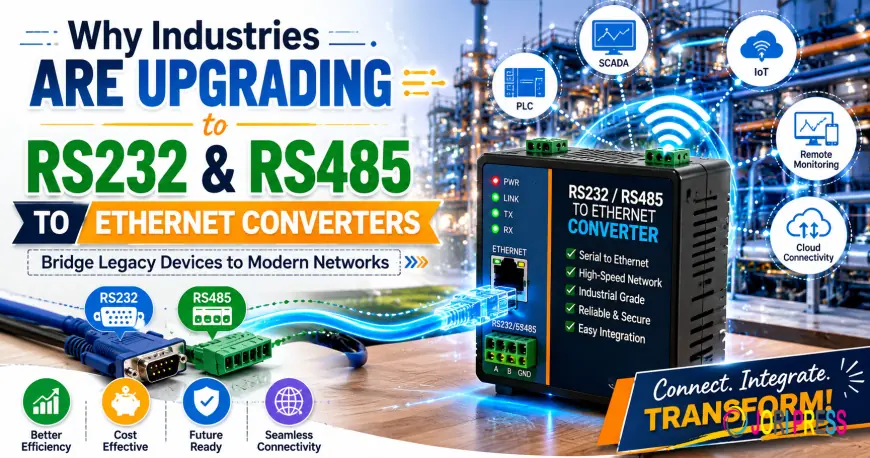
Industrial automation is evolving at an unprecedented pace. As manufacturers, utilities, logistics providers, and infrastructure operators embrace Industry 4.0, the Industrial Internet of Things (IIoT), and edge computing, there is a growing need to connect legacy serial devices with modern Ethernet-based networks. While many industrial machines still rely on RS232 and RS485 communication protocols, today's operational environments demand faster data access, remote monitoring, centralized control, and seamless integration with cloud platforms.
Replacing every legacy device with new Ethernet-enabled equipment is often expensive and disruptive. Instead, industries are increasingly turning to RS232 & RS485 to Ethernet Converters as a practical and cost-effective solution. These converters bridge the gap between traditional serial communication and modern IP networks, allowing existing equipment to remain operational while benefiting from advanced networking capabilities.
Whether it's a factory floor, power plant, water treatment facility, smart building, or transportation system, Ethernet converters are helping organizations modernize their infrastructure without replacing valuable industrial assets.
Understanding RS232 and RS485 Communication
Before exploring Ethernet converters, it's important to understand the two serial communication standards they support.
What Is RS232?
RS232 is one of the oldest and most widely used serial communication standards. It is commonly used for point-to-point communication between two devices.
Key Features of RS232
-
Point-to-point communication
-
Short-distance transmission (typically up to 15 meters)
-
Simple wiring
-
Easy implementation
-
Widely used in legacy equipment
Common RS232 Devices
-
Barcode scanners
-
Industrial printers
-
CNC machines
-
Medical equipment
-
POS terminals
-
Laboratory instruments
-
Serial modems
What Is RS485?
RS485 is designed for industrial environments where multiple devices need to communicate over long distances.
Key Features
-
Multi-drop communication
-
Long-distance transmission (up to approximately 1,200 meters)
-
High noise immunity
-
Differential signaling
-
Supports multiple devices on one communication bus
Common RS485 Devices
-
PLCs
-
Energy meters
-
Variable Frequency Drives (VFDs)
-
Human Machine Interfaces (HMIs)
-
Industrial sensors
-
HVAC controllers
-
Building automation systems
What Is an RS232 & RS485 to Ethernet Converter?
An RS232 & RS485 to Ethernet Converter is a networking device that enables serial communication equipment to connect to an Ethernet or TCP/IP network.
Instead of replacing legacy serial devices, the converter allows them to communicate through standard Ethernet infrastructure.
The converter acts as a bridge by:
-
Receiving serial data
-
Converting it into Ethernet packets
-
Transmitting the data over the network
-
Receiving Ethernet data
-
Converting it back into serial communication
This enables older equipment to participate in modern networked systems.
Why Industries Are Upgrading to Ethernet Converters
1. Protecting Existing Investments
Many industrial facilities operate machinery that has been reliable for decades.
Replacing:
-
PLCs
-
CNC machines
-
Controllers
-
Monitoring systems
-
Measurement equipment
can involve significant costs and production downtime.
An Ethernet converter allows organizations to continue using proven equipment while integrating it into modern networks.
Benefits
-
Lower capital expenditure
-
Extended equipment lifespan
-
Reduced downtime
-
Faster modernization
2. Supporting Industry 4.0 Initiatives
Industry 4.0 relies on connected devices that exchange data in real time.
Ethernet converters help legacy serial equipment participate in:
-
Smart manufacturing
-
Predictive maintenance
-
Data analytics
-
Cloud computing
-
Industrial IoT
Without replacing existing machines.
3. Enabling Remote Monitoring
Traditional serial communication limits monitoring to local connections.
Ethernet connectivity enables:
-
Remote diagnostics
-
Centralized monitoring
-
Web-based management
-
Mobile access
-
Off-site troubleshooting
This reduces maintenance costs and improves response times.
4. Improving Operational Efficiency
Centralized communication simplifies industrial operations.
Instead of technicians visiting individual machines, operators can monitor multiple devices from a control room.
Benefits include:
-
Faster decision-making
-
Reduced maintenance time
-
Improved productivity
-
Better resource utilization
5. Long-Distance Communication
Serial communication has physical limitations.
Ethernet networks overcome these challenges by enabling communication across:
-
Buildings
-
Campuses
-
Industrial plants
-
Warehouses
-
Multiple production lines
When integrated with routers and switches, devices can even be monitored across cities or countries through secure networks.
6. Simplifying Network Expansion
As industrial facilities grow, adding more serial cables becomes increasingly difficult.
Ethernet infrastructure offers:
-
Easy scalability
-
Standard network architecture
-
Flexible device placement
-
Simplified expansion
New devices can often be added with minimal changes to the existing network.
7. Better Data Accessibility
Ethernet converters allow operational data to be shared with:
-
SCADA systems
-
Manufacturing Execution Systems (MES)
-
Enterprise Resource Planning (ERP) software
-
Cloud dashboards
-
Industrial databases
This enables informed decision-making based on real-time information.
8. Enhanced Reliability
Industrial-grade Ethernet converters are built for demanding environments.
They often include:
-
Surge protection
-
Electrical isolation
-
Wide operating temperature ranges
-
Metal enclosures
-
Watchdog timers
-
Stable power management
These features ensure dependable operation in factories and outdoor installations.
9. Reduced Maintenance Costs
Remote access enables engineers to:
-
Diagnose faults
-
Update configurations
-
Monitor device status
-
Identify communication issues
without physically visiting the equipment.
This lowers travel costs and minimizes downtime.
10. Future-Proofing Industrial Infrastructure
Upgrading to Ethernet connectivity prepares facilities for future technologies such as:
-
Artificial Intelligence (AI)
-
Digital Twins
-
Edge Computing
-
Cloud Analytics
-
Smart Factories
-
IIoT Platforms
Organizations can modernize incrementally rather than replacing entire systems at once.
Key Features of Modern RS232 & RS485 to Ethernet Converters
Today's converters offer far more than protocol conversion.
Dual Serial Support
Many models support both:
-
RS232
-
RS485
allowing one device to communicate with a wide range of industrial equipment.
Multiple Communication Modes
Supported modes often include:
-
TCP Server
-
TCP Client
-
UDP
-
Virtual COM Port
-
Modbus Gateway
-
Transparent Transmission
These options provide flexibility for diverse industrial applications.
Web-Based Configuration
Most modern converters feature browser-based management interfaces, making configuration and monitoring straightforward.
Secure Network Communication
Advanced models support:
-
Password protection
-
User authentication
-
Encrypted communication
-
Access control
to improve cybersecurity.
DIN Rail Mounting
Industrial converters are commonly designed for DIN rail installation, enabling quick integration into control cabinets.
LED Status Indicators
Indicators display:
-
Power status
-
Ethernet activity
-
Serial communication
-
Error conditions
This simplifies troubleshooting and maintenance.
Industries Benefiting from Ethernet Converters
Manufacturing
Applications include:
-
Machine monitoring
-
PLC communication
-
Production data collection
-
Predictive maintenance
Energy and Utilities
Used for connecting:
-
Smart meters
-
Power analyzers
-
Solar inverters
-
Battery management systems
Oil and Gas
Support remote monitoring of:
-
Pipelines
-
Compressors
-
Pumps
-
Field instrumentation
Water and Wastewater
Ethernet converters connect:
-
Flow meters
-
Pump controllers
-
Pressure sensors
-
Water quality monitoring equipment
Building Automation
Commonly integrated with:
-
HVAC systems
-
Lighting controllers
-
Elevators
-
Security systems
Transportation
Applications include:
-
Railway signaling
-
Traffic control systems
-
Toll management
-
Fleet monitoring
Healthcare
Medical facilities use Ethernet converters to network:
-
Diagnostic equipment
-
Laboratory analyzers
-
Environmental monitoring systems
Integration with Modern Technologies
Industrial IoT (IIoT)
Converters act as gateways between legacy serial devices and IoT platforms, enabling real-time data collection and analysis.
Edge Computing
By connecting serial devices to edge gateways, data can be processed locally, reducing latency and improving response times.
Cloud Platforms
Ethernet-enabled devices can securely transmit operational data to cloud services for storage, visualization, and analytics.
Artificial Intelligence
AI systems analyze data collected through Ethernet converters to support predictive maintenance, anomaly detection, and process optimization.
Best Practices for Deployment
To achieve reliable performance:
-
Choose industrial-grade converters with appropriate environmental ratings.
-
Verify compatibility with your serial devices and communication protocols.
-
Use quality Ethernet and serial cables.
-
Configure unique IP addresses for each converter.
-
Implement secure authentication and network segmentation.
-
Regularly update firmware to address security vulnerabilities and improve functionality.
-
Document device configurations and network topology for easier maintenance.
Common Challenges and Solutions
|
Challenge |
Solution |
|
Legacy device compatibility |
Verify supported serial standards and protocols before deployment. |
|
Network security |
Use secure passwords, firewalls, and VLANs to protect industrial networks. |
|
Communication errors |
Check baud rate, parity, stop bits, and cable quality. |
|
Electrical interference |
Use isolated converters and shielded cables where appropriate. |
|
IP address conflicts |
Assign unique static IP addresses or manage them through DHCP reservations. |
Future Trends
The next generation of RS232 & RS485 to Ethernet converters is expected to include:
-
Built-in AI diagnostics
-
Enhanced cybersecurity features
-
Edge computing capabilities
-
Support for industrial Ethernet protocols
-
Remote firmware updates
-
Cloud-native management platforms
-
Energy-efficient operation
-
Integration with digital twin ecosystems
These innovations will further simplify industrial connectivity while enhancing reliability and scalability.
Choosing the Right RS232 & RS485 to Ethernet Converter
When selecting a converter, evaluate the following factors:
|
Feature |
Why It Matters |
|
RS232 and RS485 Support |
Enables compatibility with a wide range of legacy devices. |
|
Industrial-Grade Design |
Ensures reliable operation in harsh environments. |
|
Isolation Protection |
Protects equipment from voltage spikes and ground loops. |
|
Communication Modes |
Supports different application requirements, such as TCP, UDP, and Modbus. |
|
Configuration Options |
Simplifies setup and ongoing management. |
|
Security Features |
Helps safeguard industrial networks from unauthorized access. |
|
Operating Temperature |
Ensures reliable performance in challenging conditions. |
|
Mounting Options |
Facilitates easy installation in industrial control panels. |
Conclusion
As industries accelerate their digital transformation journeys, the need to connect legacy serial equipment with modern Ethernet networks has become increasingly important. RS232 & RS485 to Ethernet Converters provide a practical, cost-effective, and scalable solution that enables organizations to preserve their existing investments while unlocking the benefits of connected industrial systems.
By enabling remote monitoring, centralized control, seamless integration with SCADA, MES, ERP, cloud platforms, and IIoT applications, these converters improve operational efficiency, reduce maintenance costs, and prepare facilities for future technologies such as AI, edge computing, and predictive maintenance.
Whether deployed in manufacturing, energy, water treatment, transportation, healthcare, or building automation, RS232 & RS485 to Ethernet converters play a vital role in bridging the gap between proven legacy equipment and modern digital infrastructure. Investing in the right converter today helps ensure a smoother transition toward smarter, more connected, and future-ready industrial operations.
What's Your Reaction?
 Like
0
Like
0
 Dislike
0
Dislike
0
 Love
0
Love
0
 Funny
0
Funny
0
 Angry
0
Angry
0
 Sad
0
Sad
0
 Wow
0
Wow
0