










































How a DG & Turbine Acoustic Enclosure Reduces Noise Pollution at Industrial Sites
A DG & turbine acoustic enclosure is a sound-attenuating housing that cuts generator and turbine noise to meet site limits. Learn standards and specs.
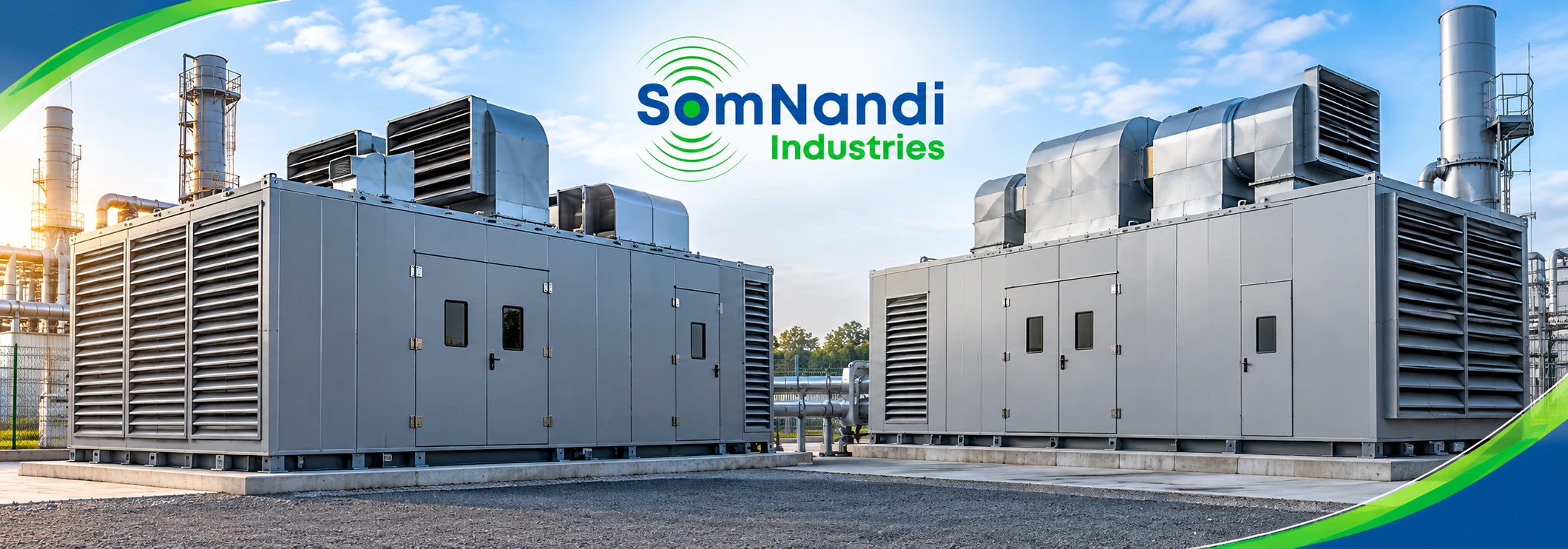
A DG & turbine acoustic enclosure is a purpose-built housing that contains the noise of diesel generator sets and gas or steam turbines. It lets a site meet permissible noise limits without compromising airflow or cooling. In India, the main references are the Noise Pollution (Regulation and Control) Rules, 2000, CPCB limits for DG sets, and measurement standards such as ISO 8528-10 and ISO 3744.
What the term means
“Acoustic” comes from the Greek akoustikos, meaning “of hearing.” “Enclosure” comes from the Old French enclore, to shut in. Together they describe a structure that shuts sound in.
A DG & turbine acoustic enclosure is an engineered, ventilated housing that absorbs, blocks and damps airborne noise from a power-generating machine so that the sound level outside meets a defined limit.
A simple way to think about it
Shout in an empty hall with bare walls, and the sound bounces back at you. Shout in a room with thick curtains, carpets and a closed door, and most of it disappears. An acoustic enclosure applies both effects. Dense outer panels keep sound from passing through, and absorbent lining inside stops it reflecting around and building up.
The difficulty is that a generator can’t be sealed like a quiet room. It needs air to breathe and cool itself, so designers add acoustic louvres and silencers that let air through while reducing sound.
Where these enclosures are used
Power generation, oil and gas, data centres, hospitals, telecom towers, manufacturing plants, commercial buildings, construction sites and infrastructure projects all depend on them. Different sites face different rules. A hospital or residential-adjacent facility works to a far stricter ambient limit than a heavy industrial zone, so the same engine may need a lighter enclosure in one place and a high-attenuation design in another. Fuel type, machine size and location, such as rooftop, basement or open yard, also shape the configuration.
Types and common uses
The main configurations are canopy-type enclosures for DG sets, container-type enclosures for portable or temporary power, walk-in enclosures for larger gensets, gas turbine enclosures, steam turbine enclosures, acoustic ventilation and exhaust silencing systems, and retrofit enclosures for existing machines. Canopies suit most standby generators, while turbine enclosures usually add fire detection, suppression and stronger ventilation, since the heat load is higher.
Standards and typical specifications
For permissible ambient noise, India’s 2000 Rules set daytime limits of about 75 dB(A) in industrial areas, 65 dB(A) in commercial areas and 55 dB(A) in residential areas, with lower night-time limits. CPCB norms for DG sets require the enclosure to meet an insertion-loss target and a sound level of around 75 dB(A) at 1 metre from the enclosure surface. ISO 8528-10 covers airborne noise measurement for generating sets, ISO 3744 covers sound power determination, and ISO 11546 covers enclosure insertion loss. For worker exposure, OSHA and NIOSH guidance (90 and 85 dB(A) over an 8-hour shift) often drives internal limits near turbines.
In practice, a well-designed DG enclosure typically achieves 25–35 dB(A) insertion loss, assessed across octave bands from roughly 63 Hz to 8 kHz. Turbine enclosures are commonly specified to bring noise to the mid-80s dB(A) or lower at 1 metre, depending on the project.
CORE TECHNOLOGY: ABSORPTION, BARRIER AND AIRFLOW
Three elements do the work. The outer shell, usually 1.5–2 mm CRCA or galvanised steel, provides the mass that blocks sound transmission. The inner lining, typically 50–100 mm of high-density rockwool (around 80–100 kg/m³) behind a perforated sheet with a protective facing, absorbs sound energy. The acoustic louvres and attenuators let air in and out while limiting noise leakage.
Low frequencies are the hardest to control, because long wavelengths pass through thin panels easily. That is why thicker infill and longer attenuator splitters matter for larger sets.
One practical tip: don’t size the enclosure for noise alone. Verify the cooling airflow and the allowable back pressure at the engine’s worst-case ambient temperature. An enclosure that meets the dB(A) target but starves the engine of air will cause derating and nuisance shutdowns. Ask for airflow calculations alongside the acoustic test report, and leave room around the set for maintenance access.
Choosing the right solution
Are you in the process of installing or choosing acoustic enclosures, an acoustic enclosure for a DG set, a DG acoustic enclosure, an acoustic DG set or a soundproof enclosure? Don’t hesitate to contact us. Our account managers and technical experts can help even if you’re unsure what you need. Share your machine rating, site location and applicable noise limit, and we can help you narrow down the configuration.
What's Your Reaction?
 Like
0
 Dislike
0
 Love
0
 Funny
0
 Angry
0
 Sad
0
 Wow
0