


































Why Your Business Is Invisible in ChatGPT and Google AI Overviews: A Bauer Bodoni Diagnostic
This guide explains why a business may be missing from ChatGPT, Google AI Overviews, Gemini, and other AI search experiences. It gives business owners a simple visibility self-test, identifies four common causes of poor AI visibility, and provides an ordered action plan covering business identity, quotable content, reviews, third-party mentions, and content freshness.
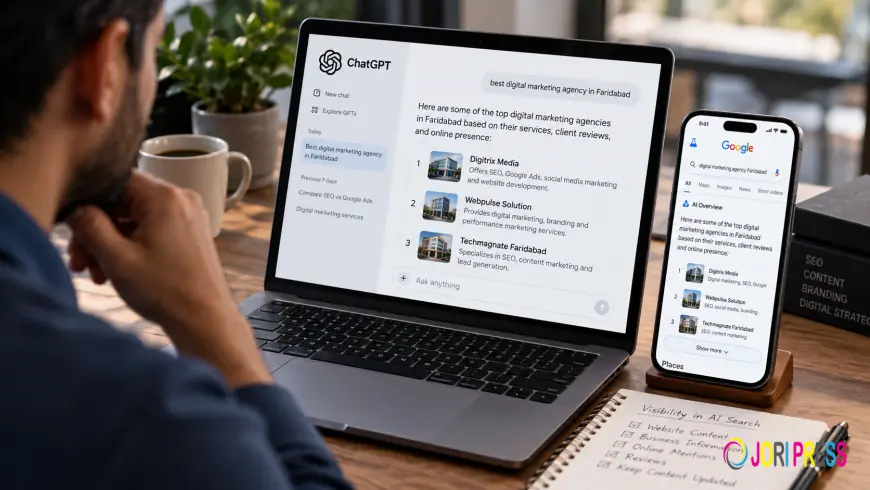
Picture a customer asking ChatGPT to recommend a digital marketing agency in Faridabad. Three competitors get named. Your business does not. That is what being invisible in AI search feels like, and at bauer bodoni we are hearing about it more every month. bauerbodoni.com
AI Overviews now appear on roughly half of Google searches, and tools like ChatGPT, Gemini, and Perplexity answer questions directly instead of sending people to websites. When the answer names your competitor and not you, you have lost business you will never know about. The good news: invisibility usually has specific, fixable causes, and this guide walks you through a self-test, the most common reasons, and what to fix first.
Run the Five-Minute Visibility Self-Test
Before fixing anything, find out where you stand. Open ChatGPT, Gemini, or Perplexity and ask three questions the way a customer would: a recommendation ("best digital marketing agency in Faridabad"), a comparison ("X vs Y" in your category), and a factual one about your own business ("what services does [your business name] offer"). Note who gets named and whether you appear at all. Then run the same searches on Google and check whether an AI Overview appears and which sources it cites. If competitors show up consistently and you do not, you have a visibility problem worth diagnosing.
Reason 1: Your Pages Never Say Anything Quotable
AI answers are assembled from passages the system can lift and cite, and many business websites give it nothing to lift. Homepages open with throat-clearing about passion and excellence; service pages describe everything in adjectives; the actual answer sits halfway down, wrapped in marketing language.
The fix is structural. Put the direct answer near the top of each important page, in plain sentences, then expand with detail below. A local SEO page should open by saying what local SEO includes and who it is for, before any background. Pages built this way serve human readers better too, which is why this fix rarely has a downside.
Reason 2: Machines Cannot Tell What Your Business Actually Is
An AI system builds its picture of your business from scattered signals: your About page, your Google Business Profile, directory listings, mentions on other sites. When those signals disagree, it trusts none of them. The name is spelled three ways across five listings; the address on the website does not match the map listing; the About page says "we are a leading provider of innovative solutions," which could describe ten thousand companies.
Audit this the way a machine would. Make your name, address, and phone number identical everywhere, and rewrite vague descriptions into specific ones: what you sell, whom you serve, and where. Concrete facts beat adjectives every time, for AI systems and humans alike.
Reason 3: Nobody Else on the Internet Mentions You
AI answers lean heavily on independent sources: reviews, directory listings, press mentions, and citations on other sites all tell the system a business is real and regarded. A company with no footprint beyond its own website looks unverified, no matter how good that website is.
This is the slowest cause to fix and the most durable once fixed. Start with what you control: a complete, actively maintained Google Business Profile, accurate listings on the directories that matter in your industry, and a steady habit of earning and responding to reviews. Then look outward: useful content under your brand name, industry conversations, and local press all create the third-party mentions AI systems treat as evidence.
Reason 4: Your Content Looks Stale or Unverifiable
Systems that generate answers prefer content that looks current and checkable. A blog whose latest post is from 2022, statistics with no named source, and claims like "trusted by hundreds" with nothing behind them all signal the same thing: quote someone else instead.
You do not need to publish daily. You need a site that looks maintained: recent updates on key pages, specific facts instead of rounded claims, and named sources where a claim depends on data. Freshness and verifiability consistently predict which pages get cited, and they are exactly what human visitors look for too.
What to Fix First, in Order
Work in this sequence. First, make your business identity consistent everywhere: name, address, phone, and a complete Google Business Profile. Nothing else compounds until the machine knows who you are. Second, rewrite the openings of your five most important pages so each states its answer directly. Third, add genuine FAQ sections with direct answers on service pages, using proper FAQ markup. Fourth, start a review habit: ask satisfied customers, make it easy with a direct link, and reply to every review. Fifth, build third-party mentions over time through useful content and local visibility work. Most businesses that work this list for a quarter see movement, though no one can promise a timeline.
Frequently Asked Questions
Is AI search replacing Google?
No. AI answers sit on top of traditional search. Ranking still matters, because AI systems prefer citing pages that already rank well. What changed is that ranking alone is no longer enough: citation inside the answer is now its own contest.
How long before fixes show up in AI answers?
No fixed timeline exists. Structural fixes like consistent business information can register within weeks; citation patterns from new content typically build over months. Treat it as compounding work, not a switch you flip.
Do I need new software or tools to fix this?
No. The highest-leverage fixes are editorial and operational: clearer pages, consistent listings, active reviews, and maintained content. Tools can help you monitor mentions, but none of them substitute for the underlying work.
Should small businesses care about this yet?
Yes, especially local ones. AI answers increasingly handle "best X near me" questions, which is exactly where small businesses win or lose. Sort out visibility now, and yours will be the name in those answers later.
Conclusion
Being invisible in AI search is rarely bad luck. It comes down to four diagnosable causes: pages with nothing quotable, an identity machines cannot pin down, no independent mentions, and stale or unverifiable content. Run the self-test, work the fixes in order, and recheck in a few months.
If competitors keep appearing where you do not, that is a concrete problem worth solving properly. bauerbodoni can run a full AI-visibility diagnostic: what the answer engines currently say about you, where the gaps are, and which fixes move the needle first.
What's Your Reaction?
 Like
0
Like
0
 Dislike
0
Dislike
0
 Love
0
Love
0
 Funny
0
Funny
0
 Angry
0
Angry
0
 Sad
0
Sad
0
 Wow
0
Wow
0