


































How Virtual IBANs Solve Payment Reconciliation Problems for Growing Businesses
Learn how virtual IBANs simplify payment reconciliation for growing businesses by improving payment tracking, reducing manual matching and supporting multi-currency collections.
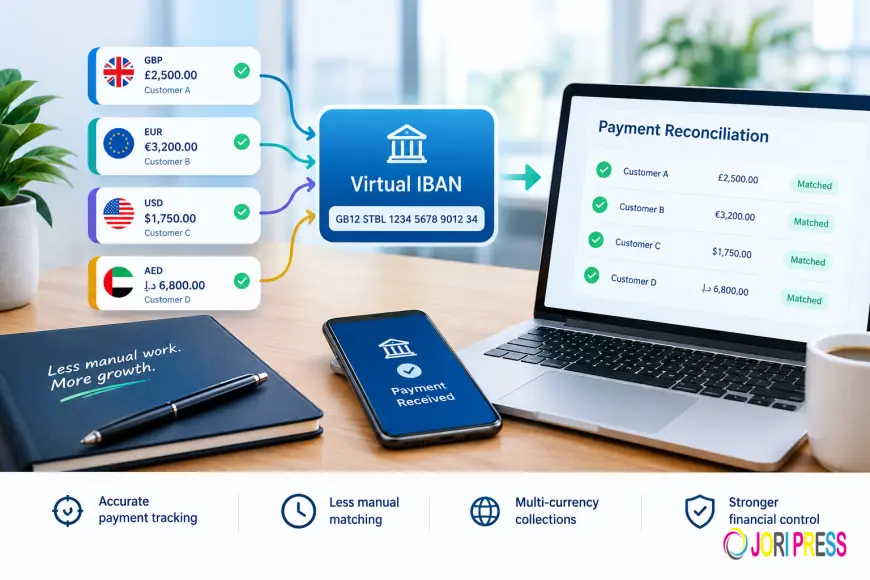
A finance team that receives forty payments a week from customers across three currencies shouldn't need to guess who sent what. A virtual IBAN solves this by assigning a distinct account identifier to each customer or payment stream before the money ever arrives, instead of leaving the business to work it out from a payment reference. Without that kind of system, payment reconciliation becomes a manual exercise: opening statements, matching amounts to invoices, and chasing missing references.
Why reconciliation breaks down at volume
Reconciliation problems rarely come from one large error. They come from volume: dozens of incoming transfers a month, each carrying a payment reference a customer typed incorrectly, left blank, or formatted differently than the finance system expects. StableOne notes that 60 percent of cross-border businesses run four or more banking relationships just to keep local collections and payouts alive, and every added relationship brings its own reconciliation workload, its own statement format, and its own manual matching process. Using a virtual IBAN for business collections removes the dependency on that reference field. Because the identifier itself, not a note attached to the payment, tells the business who paid, matching happens at the account level rather than the transaction level, and finance teams stop chasing senders to explain unmatched transfers or reissue instructions when a reference gets dropped.
What to verify before choosing a provider
The reconciliation benefit is genuine, but it depends on how the underlying account structure is built, and that varies by provider. The European Banking Authority's 2024 review of virtual IBAN issuance across the EU found the market lacks a single legal definition, which has left national regulators applying different rules to functionally similar products. The report flagged risks that matter directly to a business choosing a provider: end users who aren't holders of the underlying master account may not receive the same protections as a standard payment account holder, and weak visibility into fund segregation can slow a regulator's ability to supervise the arrangement. None of this makes virtual IBANs unsafe. It means the reconciliation convenience shouldn't be evaluated on its own. Before signing up, a business should confirm who holds the licence, how client funds are segregated from operating funds, and which authority supervises the virtual IBAN provider, rather than assuming that speed of setup and clean account numbers are the whole story.
About StableOne
StableOne issues named virtual IBANs in USD, EUR, GBP, and AED, with each identifier mapped to a single customer, merchant, or programme rather than shared across a master account. Payments settle through local rails, including ACH, SEPA, Faster Payments, and IPP, alongside SWIFT for other corridors, and client funds are held separately from operating funds. StableOne, trading as ATLPay Inc., is registered with FINTRAC as a money services business and supervised by the Bank of Canada as a Payment Service Provider under the Retail Payment Activities Act, giving named account holders clear payment reconciliation at the account level, with statements exportable for internal review.
What's Your Reaction?
 Like
0
Like
0
 Dislike
0
Dislike
0
 Love
0
Love
0
 Funny
0
Funny
0
 Angry
0
Angry
0
 Sad
0
Sad
0
 Wow
0
Wow
0