









































Top Features of Reliable XRD Testing Labs in India
Discover the top features of reliable XRD Testing Labs in India, including advanced equipment, accurate analysis, expert support, and detailed reports.

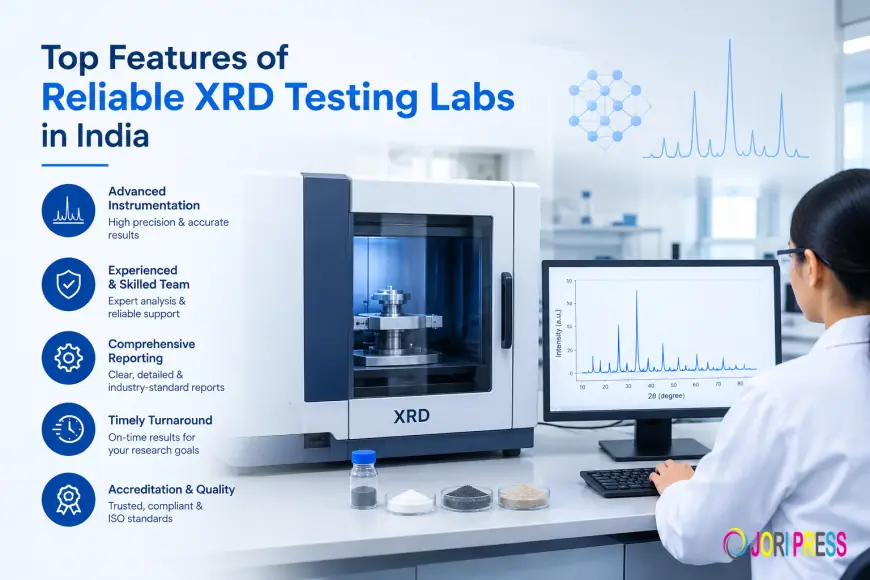
X-ray diffraction (XRD) testing is an important analytical technique used to identify crystalline materials, determine crystal structures, analyze phases, and understand the properties of various materials. From research laboratories and universities to manufacturing and industrial applications, XRD analysis can provide valuable information for material characterization and quality assessment.
However, the quality of an XRD analysis depends not only on the technique itself but also on the laboratory performing the testing. Choosing reliable XRD Testing Labs in India can help researchers and businesses obtain consistent, meaningful, and technically useful results.
In this blog, we explore the key features to consider when selecting an XRD testing laboratory in India.
1. Modern XRD Testing Equipment
One of the first features to consider is the quality and capability of the laboratory's XRD equipment.
Reliable laboratories generally use modern X-ray diffractometers that can support different types of material characterization. Depending on the testing requirements, the instrument may offer capabilities such as:
-
Phase identification
-
Crystallinity analysis
-
Crystal structure determination
-
Quantitative phase analysis
-
Lattice parameter measurement
-
Thin-film analysis
-
Residual stress analysis
Advanced equipment can provide better flexibility for handling different sample types and analytical requirements.
2. Experienced Technical Professionals
XRD testing requires more than simply operating an instrument. Proper sample preparation, instrument configuration, data collection, and interpretation can significantly influence the results.
Reliable XRD Testing Labs in India should have trained technical professionals who understand:
-
XRD principles
-
Sample preparation techniques
-
Instrument operation
-
Diffraction patterns
-
Phase identification
-
Data interpretation
-
Appropriate testing parameters
Experienced professionals can also help clients determine the appropriate testing approach based on their material and research objectives.
3. Proper Sample Preparation Facilities
Sample preparation is an important part of XRD analysis. Improper preparation can introduce unwanted variations into diffraction patterns and affect the interpretation of results.
A capable laboratory should have suitable facilities and procedures for preparing different materials, including:
-
Powders
-
Bulk solids
-
Thin films
-
Coatings
-
Ceramics
-
Metals
-
Minerals
-
Polymers containing crystalline phases
-
Nanomaterials
The laboratory should also provide clear instructions regarding sample quantity, dimensions, condition, and preparation requirements before testing.
4. Accurate Phase Identification
One of the major applications of XRD is identifying crystalline phases within a material.
Reliable laboratories should have appropriate databases and analytical software to compare measured diffraction patterns with reference data. This can help determine which crystalline phases are present in a sample.
Accurate phase identification can be useful for applications such as:
-
Material verification
-
Raw-material characterization
-
Failure analysis
-
Research and development
-
Product quality assessment
-
Mineral identification
-
Ceramic characterization
5. Comprehensive Data Analysis
Collecting an XRD pattern is only one part of the testing process. Proper analysis of the data is equally important.
Depending on the project requirements, laboratories may provide analysis related to:
-
Peak identification
-
Phase composition
-
Crystallite size
-
Lattice parameters
-
Degree of crystallinity
-
Unit-cell information
-
Quantitative phase analysis
-
Peak position and intensity
Before selecting a laboratory, it is useful to confirm which analytical outputs are included in the testing service.
6. Well-Defined Testing Procedures
Reliable laboratories should follow established testing procedures and maintain consistent workflows.
A well-defined process can include:
-
Sample receipt and inspection
-
Sample preparation
-
Instrument setup
-
Selection of testing parameters
-
Data acquisition
-
Data processing
-
Interpretation
-
Preparation of the final report
Consistent procedures can help improve repeatability and make results easier to compare across different samples or testing batches.
7. Suitable Testing Parameters
Different materials may require different XRD measurement conditions. Factors such as scanning range, step size, scan speed, radiation source, and sample characteristics can influence the resulting diffraction pattern.
A reliable laboratory should select appropriate parameters based on the material and testing objective rather than using the same settings for every sample.
This is particularly important when working with materials that have weak diffraction peaks, multiple phases, small crystallite sizes, or complex structures.
8. Clear and Detailed Test Reports
A professional XRD testing laboratory should provide a clear report that allows the customer to understand the results.
Depending on the testing scope, an XRD report may include:
-
Sample identification
-
Testing method
-
Instrument information
-
Testing conditions
-
XRD pattern
-
Peak information
-
Identified phases
-
Analytical results
-
Relevant observations
If additional interpretation is required, clients should confirm whether technical consultation or detailed analysis is included with the service.
9. Good Data Quality and Reproducibility
Consistency is important when XRD testing is used for research, product development, or quality control.
Reliable laboratories should maintain appropriate instrument calibration, testing procedures, and quality-control practices. Reproducible measurements can make it easier to compare results from:
-
Different batches
-
Different materials
-
Before-and-after processing
-
Different production stages
-
Repeated experiments
Researchers should ask about the laboratory's approach to instrument maintenance and quality assurance when selecting an XRD testing provider.
10. Experience Across Different Industries
XRD is used across a wide range of industries and research fields. A laboratory with experience handling diverse materials may be better prepared to address different testing requirements.
Common application areas include:
-
Pharmaceuticals
-
Metals and alloys
-
Ceramics
-
Cement and construction materials
-
Minerals and geology
-
Nanomaterials
-
Semiconductors
-
Energy materials
-
Polymers
-
Coatings and thin films
-
Academic research
When evaluating XRD Testing Labs in India, consider whether the laboratory has experience with materials similar to yours.
11. Flexible Testing Options
Different projects have different testing requirements. Some customers may only need phase identification, while others may require detailed structural analysis.
A laboratory offering flexible testing options can support different objectives, such as:
-
Qualitative XRD analysis
-
Quantitative phase analysis
-
Powder XRD
-
Thin-film XRD
-
Crystallinity studies
-
Crystallite-size estimation
-
Residual-stress analysis
-
Comparative analysis
Before submitting a sample, clearly communicate the purpose of the analysis so the laboratory can recommend the appropriate testing scope.
12. Transparent Communication
Communication is another important feature of a reliable testing laboratory.
The laboratory should clearly communicate information about:
-
Sample requirements
-
Testing methods
-
Expected turnaround time
-
Required documentation
-
Testing charges
-
Report format
-
Additional analysis options
Clear communication can reduce misunderstandings and help ensure that the testing process meets the project's requirements.
13. Reasonable Turnaround Time
Testing timelines can be important for research projects, product development, and industrial decision-making.
When comparing XRD Testing Labs in India, ask about the expected turnaround time before submitting samples. However, turnaround time should be considered together with testing scope and data quality rather than as the only selection factor.
For urgent projects, some laboratories may also offer expedited testing options depending on their workload and service availability.
14. Technical Support and Consultation
A laboratory that provides technical support can be particularly useful when the testing requirements are complex.
For example, customers may need assistance with:
-
Selecting an appropriate XRD method
-
Understanding sample preparation requirements
-
Interpreting diffraction patterns
-
Identifying unexpected phases
-
Comparing multiple samples
-
Understanding changes in crystallinity
Technical consultation can help researchers make better use of the information generated through XRD testing.
15. Confidentiality and Data Handling
Research and industrial samples can contain proprietary information. Therefore, customers should also consider how the laboratory manages sample information and test data.
Before sending sensitive samples, it can be useful to understand the laboratory's policies regarding:
-
Sample identification
-
Test-data storage
-
Confidentiality
-
Report access
-
Data sharing
-
Sample disposal
Clear data-handling procedures can provide additional confidence when working on proprietary research or commercial projects.
Why Choosing the Right XRD Testing Lab Matters
Selecting an appropriate XRD testing laboratory can influence the usefulness of the final analytical results. A laboratory with suitable equipment, trained professionals, proper sample preparation procedures, reliable data analysis, and clear reporting can provide more meaningful support for research and industrial applications.
Instead of selecting a laboratory based only on price, consider the complete testing process, including equipment capabilities, technical expertise, testing methodology, reporting, turnaround time, and communication.
Final Thoughts
XRD testing can provide valuable insights into the structure and composition of crystalline materials. However, obtaining useful results requires the right combination of equipment, expertise, sample preparation, testing parameters, data analysis, and reporting.
When evaluating XRD Testing Labs in India, look for laboratories that demonstrate technical capability, appropriate instrumentation, experienced professionals, transparent procedures, and dependable analytical support.
By considering these features before selecting a laboratory, researchers, manufacturers, and quality-control teams can choose an XRD testing service that aligns more closely with their specific material characterization requirements.
If you are looking for XRD testing services for material identification, phase analysis, crystallinity studies, or other characterization requirements, Lab AtoZ can help connect you with relevant laboratory resources and testing services in India.
What's Your Reaction?
 Like
0
Like
0
 Dislike
0
Dislike
0
 Love
0
Love
0
 Funny
0
Funny
0
 Angry
0
Angry
0
 Sad
0
Sad
0
 Wow
0
Wow
0