





































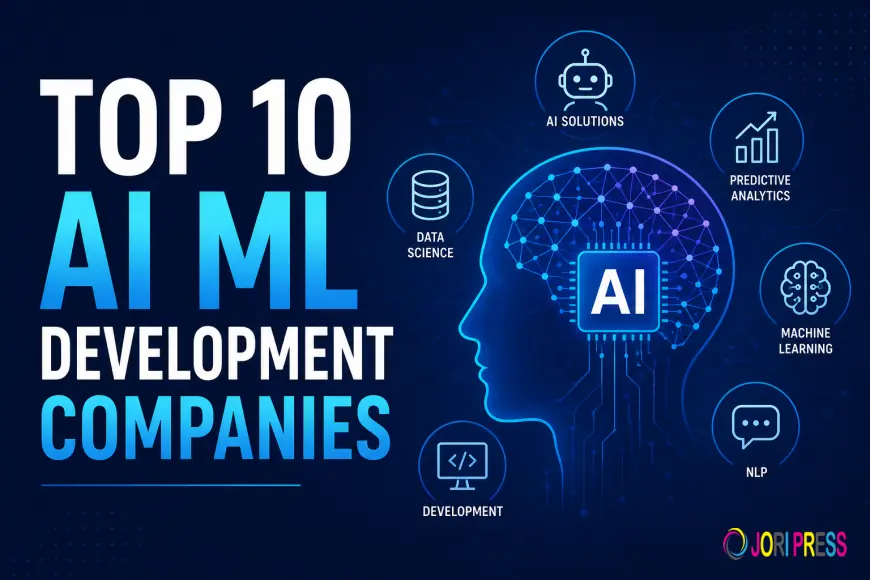
Top 10 AI and ML Development Companies to Watch in 2026
Discover the top 10 AI & ML development companies delivering custom generative AI, LLM integration, and predictive analytics. Compare expert reviews, portfolios, and pricing to choose the right partner.

Enterprise AI spending has moved well past the experimentation phase. Businesses across healthcare, finance, retail, and manufacturing are no longer asking whether to invest in machine learning and generative AI, they're asking who can actually build it, deploy it, and keep it running in production. That shift has flooded the market with vendors claiming AI expertise, which makes choosing an AI development company harder, not easier.
This list looks past marketing pages to focus on companies with verifiable delivery history: production deployments, named client work, technology partnerships, and service depth that spans strategy, model development, and MLOps rather than just prototype demos.
How This List Was Put Together
Each company below was evaluated on four criteria: how long they've operated in AI/ML specifically versus pivoting recently, whether they show evidence of production-grade deployments rather than proof-of-concept work, the breadth of their AI/ML services across consulting, model development, and MLOps, and their track record across multiple industries rather than a single niche. Founding years, headquarters, and client details are drawn from each company's own public profiles and verified third-party listings.
1. MindInventory
MindInventory has worked with global businesses on software and digital transformation since 2011, and over the past year has formalized AI and ML as a core practice rather than an add-on service. The company now runs AI and ML development services spanning AI copilots, autonomous and multi-agent systems, computer vision, NLP, and full ML pipelines from data engineering through MLOps, backed by more than 100 in-house AI, ML, and data science specialists and a recent Google Cloud partnership for production deployments.
What stands out is the domain specificity of its delivery work. A safety copilot built for a construction-site client cut on-site accidents by 59% through real-time hazard detection and multilingual alerts, and a claims-processing platform built for a US workers' compensation insurer used NLP automation to reduce processing time by 20%. MindInventory also engineered the AI-powered nutrition-tracking SDKs behind Passio.AI, which logs food intake through photo and barcode scanning with 97% accuracy. That combination of agentic AI capability, vertical depth across healthcare, finance, retail, and education, and documented production outcomes is why it tops this list.
2. ELEKS
ELEKS has been building enterprise software since 1991 out of Lviv, Ukraine, making it one of the most established engineering firms on this list. With more than 2,000 specialists across offices in the US, Canada, Poland, and the Middle East, ELEKS runs data science and AI practices alongside its core software engineering work, serving fintech, healthcare, energy, government, and logistics clients. Its strength lies less in flashy generative AI products and more in embedding machine learning into large, regulated enterprise systems where reliability and compliance matter as much as model accuracy.
3. Itransition
Founded in 1998, Itransition operates a global engineering team of roughly 3,000 people supporting clients in more than 40 countries, with five dedicated R&D labs feeding its AI and machine learning practice. The company has built AI-driven platforms for clients including PepsiCo and Expedia, and its AI consulting work tends to favor a structured, business-first approach: feasibility assessment and use-case prioritization before any model gets built. That makes Itransition a fit for enterprises that want rigor over speed.
4. Innowise
Innowise, headquartered in Warsaw with delivery centers across Europe, has grown since its founding in 2007 into a team of more than 3,000 engineers offering AI and ML development alongside staff augmentation and full-cycle software builds. Its AI/ML specializations include computer vision, NLP, and MLOps pipeline implementation, and the company reports a 93% returning-client rate, a meaningful signal in an industry where one-off engagements are common. Innowise tends to suit teams that want the flexibility to scale between dedicated AI engineering and embedded staff augmentation within the same engagement.
5. STX Next
STX Next built its reputation as Europe's largest Python-focused software house after launching in Poznań, Poland in 2005, and that Python heritage now underpins its AI, data engineering, and MLOps services. Following its 2024 merger with Brainhub, the company operates with more than 500 engineers and has delivered AI and data work for FinTech, AdTech, and eCommerce clients including Wunderman Thompson. Its AWS Advanced Tier partnership and ISO 27001 certification give it credibility for clients prioritizing security and cloud-native deployment.
6. Simform
Simform, founded in 2010 and now operating from Ahmedabad and Orlando, brands itself as a digital engineering company rather than a pure AI shop, which shows up in how it pairs AI/ML with cloud architecture and data engineering under one roof. As an AWS Premier Partner, Simform has built generative AI tools for research and customer-experience use cases, including a search platform that improved retrieval speed twentyfold for a client. Its client base spans fintech, healthcare and life sciences, and supply chain, and its co-engineering delivery model appeals to product teams that want an embedded partner rather than a hand-off vendor.
7. Azilen Technologies
Azilen Technologies has operated out of Ahmedabad, India since 2009 and has spent the last several years sharpening its focus specifically on enterprise AI, including a 2026 launch of a dedicated inference engineering practice and an edge AI framework combining TinyML with agentic systems for real-time industrial decisions. The company organizes its teams into industry-specific pods for sectors like HRTech, FinTech, and manufacturing rather than treating AI as a generic capability, and its recent AI agent platform for customer support, Azeon, reflects that production-first orientation.
8. InData Labs
InData Labs, founded in 2014, has built its identity around research-driven machine learning rather than off-the-shelf API integration, with particular strength in computer vision, NLP, and generative AI for finance, healthcare, marketing, and e-commerce clients. Its team includes data scientists with academic research backgrounds, which makes it a relevant option for businesses that need custom model development on proprietary data rather than a wrapper around existing large language models.
9. 10Clouds
10Clouds, based in Poland and founded in 2009, has built a name for combining AI development with strong product design, an unusual pairing in a field where engineering and UX often sit in separate teams. The company focuses heavily on AI-powered digital products and fintech platforms, and its agile, design-forward process tends to suit startups and growth-stage companies that need AI features shipped as part of a polished product rather than a backend capability bolted onto an existing system.
10. Markovate
Markovate has built its practice specifically around generative AI and agentic systems, working with clients across finance and banking, healthcare, insurance, construction, manufacturing, and retail to build AI agents, MLOps pipelines, and data engineering systems aimed at measurable ROI. Its narrower focus on generative and agentic AI, rather than the full spectrum of traditional ML, makes it a strong fit for organizations whose immediate priority is deploying copilots or autonomous workflows rather than building predictive models from scratch.
How to Choose the Right AI/ML Development Partner
The right company depends heavily on what stage of AI adoption a business is actually in. A business that hasn't yet validated which AI use cases are worth pursuing needs a partner strong in discovery and feasibility work, not one eager to start building models immediately. Some companies on this list, including MindInventory's AI development practice, build that discovery phase in formally, producing a data-readiness assessment before committing to a build, which protects budget from being spent on a use case the data can't actually support.
Beyond discovery, the questions worth asking any AI vendor are similar regardless of which company makes the shortlist. Has the team deployed models into production environments, not just delivered prototypes that never left a sandbox? Do they have engineers across the full stack, from data pipelines to MLOps to model monitoring, or only one piece of it? Can they point to outcomes in an industry similar to yours, where compliance, data sensitivity, or latency requirements actually resembled your own? A vendor that can answer those three questions with specifics, rather than general claims about being AI-first, is usually the safer bet.
Final Thoughts
The AI development market in 2026 has matured to the point where genuine engineering depth has become easy to tell apart from companies that pivoted into AI messaging without the underlying capability. The ten companies above each have a real, traceable track record, whether that's MindInventory's production deployments across construction, insurance, and consumer health, or ELEKS's three decades of enterprise engineering discipline. The best fit ultimately comes down to matching a vendor's specific strengths, whether that's agentic AI, MLOps maturity, or vertical domain expertise, against what your business actually needs built next.
What's Your Reaction?
 Like
1
Like
1
 Dislike
0
Dislike
0
 Love
0
Love
0
 Funny
0
Funny
0
 Angry
0
Angry
0
 Sad
0
Sad
0
 Wow
1
Wow
1