







































How Special Purpose Machine for Drilling Tapping Boosts Production
Learn how a Special Purpose Machine for Drilling Tapping boosts production, reduces cycle time and improves accuracy with MT Industries solutions.

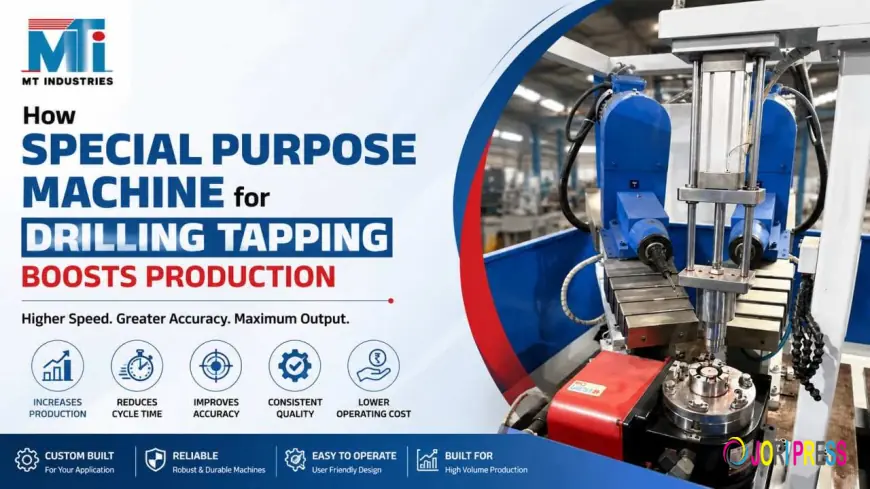
In modern manufacturing, production speed, consistency, and accuracy directly influence operational efficiency and profitability. Conventional drilling and tapping processes can become challenging when manufacturers need to produce large quantities of components with repeatable accuracy. This is where a Special Purpose Machine for Drilling Tapping can make a significant difference.
Unlike general-purpose machines designed to handle a wide range of operations, special purpose machines are engineered around specific production requirements. By integrating drilling, tapping, component positioning, and other operations into a customized system, manufacturers can reduce cycle time, improve consistency, and increase overall productivity.
For industries producing automotive components, engineering parts, electrical components, pumps, valves, and other precision products, selecting the right machine configuration can significantly improve the manufacturing process.
What Is a Special Purpose Machine for Drilling Tapping?
A Special Purpose Machine for Drilling Tapping is an industrial machine designed specifically to perform drilling and tapping operations according to the requirements of a particular component or production process.
The machine can be customized with multiple spindles, drilling heads, tapping units, fixtures, hydraulic or pneumatic systems, automatic component loading, and other mechanisms. Depending on the application, several holes can be drilled or tapped simultaneously.
The primary objective is simple: complete repetitive machining operations faster, more accurately, and with less manual intervention.
For example, instead of manually drilling one hole at a time and then transferring the component to another machine for tapping, an integrated setup can perform both operations within the same production cycle.
How Does a Drilling and Tapping SPM Increase Production?
Production improvement comes from several factors rather than just machine speed. A properly designed Special Purpose Machine for Drilling Tapping can optimize the complete machining cycle.
1. Multiple Operations in One Cycle
One of the biggest advantages is the ability to combine multiple operations.
A machine can be configured to perform drilling and tapping simultaneously at different positions. This reduces the need to move the component between separate machines.
For high-volume manufacturing, eliminating unnecessary transfers can save considerable time over hundreds or thousands of components.
2. Reduced Cycle Time
Cycle time is an important factor in manufacturing productivity. If a conventional process requires several individual operations, the total production time can increase significantly.
A customized Multi Drilling Tapping Machine can perform multiple drilling and tapping operations in a single cycle. Depending on component design and machine configuration, this can substantially reduce the time required per component.
Lower cycle time means manufacturers can produce more components during the same working shift without necessarily increasing manpower or machine count.
3. Improved Repeatability
Manual machining can introduce variations because of differences in operator handling, positioning, and measurement.
An automated Tapping SPM Machine uses predefined tooling, fixtures, feeds, speeds, and positioning systems. Once the setup is properly established, the machine can repeat the same operation across a large production batch.
This helps maintain consistent hole position, thread quality, depth, and overall component dimensions.
4. Better Component Positioning
Fixture design is one of the most important elements of an SPM. A well-designed fixture holds the component securely and positions it accurately before machining begins.
For manufacturers dealing with repetitive components, dedicated fixtures can reduce setup time and minimize positioning errors.
The combination of accurate fixtures and controlled machine movements helps improve the consistency of every production cycle.
Key Features of a Special Purpose Drilling Tapping Machine
The exact configuration depends on the component and production requirements. However, several features are commonly considered when designing a Special Purpose Machine for Drilling Tapping.
Multiple Spindles
Multiple spindle arrangements allow several holes to be machined during the same cycle. This is particularly useful for components requiring multiple holes at fixed locations.
Dedicated Drilling and Tapping Heads
The machine can include separate drilling and tapping heads according to the component's machining sequence. The arrangement can be customized based on hole size, depth, pitch, and production volume.
Customized Fixtures
Fixtures are designed around the component geometry. Proper clamping prevents movement during machining and supports accurate hole positioning.
Automated Feed Systems
Depending on production requirements, automatic feeding and component handling systems can be integrated into the machine. This reduces manual loading and unloading.
Pneumatic or Hydraulic Systems
Pneumatic and hydraulic mechanisms can be used for clamping, movement, feeding, and other machine functions. The choice depends on the application and required force.
PLC-Based Controls
Modern SPMs can use programmable control systems to manage machine sequences. Operators can monitor and control different stages of the production cycle through an appropriate control interface.
Special Purpose Machine vs Conventional Drilling and Tapping
A conventional setup may require operators to perform several individual steps. The component may need to be moved between machines, repositioned, measured, and manually loaded multiple times.
A Special Purpose Machine for Drilling Tapping is designed around a specific production requirement. This allows manufacturers to optimize the sequence and reduce unnecessary handling.
|
Factor |
Conventional Setup |
Drilling & Tapping SPM |
|
Production method |
Multiple operations |
Integrated operations |
|
Component handling |
More frequent |
Reduced |
|
Cycle time |
Generally higher |
Optimized |
|
Repeatability |
Operator-dependent |
More consistent |
|
Customization |
Limited |
Application-specific |
|
High-volume production |
Less efficient |
Highly suitable |
However, an SPM is not automatically the right choice for every manufacturer. It is most beneficial when the component design is relatively stable and production volume justifies dedicated automation.
When Should You Invest in a Tapping SPM Machine?
A Tapping SPM Machine can be a practical investment when a manufacturer regularly performs repetitive tapping operations on the same or similar components.
Consider an SPM when:
-
Production volumes are consistently high.
-
The same components are manufactured repeatedly.
-
Manual tapping is creating bottlenecks.
-
Multiple holes need to be tapped in one component.
-
Consistent thread quality is important.
-
Operators spend significant time on repetitive machining.
-
Component handling between machines is increasing cycle time.
-
Production demand is growing.
Before investing, manufacturers should evaluate current cycle time, expected production volume, component geometry, tooling requirements, labor involvement, maintenance needs, and expected return on investment.
How a Multi Drilling Tapping Machine Supports High-Volume Manufacturing
A Multi Drilling Tapping Machine is particularly useful when a component contains multiple holes that must be drilled and tapped according to a fixed pattern.
Instead of completing each hole through separate manual operations, multiple machining units can be arranged to address different locations during the same cycle.
This approach can provide several operational advantages:
-
Higher output per shift
-
Reduced component handling
-
Consistent machining sequence
-
Better utilization of production space
-
Lower dependency on repetitive manual operations
-
Improved production planning
-
More predictable cycle times
The machine should still be designed according to actual production requirements. Simply adding more spindles does not guarantee better productivity. Spindle arrangement, tooling, fixture design, component loading, chip evacuation, and machine sequencing all need to work together.
How to Select the Right Drilling Tapping SPM
Choosing the right machine requires more than comparing machine specifications. Manufacturers should first understand the component and production process.
Analyze the Component
Identify the number of holes, hole diameters, thread sizes, depths, material, component dimensions, and required tolerances.
Calculate Production Requirements
Determine current cycle time and required output per hour or shift. This helps establish the appropriate machine capacity.
Consider Material and Tooling
Different materials require different drilling and tapping parameters. Tool selection, spindle speed, feed rate, coolant requirements, and chip removal should be considered during machine design.
Evaluate Automation Requirements
Decide whether manual loading is sufficient or whether automatic loading, unloading, sensing, and inspection systems are required.
Focus on Maintenance
A production machine should be practical to maintain. Easy access to tooling, lubrication points, electrical components, and critical mechanical systems can help reduce downtime.
Companies such as MT Industries focus on developing customized industrial machinery based on specific production applications rather than treating every manufacturing requirement the same.
Common Applications
A Special Purpose Machine for Drilling Tapping can be used across various manufacturing sectors, including:
-
Automotive component manufacturing
-
Agricultural equipment
-
Pumps and valves
-
Electrical and electronic components
-
General engineering
-
Industrial equipment
-
Hardware manufacturing
-
Two-wheeler and four-wheeler components
-
Precision fabricated components
The actual machine configuration depends on the component, material, required output, and machining sequence.
What Should Manufacturers Ask Before Buying?
Before finalizing an SPM, manufacturers should ask:
-
What is the required production output per shift?
-
How many drilling and tapping operations are required?
-
Can multiple operations be performed simultaneously?
-
What level of automation is necessary?
-
What tolerances must be maintained?
-
What type of fixture will provide reliable positioning?
-
How easy will tooling changes and maintenance be?
-
Can the machine accommodate future production requirements?
A detailed application study can help prevent overdesigning or underdesigning the machine.
Why Customized SPM Design Matters
Every production line has different requirements. A machine that works efficiently for one component may not be suitable for another.
Customization allows the machine designer to consider component geometry, machining sequence, production volume, tooling, operator interaction, safety requirements, and available floor space.
For this reason, manufacturers should discuss the complete application before selecting a Special Purpose Machine for Drilling Tapping. MT Industries, for example, can evaluate specific production requirements and develop machine configurations around the intended application.
Conclusion
A Special Purpose Machine for Drilling Tapping can significantly improve production efficiency when drilling and tapping operations are repetitive, high-volume, and standardized. By combining multiple operations, reducing component handling, improving repeatability, and optimizing cycle time, an SPM can help manufacturers achieve more consistent production output.
A Tapping SPM Machine is particularly useful for repetitive threading applications, while a Multi Drilling Tapping Machine can be advantageous when several holes need to be processed within a single production cycle.
The key is to select a machine based on actual production requirements rather than choosing equipment solely on specifications. Proper fixture design, tooling, automation, machine layout, and process planning are equally important for achieving long-term productivity.
For manufacturers evaluating dedicated drilling and tapping automation, MT Industries can be considered as a machine-building partner for application-specific industrial requirements.
FAQs
1. What is a Special Purpose Machine for Drilling Tapping?
A Special Purpose Machine for Drilling Tapping is a customized industrial machine designed to perform drilling and tapping operations according to a specific component and production process. It can combine multiple machining operations to improve productivity and consistency.
2. What are the benefits of a Tapping SPM Machine?
A Tapping SPM Machine can reduce cycle time, improve thread consistency, minimize manual handling, and support high-volume production. It is especially useful when the same tapping operations are repeated across large production batches.
3. Is a Multi Drilling Tapping Machine suitable for mass production?
Yes. A Multi Drilling Tapping Machine is particularly suitable for high-volume production where components require multiple drilling and tapping operations at fixed positions. Multiple machining units can help complete several operations within a single cycle.
4. How do I choose the right drilling and tapping SPM?
Start by evaluating the component material, hole sizes, thread specifications, number of operations, production volume, cycle time, tolerances, fixture requirements, and desired automation level. A machine should be designed around the complete production process.
5. Can MT Industries customize a drilling and tapping SPM?
Yes, MT Industries works with application-specific industrial machinery requirements. The appropriate machine configuration can be determined based on factors such as component design, machining operations, production volume, tooling, fixtures, and automation requirements.
What's Your Reaction?
 Like
0
Like
0
 Dislike
0
Dislike
0
 Love
0
Love
0
 Funny
0
Funny
0
 Angry
0
Angry
0
 Sad
0
Sad
0
 Wow
0
Wow
0