






































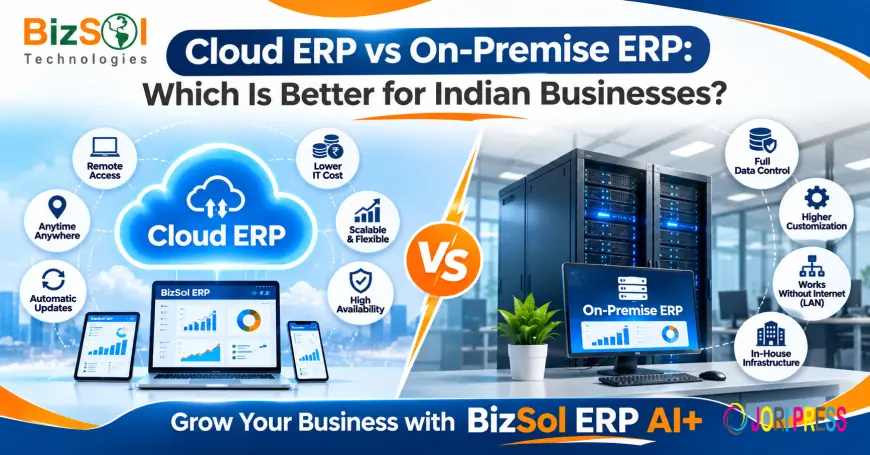
Cloud ERP vs On-Premise ERP: Which Is Better for Indian Businesses?
Introduction
Businesses are increasingly using ERP software to manage their daily operations. From finance and inventory to production and sales, an ERP system helps connect different departments through a centralized platform.
However, before selecting an ERP solution, companies must decide how they want the software to be deployed.
Two common options are Cloud ERP and On-Premise ERP.
Both deployment models can support business operations, but they differ in infrastructure, accessibility, maintenance and cost management.
Understanding the difference between Cloud ERP vs On-Premise ERP can help businesses select a solution that matches their requirements.
What Is Cloud ERP?
Cloud ERP is software hosted on cloud infrastructure and accessed through an internet connection.
Instead of maintaining all ERP infrastructure on company-owned servers, businesses use a cloud-hosted environment provided by the ERP vendor or hosting provider.
Key benefits of Cloud ERP include:
- Remote Accessibility: Authorized users can access the system from different locations, subject to permissions and internet availability.
- Reduced Infrastructure Management: Businesses may have less responsibility for maintaining physical servers.
- Scalability: Resources and user capacity can be adjusted based on business requirements.
- Centralized Information: Departments can access shared business information through the same platform.
- Maintenance: Hosting and infrastructure maintenance responsibilities are generally handled by the provider, depending on the service agreement.
Cloud ERP can be suitable for businesses that need flexible access and want to reduce their dependence on local infrastructure.
What Is On-Premise ERP?
On-premise ERP is installed on servers or infrastructure managed by the business.
The organization is responsible for managing the hardware, system administration, maintenance and other technical requirements, either through its own IT team or an external service provider.
Key benefits of On-Premise ERP include:
- Infrastructure Control: Businesses have direct control over their hosting environment.
- Deployment Flexibility: Organizations can configure their infrastructure according to internal requirements.
- Internal IT Management: Companies can manage system maintenance and administration through their own teams.
- Infrastructure Customization: Deployment can be designed around specific technical and operational requirements.
This model may suit organizations that have established IT infrastructure and require greater control over their hosting environment.
Cloud ERP vs On-Premise ERP: Key Differences
| Comparison Factor | Cloud ERP | On-Premise ERP |
|---|---|---|
| Hosting | Cloud infrastructure | Company-managed infrastructure |
| Accessibility | Internet-based access | Depends on configured network access |
| Infrastructure | Generally managed by provider | Managed by business or IT partner |
| Initial Investment | Often lower infrastructure investment | May require server and infrastructure investment |
| Maintenance | Shared or provider-managed | Business-managed or outsourced |
| Scalability | Resources can be adjusted | May require infrastructure expansion |
| Data Management | Depends on hosting and service arrangements | Greater direct infrastructure control |
| Best Suited For | Businesses needing flexible access | Businesses needing infrastructure control |
The actual costs and responsibilities depend on the ERP licensing model, hosting agreement and implementation requirements.
Which ERP Deployment Model Should You Choose?
There is no single deployment model that suits every organization.
Consider Cloud ERP if:
- Your employees need access from multiple locations.
- You want to reduce physical server management.
- Your business expects changing resource requirements.
- You prefer a provider-managed hosting environment.
Consider On-Premise ERP if:
- Your company already maintains IT infrastructure.
- You require direct control over hosting.
- You have an internal IT team.
- Your operational or compliance requirements influence infrastructure decisions.
Before making a decision, discuss data security, backup arrangements, disaster recovery, system availability and support responsibilities with the ERP provider.
What About Hybrid ERP?
Some businesses may benefit from a hybrid deployment model.
Hybrid ERP combines cloud-based and on-premise infrastructure. It can support organizations that need flexible access while retaining control over certain systems or data environments.
However, hybrid deployment can introduce additional integration and management requirements.
Therefore, businesses should evaluate the technical complexity before selecting this approach.
How BizSol ERP AI+ Supports Flexible Business Management
BizSol Technologies provides intelligent ERP solutions designed to help businesses simplify operations and improve decision-making.
BizSol ERP AI+ offers cloud and on-premise deployment options, allowing businesses to evaluate the environment that best suits their infrastructure and operational needs.
Its platform brings together:
- Finance and accounting.
- Inventory management.
- Production planning.
- Sales and CRM.
- HR and payroll.
- Real-time reporting and analytics.
- AI-powered business insights.
The platform also provides customizable modules to support different business workflows.
Explore BizSol Manufacturing ERP Software to learn more about its manufacturing management capabilities.
Conclusion
Cloud ERP and On-Premise ERP offer different advantages. Cloud ERP focuses on flexible access and reduced infrastructure management, while On-Premise ERP provides greater direct control over the hosting environment.
The right option depends on your company's budget, technical resources, security requirements and future growth plans.
Evaluate both deployment models carefully and request a product demonstration before investing.
With BizSol ERP AI+, businesses can explore intelligent ERP capabilities designed to support connected operations and sustainable growth.
What's Your Reaction?
 Like
0
 Dislike
0
 Love
0
 Funny
0
 Angry
0
 Sad
0
 Wow
0