


































Why Regional Language Support Helps Matrimonial Platforms Grow
Regional language support helps matrimonial platforms reach Tier-2 and Tier-3 users who feel excluded by English-first designs. This article covers what real multilingual support requires and how founders can build it without inflating development costs.
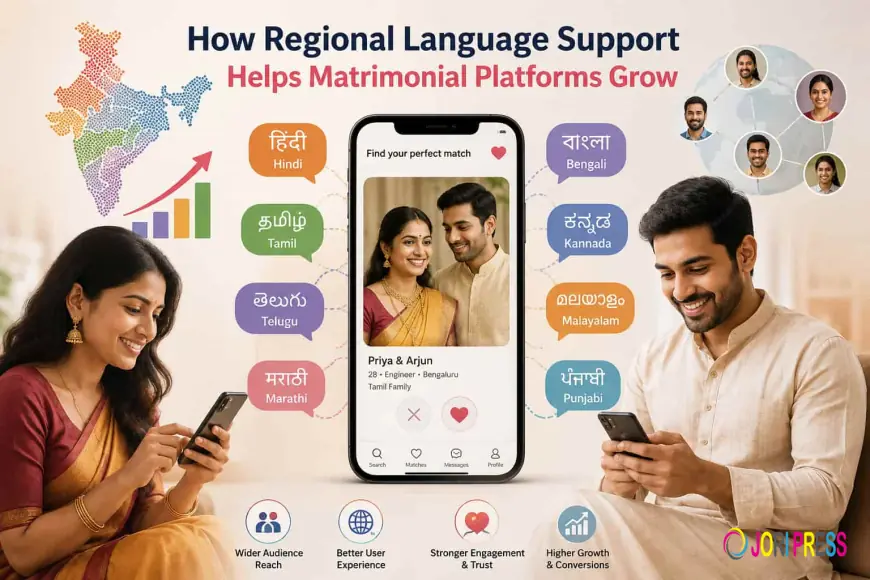
Regional language support helps matrimonial platforms reach Tier-2 and Tier-3 users who feel excluded by English-first designs. This article covers what real multilingual support requires and how founders can build it without inflating development costs.
Why Regional Language Support Helps Matrimonial Platforms Grow'
Most matrimonial platforms are built with one language in mind — English, or possibly Hindi. That made sense when the internet was expensive and urban. It doesn't make as much sense now.
Over 600 million Indians access the internet in regional languages. Marathi speakers in Nashik, Tamil speakers in Madurai, Odia speakers in Bhubaneswar — they're all online, and they're all looking for partners. Many of them land on a regional language matrimonial platform and leave within 30 seconds because the interface feels foreign. Not the design. The language.
If you're building a matrimony platform — especially one aimed at a specific community or geography — language localisation isn't a nice-to-have feature. It's the product decision that determines whether users stay or bounce. This article walks through why that is, what it takes to do it properly, and how to approach it whether you're building from scratch or using a ready-made script.
The Language Gap Most Matrimonial Platforms Overlook
The big platforms — Shaadi.com, BharatMatrimony, Jeevansathi — built their foundations for urban, English-comfortable users. Their core UX, their help content, their notification emails, most of it defaults to English or at best a thin Hindi overlay. They've since added some regional language options, but the experience is patchy. A Tamil speaker on Shaadi might get a Tamil profile-search filter but English error messages and English onboarding prompts.
That patchiness is actually an opportunity for smaller, focused platforms. Tier-2 and Tier-3 cities now account for a growing share of new internet users in India. Many of these users are first-generation smartphone users. They're comfortable on YouTube, WhatsApp, and local news apps — all of which serve them in their own language. When they arrive at a matrimonial site that feels like it was designed for someone else, they leave.
The drop-off isn't always because registration is hard. It's because the platform doesn't feel like it was made for them. Language is the first signal of that.
Why a Regional Language Matrimonial Platform Reaches Users Others Miss
There are roughly 83 million native Marathi speakers, 80 million Telugu speakers, and around 74 million Tamil speakers in India. These aren't niche communities. And within matrimony specifically, the preference for community-based, culturally aligned matches is still strong — often stronger in smaller cities than in metros.
A Marathi-speaking family in Aurangabad looking for a match for their son doesn't want to navigate a platform designed for Bangalore techies. They want to input caste, gotra, and astrological details in a form that speaks their language. They want confirmation messages in Marathi. They want their experience to feel like something built for their community — not a translation layered onto someone else's product.
This is why regional language support is a growth driver, not just a UX improvement. When a platform genuinely serves a linguistic community, word-of-mouth spreads faster. A recommendation from a neighbour who 'used the Marathi matrimony app' carries more weight than a generic matrimony site ad on Facebook.
What Multilingual Matrimonial Software Actually Needs to Handle
Here's where founders often get it wrong. They think adding a language selector to the home page is localisation. It isn't. Real multilingual matrimonial software needs to go much deeper than that.
The profile-creation flow needs to be in the user's language — including dropdown labels, placeholder text, field names, and helper copy. The search and filter UI needs regional language labels. When someone searches for a 'Iyer brahmin' match from Chennai, the search field should accept Tamil input or at minimum present Tamil character support. Notifications — email, SMS, in-app — need to go out in the user's language, not default English.
Support content matters too. An FAQ page in English is useless to someone whose first language is Odia. Error messages matter. Onboarding tooltips matter. All of it adds up to whether the platform feels native or foreign.
Honestly, the hard part isn't the translation. It's building an architecture that allows every content string to be swapped per language without breaking the layout or the logic. That's where a lot of custom builds stumble.
Should Your Matrimonial App Support One Regional Language or Several?
This is a real decision, not a rhetorical one. The answer depends entirely on who you're building for.
If you're launching a community-based matrimonial app for, say, Kannada-speaking families in Karnataka, you don't need eight languages on day one. You need one — done really well. Deep localisation in a single language will always outperform shallow localisation in five. Get the Kannada experience right first: full UI translation, proper Unicode rendering, localised field labels for matrimony-specific data (gotras, sub-communities, astrological preferences). Launch. Get users. Learn.
If you're building a broader regional matrimony platform that spans states — say a platform for all south Indian communities — then multi-language support becomes a core feature from the start. In that case, the technical architecture needs to support it cleanly from the beginning. Retrofitting multilingual support into a monolingual codebase later is expensive and messy.
The mistake most founders make is trying to serve everyone at once with thin support, rather than serving one community deeply and expanding from there.
How a Matrimonial App Builder Handles Multilingual Without Ballooning Dev Costs
Building multilingual support from scratch takes time. You're not just writing translation files — you're engineering the whole UI to be language-agnostic, handling right-to-left script edge cases (if you're covering Urdu matrimony, for example), and managing a content system that can serve the right strings to the right users without lag.
This is one reason many founders now start with a ready-made matrimonial app builder rather than a custom build. Some vendors, such as Best Dating Scripts, offer matrimonial scripts that include built-in multilingual frameworks — meaning the architecture for language support is already in place, and operators need only supply translations for the languages they want to support.
Jordan R., a digital agency operator who builds niche matrimony platforms for clients, noted that using a ready-made foundation let his team focus on actual localisation content rather than on building the infrastructure to support it — saving weeks of development time across projects.
That's a meaningful distinction for a founder working with a limited budget. The question isn't just 'can we support Tamil?'. It's 'can we support Tamil without rebuilding the notification system, the search engine, and the profile renderer from scratch?'. A well-structured matrimonial script answers yes to that without requiring six months of back-end engineering.
Building Where Matrimony Actually Happens
Matrimony in India is deeply local. It's shaped by language, community, caste, family expectations, and geography. The platforms that win in smaller cities and regional markets won't be the ones that translate their English interface at the last minute. They'll be the ones that built language support into the product from the start — so the experience feels native, not adapted.
If you're planning a regional language matrimonial platform, the practical takeaways are simple. Pick your community first. Build language support deep into the stack, not as a surface-level overlay. Start with one language done well before expanding. And choose your technology foundation carefully — retrofitting multilingual support later costs more than building it right the first time.
The next wave of matrimony platform growth isn't coming from Delhi or Mumbai. It's coming from Coimbatore, Bhopal, Vizag, and Patna. The founders who reach those users in their own language will have a real advantage — and one that's surprisingly hard for larger platforms to copy quickly.
What's Your Reaction?
 Like
0
Like
0
 Dislike
0
Dislike
0
 Love
0
Love
0
 Funny
0
Funny
0
 Angry
0
Angry
0
 Sad
0
Sad
0
 Wow
0
Wow
0