











































How Real Estate Tokenization Development Improves Liquidity, Compliance, and Accessibility
Explore how real estate tokenization improves liquidity, compliance, and accessibility through blockchain-based fractional ownership models.

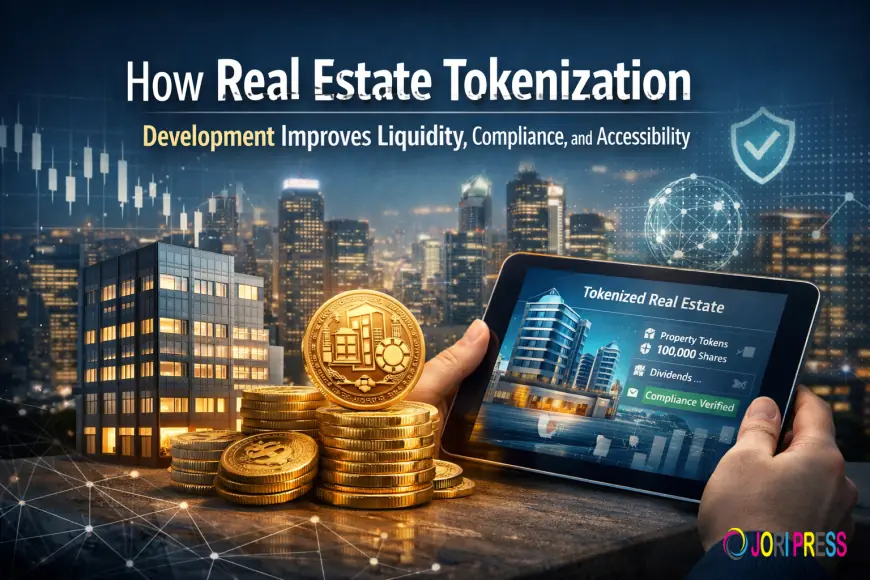
The real estate sector has historically been considered one of the most capital-intensive and operationally rigid investment domains in the global economy. Traditional property transactions involve extensive paperwork, illiquid ownership structures, intermediary dependency, prolonged settlement timelines, and high entry barriers for retail investors. As digital asset infrastructure matures, tokenization is emerging as a transformative mechanism capable of modernizing how real estate assets are issued, managed, traded, and fractionalized.
Real estate tokenization refers to the process of converting ownership rights of physical or institutional-grade property assets into blockchain-based digital tokens. These tokens represent fractional or full ownership interests and are governed through programmable smart contracts. By integrating distributed ledger infrastructure into property investment ecosystems, tokenization introduces enhanced transparency, automated compliance, secondary market participation, and significantly improved liquidity dynamics.
The growth of digital securities, decentralized finance architecture, and regulated blockchain ecosystems has accelerated enterprise interest in tokenized real estate frameworks. Property developers, investment firms, asset managers, REIT operators, and institutional issuers are increasingly evaluating tokenization to optimize capital formation strategies while broadening investor participation models.
This shift is not merely technological. It represents a structural redesign of real estate finance, ownership distribution, and asset accessibility.
The Structural Limitations of Traditional Real Estate Investment Models
Conventional real estate investment mechanisms are burdened by several inefficiencies that reduce operational scalability and restrict capital mobility. Unlike equities or digitally traded financial instruments, real estate assets are inherently illiquid due to transaction complexity, geographic limitations, regulatory fragmentation, and administrative overhead.
Traditional property acquisition workflows often involve:
- Lengthy due diligence procedures
- Multi-party legal verification
- Escrow management complexity
- Manual compliance documentation
- High brokerage and intermediary fees
- Geographic investment restrictions
- Large minimum capital requirements
These constraints create a market environment where institutional participants dominate access to premium assets while smaller investors remain excluded from diversified property portfolios. Furthermore, exiting an investment position frequently requires complete asset liquidation or cumbersome ownership transfers, making portfolio flexibility extremely limited.
Liquidity constraints particularly affect commercial real estate markets where high-value assets remain locked for extended periods without efficient secondary trading infrastructure. This reduces investment agility and creates capital inefficiencies for both issuers and investors.
Tokenization addresses these structural bottlenecks by introducing divisible ownership architecture powered through blockchain-enabled programmable asset frameworks.
How Tokenization Enhances Liquidity in Real Estate Markets
Liquidity remains one of the strongest value propositions of real estate tokenization development. In traditional markets, real estate investments often require years before investors can realize returns through resale or appreciation. Tokenization fundamentally changes this dynamic by enabling fractional ownership and digital secondary trading capabilities.
When a real estate asset is tokenized, ownership can be segmented into smaller digital units that represent proportional economic rights. These blockchain-based tokens can then be transferred or traded through compliant digital asset marketplaces, creating a more fluid investment environment.
This fractionalization model unlocks several liquidity advantages:
- Investors can buy smaller ownership portions instead of entire properties
- Asset issuers can access a broader capital pool globally
- Secondary market participation becomes more efficient
- Portfolio diversification becomes easier across multiple properties
- Exit opportunities improve through digital transfer mechanisms
For example, a commercial property valued at several million dollars can be divided into thousands of digital ownership tokens. Rather than requiring a single institutional buyer, the property can attract diversified participation from multiple accredited or retail investors depending on jurisdictional regulations.
The introduction of blockchain-based transferability also reduces settlement friction. Smart contracts automate transactional execution, ownership verification, and distribution processes, minimizing dependency on centralized intermediaries.
Another important factor is the emergence of programmable liquidity infrastructure. Tokenized assets can integrate automated dividend distributions, revenue-sharing models, and dynamic ownership management systems directly into smart contract logic. This creates operational efficiency while reducing administrative overhead.
Institutional adoption is also increasing because tokenization improves balance sheet flexibility. Developers and real estate firms can unlock dormant capital tied to large physical assets without requiring complete asset divestment. Partial ownership issuance enables capital recycling while maintaining operational control over underlying infrastructure.
As the digital securities ecosystem expands, liquidity layers surrounding tokenized real estate assets are expected to mature further through interoperable exchanges, regulated custody providers, and blockchain-based settlement networks.
Compliance Automation Through Smart Contract Infrastructure
Regulatory compliance remains one of the most critical aspects of real estate tokenization development. Unlike speculative cryptocurrency ecosystems, tokenized real estate assets often operate within securities frameworks and therefore require strict adherence to financial regulations, investor eligibility standards, and anti-money laundering protocols.
One of the most significant technological advantages of tokenization lies in programmable compliance automation.
Smart contracts enable predefined regulatory conditions to be embedded directly into transaction logic. Instead of relying solely on manual legal oversight, compliance mechanisms can execute automatically during token issuance, transfer validation, and ownership management.
Key compliance functions typically integrated into tokenized real estate ecosystems include:
- Know Your Customer (KYC) verification
- Anti-Money Laundering (AML) monitoring
- Investor accreditation validation
- Jurisdiction-based participation restrictions
- Ownership cap enforcement
- Automated reporting and audit trails
These capabilities reduce operational risk while increasing transparency across the investment lifecycle.
For enterprises entering the blockchain-enabled real estate sector, partnering with a specialized Real Estate Tokenization Development Company becomes essential for implementing secure compliance architecture aligned with regional securities regulations and digital asset governance requirements.
Another important compliance advantage is immutability. Blockchain ledgers create transparent transaction histories that cannot be retroactively manipulated. This auditability improves investor confidence and simplifies regulatory inspection procedures.
Additionally, tokenization platforms can integrate permissioned blockchain environments where only verified participants gain access to transactional ecosystems. This hybrid approach balances decentralization with regulatory accountability.
Cross-border investment frameworks also benefit from programmable compliance layers. International investors can participate in tokenized real estate offerings while jurisdiction-specific rules are enforced automatically through smart contract governance.
As regulatory frameworks surrounding digital securities evolve globally, compliance-centric tokenization infrastructure is expected to become a foundational requirement for institutional-grade blockchain adoption within real estate markets.
Expanding Accessibility Through Fractional Ownership Models
Accessibility is another transformative advantage introduced through tokenized real estate ecosystems. Historically, premium property investment opportunities were largely restricted to high-net-worth individuals, institutional funds, or large financial syndicates due to substantial capital requirements.
Tokenization reduces these barriers by enabling fractional participation structures.
Instead of purchasing an entire property or committing large investment amounts, participants can acquire smaller ownership percentages represented by digital tokens. This democratization model opens access to diversified real estate portfolios for a significantly broader investor base.
The implications of improved accessibility extend beyond retail participation. Tokenization also enhances global capital connectivity by reducing geographic and operational barriers associated with international property investment.
Several accessibility improvements enabled through tokenization include:
- Lower minimum investment thresholds
- Increased access to institutional-grade assets
- Cross-border investment participation
- Simplified onboarding procedures
- Greater portfolio diversification opportunities
- Improved transparency in ownership structures
Digital onboarding frameworks further streamline investor participation. Blockchain-integrated identity verification systems reduce administrative complexity while accelerating onboarding timelines.
Additionally, tokenization creates opportunities for underrepresented investor groups to access income-generating real estate assets previously dominated by institutional players. This can contribute to broader financial inclusion and diversified wealth participation models.
Accessibility improvements are particularly relevant in emerging economies where access to traditional real estate investment infrastructure remains limited. Blockchain-enabled ownership systems can create alternative investment channels without requiring extensive banking or brokerage infrastructure.
The ability to tokenize multiple asset categories—including residential developments, commercial towers, hospitality infrastructure, industrial parks, and mixed-use properties—also broadens market participation.
As digital financial literacy improves globally, accessibility-driven tokenization models may redefine how individuals engage with long-term asset ownership and wealth generation.
The Future of Enterprise Real Estate Tokenization Ecosystems
The future trajectory of real estate tokenization extends beyond simple digital ownership representation. Enterprise-grade tokenization ecosystems are evolving toward integrated financial infrastructure models capable of reshaping capital markets.
Several technological and operational developments are expected to accelerate adoption:
Integration with Decentralized Finance
Tokenized real estate assets are increasingly being explored within decentralized finance ecosystems. This may enable:
- Asset-backed lending mechanisms
- Yield generation models
- Collateralized borrowing frameworks
- Automated liquidity provisioning
- Tokenized mortgage infrastructure
These integrations could significantly expand capital efficiency within real estate finance markets.
Institutional Custody and Security Advancements
Institutional adoption requires highly secure custody architecture. Advanced multi-signature wallets, hardware security modules, and regulated custodial platforms are strengthening enterprise confidence in tokenized asset management.
Cybersecurity frameworks are becoming central components of tokenization infrastructure, particularly for high-value commercial assets.
Interoperable Digital Asset Infrastructure
Future ecosystems are likely to prioritize interoperability between blockchain networks, financial institutions, and regulatory systems. Standardized token protocols may improve compatibility across exchanges, custodians, and compliance providers.
This interoperability will be essential for scaling global participation and secondary market liquidity.
AI-Driven Asset Intelligence
Artificial intelligence integration may enhance tokenized real estate ecosystems through predictive valuation analytics, automated risk assessment, tenant behavior forecasting, and dynamic investment optimization models.
These capabilities could improve investor decision-making while reducing operational inefficiencies.
Regulatory Standardization
As governments and financial authorities establish clearer digital asset frameworks, institutional participation is expected to accelerate. Regulatory clarity will likely encourage traditional financial institutions to expand involvement in tokenized securities markets.
Over time, tokenized real estate may evolve into a mainstream asset class operating alongside traditional investment instruments within global financial ecosystems.
Conclusion
Real estate tokenization is fundamentally transforming how property assets are financed, managed, distributed, and traded. By leveraging blockchain infrastructure, smart contract automation, and programmable ownership models, tokenization introduces meaningful improvements across liquidity, compliance, and accessibility dimensions.
Traditional real estate investment structures have long suffered from illiquidity, high entry barriers, operational inefficiencies, and limited market participation. Tokenization addresses these challenges through fractional ownership systems, automated regulatory enforcement, and digitally transferable asset frameworks.
Improved liquidity enables more dynamic capital movement and secondary market participation. Compliance automation strengthens transparency while reducing administrative burden. Enhanced accessibility broadens investor inclusion and creates new pathways for global participation in institutional-grade property assets.
As digital securities infrastructure matures, real estate tokenization is positioned to become a major component of next-generation financial ecosystems. Enterprises adopting tokenization strategies today are not simply integrating blockchain technology—they are participating in the modernization of global asset ownership architecture.
What's Your Reaction?
 Like
0
Like
0
 Dislike
0
Dislike
0
 Love
0
Love
0
 Funny
0
Funny
0
 Angry
0
Angry
0
 Sad
0
Sad
0
 Wow
0
Wow
0