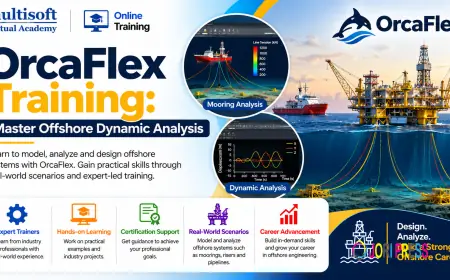


































OrcaFlex Training: Master Offshore Dynamic Analysis
Learn OrcaFlex Training with expert guidance, practical exercises, and real-world projects to develop skills in offshore engineering and marine analysis.

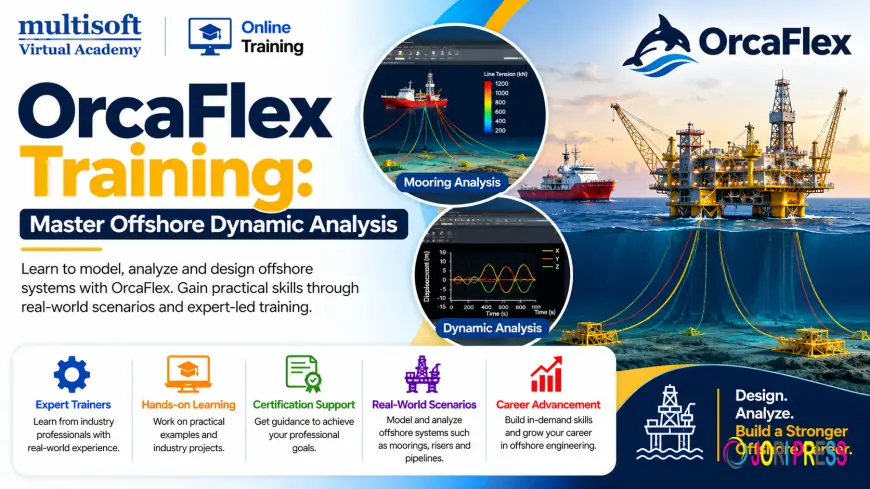
Offshore engineering projects involve complex marine structures, floating systems, subsea pipelines, mooring arrangements, and flexible risers. These systems operate under changing environmental conditions such as waves, currents, wind, and vessel movements. Engineers must understand how these factors influence structural behaviour and system performance before making important design and operational decisions.
OrcaFlex is a specialist software application used for modelling and analysing offshore and marine systems. It supports static and dynamic analysis, allowing engineers to evaluate the behaviour of different offshore configurations under defined environmental and operational conditions.
OrcaFlex Training helps engineering professionals develop practical knowledge of offshore modelling, simulation, and result interpretation. It introduces the software environment and explains how to create models, define engineering properties, configure environmental conditions, run simulations, and review analysis results.
For professionals working in offshore, subsea, marine, and renewable energy projects, learning OrcaFlex can strengthen their technical understanding and support the development of specialised simulation skills.
What Is OrcaFlex Software?
OrcaFlex is a marine engineering software package developed by Orcina. It is primarily used for the global static and dynamic analysis of offshore systems, including vessels, mooring lines, risers, pipelines, umbilicals, and subsea cables.
The software helps engineers represent complex marine systems through numerical models. Users can define system geometry, material properties, environmental conditions, boundary conditions, and operational parameters to investigate how a system may respond under different scenarios.
Its applications include offshore oil and gas engineering, marine operations, floating offshore wind, subsea infrastructure, and other marine engineering activities.
OrcaFlex is particularly useful when engineers need to study the interaction between vessels, floating structures, and connected line systems. It also provides tools for examining time-dependent behaviour and reviewing important engineering results.
Why Is OrcaFlex Training Important?
Offshore engineering requires accurate modelling and careful assessment of environmental loads. Engineers must understand how different system components behave under operational and extreme conditions.
A structured training program helps learners understand the software and the engineering principles behind its modelling workflows.
1. Develop Offshore Modelling Skills
OrcaFlex training introduces participants to model creation, object configuration, coordinate systems, line properties, and connections. These fundamentals help learners understand how to represent offshore systems within the software.
2. Understand Static and Dynamic Analysis
Static analysis helps determine the equilibrium configuration of an offshore system. Dynamic analysis evaluates how the system responds to changing conditions over time.
Learning both approaches helps professionals understand how simulation methods support different engineering studies.
3. Improve Mooring and Riser Analysis Knowledge
Mooring systems and risers are important components of offshore facilities. Their behaviour depends on environmental loading, vessel movement, material properties, geometry, and operating conditions.
Training introduces modelling approaches that help engineers evaluate tension, displacement, curvature, and other relevant responses.
4. Interpret Engineering Results
Generating simulation results is only one part of offshore analysis. Engineers must also understand how to interpret outputs, identify critical response locations, compare scenarios, and review model assumptions.
Practical training helps develop this analytical approach.
Key Topics Covered in OrcaFlex Training
A comprehensive OrcaFlex Training Course should combine software fundamentals with practical offshore engineering examples. Important learning areas include the following.
OrcaFlex Interface and Model Creation
The first stage introduces the software interface and its modelling environment. Participants learn how to create new models, navigate the workspace, add objects, configure data, and organize simulation files.
Topics may include:
- Software interface and navigation
- Model browser and object management
- Coordinate systems and local origins
- Object connections and relationships
- Model data configuration
- Saving and managing simulation files
- Model checking and troubleshooting
Understanding these fundamentals provides a foundation for more advanced modelling activities.
Environmental Conditions and Hydrodynamic Loading
Environmental conditions have a major influence on offshore system behaviour. Engineers must represent waves, wind, currents, water depth, and seabed characteristics appropriately.
Training may cover regular and irregular waves, wave spectra, current profiles, environmental directions, and hydrodynamic loading concepts.
Participants also explore the influence of drag, inertia, buoyancy, and other relevant parameters on offshore structures and line systems.
Line Modelling and Structural Properties
Line modelling is an important part of OrcaFlex analysis. Offshore systems often contain flexible lines, mooring ropes, risers, pipelines, and umbilicals.
The training may introduce:
- Line types and configurations
- Line geometry and segmentation
- Material properties
- Mass and buoyancy characteristics
- Axial and bending stiffness
- Torsional properties
- Hydrodynamic properties
- Line end connections
- Seabed contact and interaction
These concepts help learners understand how line properties influence the overall simulation.
Vessel Modelling and Motion Analysis
Vessels are frequently connected to offshore systems through mooring lines, risers, and other flexible structures. Their movements can influence the behaviour of the connected components.
Training may cover vessel objects, coordinate systems, reference points, vessel properties, displacement, draft, and response amplitude operators (RAOs).
Learners can also explore how vessel motions are represented in simulation models and how they affect connected offshore systems.
Mooring System Modelling
Mooring systems help maintain the position of floating offshore structures. Their design and analysis require an understanding of line configuration, pretension, environmental loading, and vessel movement.
OrcaFlex training may introduce catenary and taut mooring arrangements, chain and wire properties, anchor locations, fairlead connections, and multiple-line configurations.
Important analysis parameters include line tension, vessel offset, system equilibrium, and the response under different environmental conditions.
Riser and Umbilical Analysis
Risers provide connections between floating facilities and subsea infrastructure. They may experience complex loading caused by vessel motion, waves, currents, internal contents, and structural characteristics.
Training can introduce flexible risers, steel catenary risers, top tensioned risers, lazy-wave configurations, and other relevant arrangements.
Participants may learn to review effective tension, curvature, bend radius, touchdown behaviour, buoyancy distribution, and seabed interaction.
The course may also cover umbilicals, flexible pipes, and subsea cable modelling, depending on its syllabus.
Static Analysis and Dynamic Simulation
Static analysis establishes the equilibrium configuration of a model before dynamic simulation. It helps engineers review initial geometry, line shapes, pretension, and system stability.
Dynamic analysis evaluates system behaviour over time under changing environmental or operational conditions.
Training may cover time-domain calculations, simulation duration, time-step selection, environmental loading, dynamic vessel motions, and line response.
Understanding these methods helps learners select appropriate simulation approaches for different offshore engineering problems.
Offshore Installation Analysis
Offshore installation activities often involve vessels, lifting equipment, winches, pipelines, subsea equipment, and flexible line systems.
OrcaFlex can support the modelling of different marine operation scenarios. Training may introduce deployment, lowering, overboarding, line payout, lifting operations, vessel movement, and subsea installation concepts.
These exercises help participants understand how modelling can support engineering assessments during offshore operations.
Results Interpretation and Reporting
After completing a simulation, engineers need to examine the results and determine whether the model behaves as expected.
Training may cover time histories, range graphs, statistical outputs, extreme values, vessel motions, line tensions, curvature, and displacement.
Learners can also explore methods for comparing simulation cases, extracting relevant information, and preparing engineering reports.
Industries That Use OrcaFlex
OrcaFlex is relevant to several industries where offshore and marine system analysis is required.
Oil and gas: Offshore oil and gas projects use simulation tools to investigate mooring systems, risers, pipelines, subsea equipment, and installation operations.
Subsea engineering: Engineers may analyse subsea cables, umbilicals, flexible pipelines, and connected marine systems.
Offshore renewable energy: Floating offshore wind projects involve mooring arrangements, dynamic cables, floating structures, and environmental response assessments.
Marine engineering: Naval architects and marine engineers use modelling and analysis tools to study vessels, floating systems, and marine operations.
Offshore installation: Installation contractors and engineering teams may use simulation studies to evaluate deployment, lifting, lowering, and other marine operations.
Engineering consultancy: Specialist consultants use offshore analysis software to support design studies, engineering assessments, and project-specific investigations.
Who Should Enrol in OrcaFlex Training?
OrcaFlex training can benefit professionals who work with offshore systems and marine engineering applications.
- Offshore Engineers: Professionals involved in offshore structural systems and engineering analysis.
- Marine Engineers: Specialists working with vessels, floating systems, and marine operations.
- Naval Architects: Professionals interested in vessel behaviour and offshore system interactions.
- Mooring Engineers: Engineers responsible for mooring system modelling and assessment.
- Riser Engineers: Specialists working with offshore riser configurations and dynamic response.
- Subsea Engineers: Professionals involved in subsea infrastructure, cables, and pipelines.
- Pipeline Engineers: Engineers interested in pipeline modelling and offshore installation analysis.
- Structural Engineers: Professionals working on offshore structural assessment and system behaviour.
- Installation Engineers: Specialists involved in marine installation planning and simulation.
Engineering graduates can also consider introductory training if they have a basic understanding of mechanics, engineering principles, and marine systems.
Career Opportunities After OrcaFlex Training
Developing OrcaFlex skills can complement an engineering professional's existing technical knowledge. Depending on educational qualifications, experience, and project requirements, learners may explore career paths such as:
- Offshore Analysis Engineer
- Marine Engineer
- Mooring Analysis Engineer
- Riser Analysis Engineer
- Subsea Engineer
- Pipeline Engineer
- Offshore Installation Engineer
- Naval Architect
- Marine Simulation Engineer
- Offshore Structural Engineer
Employers generally look for a combination of engineering fundamentals, practical simulation experience, knowledge of relevant industry standards, and the ability to interpret technical results.
Training can provide a useful starting point, but professional competence develops through continued practice and exposure to real engineering projects.
How to Choose the Right OrcaFlex Training Course
Selecting a suitable training program is important for developing useful software and engineering skills. Consider these factors before enrolling.
Review the Course Curriculum
Check whether the syllabus covers model creation, line modelling, environmental conditions, static analysis, dynamic simulation, mooring systems, risers, and result interpretation.
Choose a program that matches your experience and professional requirements.
Check Practical Learning Opportunities
Practical exercises help learners understand how software functions are applied to engineering problems. Look for guided modelling activities, simulation exercises, and representative offshore case studies.
Understand the Trainer's Experience
An instructor with relevant offshore engineering and simulation experience can explain technical concepts more clearly and connect software workflows with practical applications.
Confirm Software Access
Ask whether software access or training licences are included. Also confirm the software version and system requirements before starting the course.
Compare Training Formats
Live online sessions can provide direct interaction with instructors, while self-paced learning offers greater scheduling flexibility. Select the format that suits your learning objectives.
Explore Advanced Learning Options
Experienced users may also consider specialised topics such as offshore wind modelling, fatigue analysis, Python automation, and advanced simulation workflows.
Frequently Asked Questions About OrcaFlex Training
What is OrcaFlex Training?
OrcaFlex Training teaches participants how to use OrcaFlex for offshore and marine system modelling, static analysis, dynamic simulation, and engineering result interpretation.
Is OrcaFlex suitable for beginners?
Yes. Beginners can start with introductory software concepts and basic modelling exercises. A background in engineering mechanics or offshore engineering is helpful.
What are the main applications of OrcaFlex?
Common applications include mooring analysis, riser analysis, pipeline modelling, subsea cable assessment, vessel response, and offshore installation simulation.
Does OrcaFlex support dynamic analysis?
Yes. OrcaFlex supports dynamic analysis, including time-domain simulation, for evaluating the behaviour of offshore systems under changing conditions.
Who uses OrcaFlex software?
Offshore engineers, marine engineers, naval architects, subsea specialists, mooring engineers, riser engineers, and engineering consultants may use the software.
Does OrcaFlex training include practical projects?
Course coverage varies. Many training programs include practical exercises and representative engineering scenarios. Check the syllabus to confirm the specific activities included.
Conclusion
OrcaFlex is an important engineering tool for modelling and analysing offshore and marine systems. Developing practical knowledge of line modelling, environmental loading, mooring systems, risers, static analysis, dynamic simulation, and result interpretation can help professionals strengthen their technical capabilities. The right training program should combine software instruction with engineering fundamentals and practical exercises relevant to industry requirements. Multisoft Virtual Academy offers OrcaFlex Training designed to help offshore, marine, subsea, and other engineering professionals develop software knowledge and practical modelling skills for offshore engineering applications.
What's Your Reaction?
 Like
0
 Dislike
0
 Love
0
 Funny
0
 Angry
0
 Sad
0
 Wow
0