




































MPPSC and MPESB Exam Preparation 2026–27: How to Master MP GK, Maths and Previous-Year Questions
Preparing for Madhya Pradesh competitive examinations requires a combination of state-specific General Knowledge, subject knowledge, regular practice and effective revision.

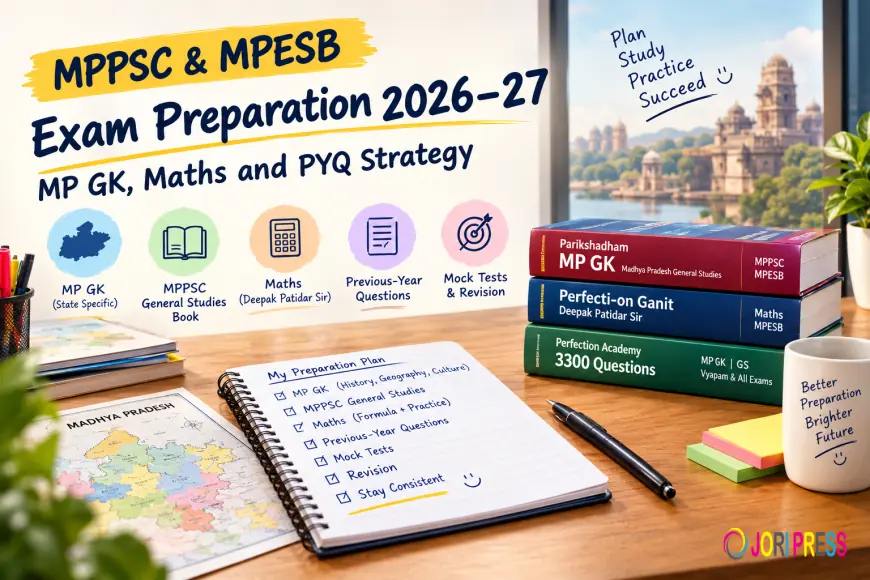
Preparing for Madhya Pradesh competitive examinations requires a combination of state-specific General Knowledge, subject knowledge, regular practice and effective revision. Whether you are targeting MPPSC, MPESB recruitment examinations or other Madhya Pradesh government exams, a structured study plan can help you cover the syllabus without wasting time on unnecessary resources.
For the 2026–27 preparation cycle, aspirants should focus on understanding the requirements of their target examination, strengthening weak subjects and practising questions regularly. MP GK and Mathematics deserve particular attention because both require a combination of conceptual understanding, factual recall and repeated revision.
Here is a practical guide to organising your preparation and choosing suitable study resources.
1. Understand Your Exam Pattern Before Starting
The first step in preparing for a competitive examination is understanding its syllabus, selection process and question pattern. MPPSC and MPESB examinations may test different combinations of General Studies, aptitude, Mathematics, reasoning and other subjects, depending on the post.
Avoid following a single timetable for every examination. Begin by checking the official notification and syllabus for your target exam. Then divide the syllabus into smaller sections and identify which subjects need the most attention.
A simple preparation checklist should include:
-
Important topics and subject-wise syllabus coverage.
-
Previous-year question papers, wherever available.
-
The examination's marking scheme and time limit.
-
Daily study targets and weekly revision sessions.
-
Regular practice tests to measure your progress.
This initial planning makes it easier to select books that match your actual examination requirements.
2. Strengthen Madhya Pradesh General Knowledge
Madhya Pradesh General Knowledge is an important preparation area for many state-level competitive examinations. Depending on the syllabus, topics may include the state's history, geography, rivers, national parks, economy, culture, administrative structure and important personalities.
Instead of memorising isolated facts, organise MP GK into topic-wise notes. For example, prepare separate sections for geography, history, culture and economic development. Use tables, maps and short summaries wherever they make information easier to remember.
A suitable MP GK Book English Medium can help English-medium aspirants organise their Madhya Pradesh General Studies preparation.
When selecting an MPPSC General Studies Book, check whether its coverage matches your examination syllabus and whether the explanations are easy to revise. English-medium students should also pay attention to terminology and the clarity of explanations.
3. Prepare MP GK Through Repeated Revision
One common mistake is reading General Knowledge once and moving to another subject without revisiting the information. Since state-specific GK includes many facts, regular revision is necessary to improve recall.
Try dividing your revision into three stages:
First revision: Review the chapter soon after completing it and identify the most important facts.
Second revision: Revisit the same topic after a few days and test yourself without looking at your notes.
Practice revision: Solve topic-wise MCQs and review every incorrect answer.
Previous-year questions can help you understand how factual information is tested. However, do not assume that only previously asked facts are important. Use them alongside the prescribed syllabus and reliable study material.
Students preparing with Madhya Pradesh Competitive Exam Books should prioritise resources that support both topic-wise learning and repeated practice.
4. Improve Mathematics Through Daily Problem-Solving
Mathematics preparation often becomes difficult when students study formulas but do not practise enough questions. Understanding a concept is only the beginning; applying it accurately under time pressure requires regular problem-solving.
Depending on the target examination, important areas may include percentages, ratios, averages, profit and loss, simple and compound interest, time and work, time and distance, number systems and other quantitative aptitude topics.
Start by learning the basic method for each topic. Solve straightforward examples first, then move towards questions that require multiple steps.
Students looking for a Deepak Patidar Sir Maths book can consider it as part of their Hindi-medium Mathematics practice resources.
When choosing a Vyapam Maths book, check its relevance to your target examination, the quality of its explanations and the availability of practice questions. Your preparation should match the actual syllabus rather than cover every possible quantitative aptitude topic indiscriminately.
5. Use Previous-Year Questions to Identify Weak Areas
Previous-year questions are useful because they help aspirants become familiar with question formats, difficulty levels and recurring subject areas. They also provide a practical way to evaluate whether a topic has been understood properly.
For Mathematics, solve questions under timed conditions and record the types of mistakes you make. For General Knowledge, review the facts and concepts behind incorrect answers instead of simply memorising the correct option.
After each practice session, classify mistakes into three categories:
-
Knowledge gaps: The concept or fact was not known.
-
Application errors: The concept was understood but applied incorrectly.
-
Time-management errors: The question took too long or was misread.
This simple method helps you decide what to revise next. It also makes MPESB Maths preparation more focused by directing your practice towards the areas where improvement is needed.
6. Choose MPESB Exam Books According to Your Target Post
MPESB conducts recruitment examinations for different posts, and their requirements can vary. Therefore, aspirants should not assume that one book or question bank will be sufficient for every examination.
Before choosing MPESB exam books, review the relevant notification and compare the syllabus with the subjects covered by the book. Check the edition, language, topic coverage and whether the resource provides previous-year questions or additional practice questions.
For candidates who want a question-focused resource, the MPESB exam books collection item featuring 3300 questions may be worth evaluating against their target exam's syllabus.
A book containing 3300 questions can provide substantial practice, but the number of questions alone should not determine your choice. Relevance, accuracy, explanations and alignment with the examination requirements are equally important.
7. Combine Subject Preparation with Mock Tests
Reading books and solving individual questions are important, but aspirants also need to practise completing papers within the available time.
Begin with topic-wise tests while studying new material. Once you have covered a reasonable portion of the syllabus, introduce mixed-subject tests and full-length mock papers where suitable.
After every test, spend time reviewing your performance. Note the subjects where your accuracy is low, questions that consume too much time and topics you repeatedly forget.
For MP GK, revise facts and concepts associated with incorrect answers. For Mathematics, practise similar questions until you can solve them confidently. For other subjects, return to the relevant chapter before attempting another test.
Mock tests become more useful when you analyse mistakes instead of moving immediately to the next paper.
8. Create a Weekly Study Plan for 2026–27
A practical timetable should balance learning, revision and question practice. You do not need to study every subject for the same amount of time. Give more attention to difficult topics while maintaining regular revision of subjects you already understand.
A sample weekly structure could include:
-
Monday to Wednesday: Focus on core syllabus topics and concept learning.
-
Thursday: Practise Mathematics, reasoning or other aptitude topics relevant to your exam.
-
Friday: Revise Madhya Pradesh General Knowledge and solve topic-wise questions.
-
Saturday: Attempt a sectional test or previous-year question paper.
-
Sunday: Review mistakes, revise completed topics and plan the next week.
Adapt this schedule according to your target examination, preparation level and available study hours. If an official notification changes the examination timeline, update your plan accordingly.
9. Avoid Common Preparation Mistakes
Many aspirants lose valuable preparation time by repeatedly changing books, collecting too many notes or following timetables that are difficult to maintain.
Avoid these common mistakes:
-
Studying without checking the official syllabus.
-
Reading MP GK without revising previously covered topics.
-
Memorising Mathematics formulas without solving questions.
-
Attempting mock tests without analysing incorrect answers.
-
Purchasing multiple books that cover the same material.
-
Relying on unofficial recruitment dates or unverified exam updates.
Keep your resources manageable and track progress through completed topics, practice accuracy and revision consistency.
Conclusion
Effective MPPSC and MPESB preparation depends on understanding the examination requirements, strengthening Madhya Pradesh General Knowledge, practising Mathematics regularly and learning from previous-year questions.
Choose study material according to your target examination and preferred language. Build a realistic weekly schedule, revise important topics repeatedly and use mock tests to identify areas that need improvement.
Most importantly, verify examination-specific details through official notifications and focus your efforts on the syllabus that applies to your chosen post. A consistent, practice-oriented approach can make your 2026–27 preparation more organised and productive.
What's Your Reaction?
 Like
0
Like
0
 Dislike
0
Dislike
0
 Love
0
Love
0
 Funny
0
Funny
0
 Angry
0
Angry
0
 Sad
0
Sad
0
 Wow
0
Wow
0