










































Learning Chords Through Visual Tools vs Videos – Which Works Better?
Compare visual music tools and video tutorials for learning chords. Discover which method helps beginners understand chords and improve musical skills.

Learning to play music involves understanding how different notes work together to create meaningful sounds. One of the most important skills beginners need to develop is learning chords. Whether someone wants to play the piano, guitar, or another musical instrument, understanding chords creates a foundation for playing songs and exploring music independently.
However, beginners often face an important question: Should they learn chords through traditional video tutorials or use modern visual music learning tools?
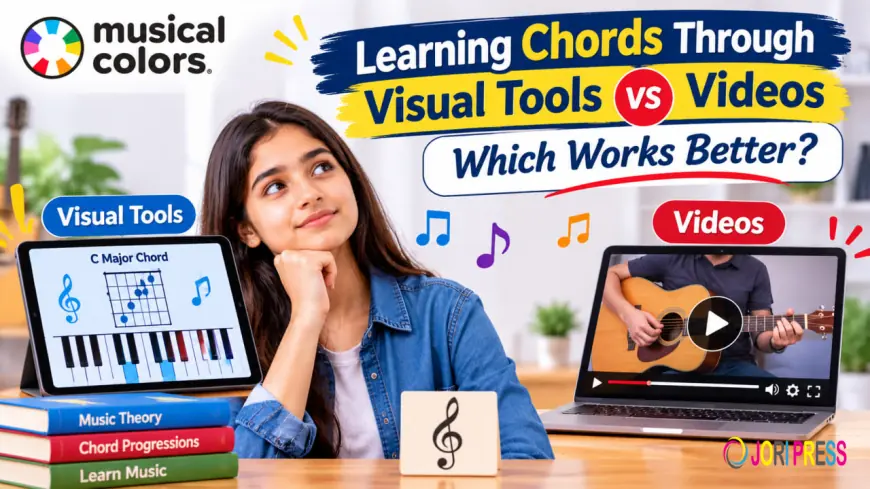
Both approaches offer different advantages. Videos provide demonstrations, explanations, and real playing examples, while visual tools help learners understand chord structures through colours, diagrams, interactive keyboards, and note relationships.
Choosing the right approach depends on individual learning preferences, musical experience, and practice goals. In this guide, we compare both methods to help beginners decide which approach offers a better learning experience.
What Does Learning Chords Actually Involve?
Before comparing learning methods, it is important to understand what chords are and why they matter.
A musical chord is generally a combination of three or more different notes played together. Chords provide harmony and help create the emotional character of a musical composition.
For example, a basic C major chord contains three notes:
-
C – Root note
-
E – Major third
-
G – Perfect fifth
When these notes are played together, they produce a major chord sound.
Beginners usually start by understanding major chords, minor chords, chord progressions, and basic harmony. These concepts help learners understand how songs are structured and how different chords connect.
The challenge is not simply memorising chord names. It is understanding how notes combine and recognising their relationships while playing an instrument.
Learning Chords Through Video Tutorials
Video tutorials are among the most popular resources for people starting their musical journey. Online platforms provide thousands of lessons covering piano chords, guitar chords, music fundamentals, and practical playing techniques.
Benefits of Learning Chords Through Videos
1. Real-Time Demonstrations
One major advantage of video tutorials is that learners can watch an instructor play chords on an actual instrument.
For example, a piano teacher can demonstrate finger placement for a C major chord, while a guitar instructor can show how to position fingers across the fretboard.
This makes videos useful for understanding physical playing techniques.
2. Step-by-Step Explanations
Many video lessons introduce chords gradually. Beginners can start with simple major and minor chords before progressing towards more advanced combinations.
They can pause, rewind, and repeat explanations whenever a concept feels difficult.
3. Learning Through Listening
Videos allow learners to hear how different chords sound.
This is important because understanding music involves more than identifying notes visually. Developing the ability to recognise chord sounds also requires listening practice.
4. Access to Different Teaching Styles
Beginners can explore different instructors and teaching approaches. If one explanation is difficult to understand, they can find another lesson covering the same topic.
Limitations of Video-Based Learning
Although video tutorials are convenient, they also have some limitations.
-
Some videos move too quickly for complete beginners.
-
Learners may copy finger positions without understanding chord construction.
-
Finding specific information can require watching lengthy tutorials.
-
Video demonstrations do not always provide interactive learning experiences.
-
Understanding note relationships may remain difficult without additional visual explanations.
Videos are particularly useful for demonstrations, but they may not explain every theoretical concept in a way that suits all beginners.
Learning Chords Through Visual Music Tools
Visual music learning tools explain musical concepts through diagrams, colour-coded systems, interactive keyboards, and graphical representations.
Instead of relying entirely on spoken explanations, these resources help learners see how notes combine to form chords.
For example, a visual chord chart can highlight the C, E, and G notes together, helping beginners recognise the structure of a C major chord.
Benefits of Visual Chord Learning Tools
1. Simplifies Chord Structures
Visual diagrams make it easier to understand how different notes form a chord.
Beginners can identify root notes, thirds, and fifths without depending entirely on written explanations.
2. Makes Musical Relationships Easier to Recognise
Colour-coded learning systems can help learners distinguish between notes and identify patterns.
This can be especially useful when studying different chord types, scales, and harmonic relationships.
3. Supports Independent Exploration
Many visual resources allow learners to explore musical concepts at their own pace.
They can revisit diagrams, compare chords, and review difficult topics without following the speed of a video instructor.
4. Connects Theory with Practical Understanding
Visual keyboards and chord diagrams help bridge the gap between theoretical knowledge and instrument practice.
For instance, learners can understand which piano keys belong to a particular chord before practising the combination on a physical keyboard.
5. Encourages Active Learning
Rather than simply watching someone else play, learners can interact with visual representations and test their understanding.
Resources and visual learning approaches associated with Musical Colors can help make musical relationships more accessible to beginners exploring music education.
Limitations of Visual Learning Tools
Visual resources also have limitations that beginners should consider.
-
Diagrams cannot fully replace real instrument demonstrations.
-
Colour coding alone does not develop listening skills.
-
Some tools may simplify advanced musical concepts.
-
Learners still need regular instrument practice.
-
Too many visual elements can become distracting.
Visual learning works best when it supports practical playing and listening rather than replacing them.
Visual Tools vs Videos – Which Is Better for Learning Chords?
Both methods can support musical development, but they serve slightly different purposes.
Here is a practical comparison.
|
Comparison Factor |
Video Tutorials |
Visual Learning Tools |
|
Chord demonstrations |
Excellent |
Depends on the tool |
|
Understanding note relationships |
Varies by instructor |
Often easier through diagrams |
|
Learning finger placement |
Very useful |
Limited without demonstrations |
|
Understanding chord structures |
Good |
Very useful |
|
Learning at your own pace |
Pause and rewind |
Explore independently |
|
Listening practice |
Strong advantage |
Depends on audio features |
|
Interactive learning |
Limited in standard videos |
Available in interactive tools |
|
Music theory concepts |
Explained verbally |
Explained visually |
Which works better?
For understanding how chords are constructed, visual tools can be particularly helpful. For watching finger placement and hearing how chords sound, video tutorials offer clear advantages.
Therefore, neither method is universally better. Combining both can provide a more complete learning experience.
Which Method Is Better for Different Types of Beginners?
The right learning approach also depends on what someone wants to achieve.
1. Complete Beginners
People with no previous musical experience may benefit from starting with visual explanations.
Understanding note positions and chord structures through diagrams can make early lessons less confusing.
After understanding the basics, video demonstrations can help them apply that knowledge.
2. Piano and Keyboard Learners
Visual keyboards are particularly useful for piano beginners.
They can show which keys belong to a particular chord and help learners recognise patterns across the keyboard.
Video tutorials can then demonstrate correct hand positioning and playing techniques.
3. Guitar Beginners
Guitar learners often need to understand chord diagrams, finger positioning, and fretboard patterns.
Videos are valuable for observing hand movements, while visual chord charts help learners remember different chord shapes.
4. Self-Taught Musicians
People learning independently can benefit from combining different resources.
Visual tools provide quick references, while video lessons offer practical explanations and demonstrations.
How to Choose the Right Chord Learning Resource
Before investing time or money in a music learning platform, consider these important factors.
1. Beginner-Friendly Explanations
Choose resources that explain basic concepts clearly without assuming previous musical knowledge.
2. Clear Visual Representations
Look for understandable chord diagrams, note charts, and interactive keyboards.
3. Practical Examples
The resource should connect theoretical concepts with actual instrument playing.
4. Learning Flexibility
Good learning resources allow users to revisit lessons and practise at their own pace.
5. Coverage of Music Fundamentals
A useful learning platform should gradually introduce notes, intervals, chords, scales, and basic harmony.
When exploring resources such as Musical Colors, beginners should consider whether the visual learning approach matches their preferred way of understanding musical concepts.
Can You Combine Visual Tools and Videos to Learn Chords Faster?
Yes. Combining both approaches can provide a more balanced learning experience because each method addresses different learning needs.
Here is a simple practice routine beginners can follow:
Step 1: Understand the chord visually
Start with a chord diagram or visual keyboard to identify the notes that form the chord.
Step 2: Watch a practical demonstration
Find a video showing how to play the same chord on your instrument.
Step 3: Listen carefully
Pay attention to the sound produced when the notes are played together.
Step 4: Practise independently
Try playing the chord several times without continuously referring to the tutorial.
Step 5: Compare different chords
Explore how major and minor chords differ in their note structures and sounds.
Step 6: Apply chords to simple songs
Practise familiar songs using basic chord progressions to connect your learning with real music.
Even 15–20 minutes of focused daily practice can help beginners develop familiarity with chord structures and improve their playing confidence.
Final Verdict – Which Learning Method Should You Choose?
When comparing visual tools and videos, the best choice depends on the skill you want to develop.
Video tutorials are excellent for watching demonstrations, understanding instrument techniques, and hearing musical examples. Visual learning tools are particularly useful for recognising notes, understanding chord construction, and exploring musical relationships.
For beginners, combining both methods is often the most practical approach.
If your goal is to develop a strong foundation in music, do not focus only on memorising chord shapes. Take time to understand why notes work together and how different chords create musical harmony.
With helpful visual resources, practical demonstrations, and consistent practice, learning chords can become a more structured and enjoyable experience.
At Musical Colors, visual approaches to music education offer an interesting way to explore musical concepts through colours, patterns, and relationships. Choosing learning resources that make these concepts easier to understand can help beginners take more confident steps towards their musical goals.
Frequently Asked Questions (FAQs)
1. Is it better to learn chords through videos or visual tools?
Both methods are useful for different purposes. Videos are better for watching instrument demonstrations and listening to chord sounds, while visual tools help explain note combinations and chord structures. Combining both methods can provide a more complete learning experience.
2. What is the easiest way to start learning chords for beginners?
Start with basic major and minor chords. Learn the notes that form each chord through visual diagrams, watch practical demonstrations, and practise playing them on your instrument. Begin with simple chord progressions before exploring advanced harmony.
3. Are visual chord charts better than video tutorials?
Visual chord charts can make note relationships and chord structures easier to understand. However, video tutorials are more useful for demonstrating finger placement and playing techniques. Neither resource completely replaces the other.
4. Can I learn piano or guitar chords without a music teacher?
Yes. Beginners can use online tutorials, chord diagrams, visual keyboards, and music learning platforms for independent practice. However, feedback from an experienced music teacher can help identify mistakes and improve technique.
5. How can Musical Colors help with learning chords?
Musical Colors introduces a visual approach to understanding music. Visual learning methods can help beginners explore musical notes, chord structures, scales, and patterns. Combining these resources with listening exercises and instrument practice can support a stronger understanding of music fundamentals.
What's Your Reaction?
 Like
0
 Dislike
0
 Love
0
 Funny
0
 Angry
0
 Sad
0
 Wow
0