




































Latest Trends in AFM Testing Labs in India in 2026
Explore AFM Testing Labs India trends in 2026, including advanced technologies, automation, and innovations shaping lab testing accuracy and growth.

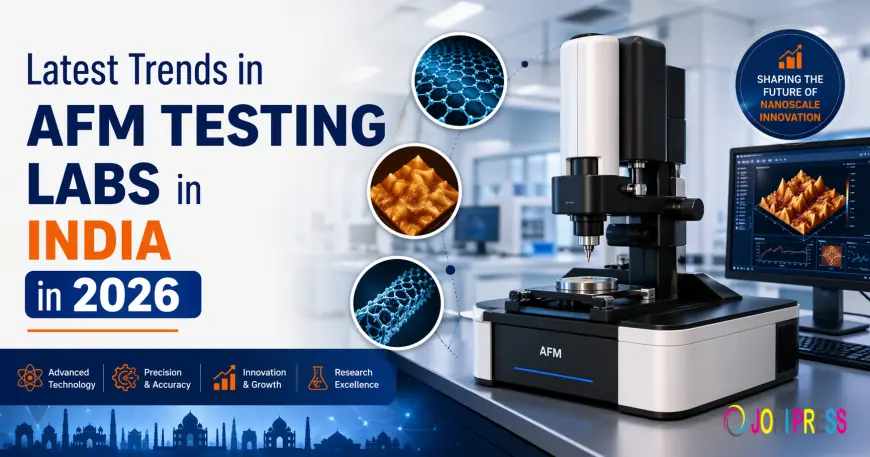
Atomic Force Microscopy (AFM) has emerged as one of the most powerful tools for nanoscale characterization, enabling scientists and industries to study surface morphology, mechanical properties, and material behavior with extreme precision. In India, AFM testing labs are rapidly advancing to support the growing demands of sectors such as semiconductors, nanotechnology, pharmaceuticals, and advanced manufacturing.
As we progress through 2026, AFM testing labs in India are not just upgrading their instrumentation but also transforming their methodologies, workflows, and service capabilities. Below is a detailed look at the latest trends shaping this evolution.
1. Adoption of AI and Automation in AFM Testing
One of the most transformative trends is the integration of artificial intelligence (AI) and automation into AFM systems. Traditionally, AFM required skilled operators to manually adjust parameters such as scan size, resolution, and probe interaction. However, modern AFM systems now incorporate intelligent algorithms that can:
-
Automatically optimize scanning conditions
-
Detect and correct imaging errors
-
Analyze large datasets with minimal human intervention
This shift is significantly improving efficiency, reducing human error, and enabling high-throughput testing. Indian AFM labs are increasingly adopting these smart systems to deliver faster and more reliable results, especially for industrial clients who require consistent quality.
2. Multi-Technique Integration for Comprehensive Analysis
AFM testing labs in India are moving toward integrated analytical platforms. Instead of relying solely on AFM, labs are combining it with complementary techniques such as:
-
Scanning Electron Microscopy (SEM)
-
Raman Spectroscopy
-
Optical Profilometry
This multi-modal approach allows researchers to gather structural, chemical, and mechanical information from a single sample. For example, while AFM provides surface topography at the nanoscale, Raman spectroscopy can reveal chemical composition, creating a more holistic understanding of the material.
Such integration is particularly valuable in research institutions and industries like semiconductors and materials science, where complex characterization is essential.
3. Growing Demand from the Semiconductor Industry
India’s push toward becoming a global semiconductor manufacturing hub is significantly influencing AFM testing labs. As chip sizes shrink to the nanoscale, the need for precise surface analysis becomes critical.
AFM is widely used in semiconductor applications for:
-
Surface roughness measurement
-
Thin film analysis
-
Defect detection
-
Failure analysis
AFM testing labs are upgrading their capabilities to support wafer-level inspection and process optimization. This trend is expected to accelerate as India continues to invest in semiconductor fabrication and electronics manufacturing.
4. Expansion in Life Sciences and Biotechnology
AFM is no longer limited to material science—it is increasingly being used in life sciences and biotechnology. Indian AFM testing labs are expanding their services to cater to:
-
Protein and DNA analysis
-
Cell imaging in physiological conditions
-
Drug delivery research
-
Tissue mechanics studies
AFM’s ability to operate in liquid environments makes it ideal for studying biological samples in their natural state. This has opened new opportunities in pharmaceutical research, diagnostics, and biomedical engineering.
5. Advancements in Probe Technology
The performance of AFM largely depends on the probe or tip used during scanning. In 2026, significant advancements in probe technology are enhancing the capabilities of AFM testing labs in India.
Modern probes can now measure:
-
Electrical conductivity
-
Magnetic properties
-
Thermal behavior
-
Mechanical stiffness
These specialized probes enable multifunctional analysis, allowing labs to offer a wider range of testing services. Additionally, improvements in probe durability and sensitivity are reducing operational costs and improving measurement accuracy.
6. High-Speed and High-Throughput AFM Systems
Speed has traditionally been a limitation of AFM. However, recent innovations have led to the development of high-speed AFM systems capable of scanning larger areas in less time.
Indian AFM labs are adopting these systems to:
-
Increase sample throughput
-
Reduce turnaround time
-
Support industrial-scale testing
This trend is particularly important for industries such as electronics and coatings, where large volumes of samples need to be analyzed quickly without compromising accuracy.
7. Emergence of Portable and Compact AFM Instruments
Another notable trend is the development of compact and portable AFM systems. These instruments are designed for:
-
On-site testing
-
Field research
-
In-situ industrial analysis
Portable AFM systems are making it easier for industries to perform real-time quality control without sending samples to centralized labs. This is especially beneficial for sectors like manufacturing, energy, and environmental monitoring.
8. Increased Focus on Non-Destructive Testing (NDT)
AFM is inherently a non-destructive technique, making it ideal for analyzing sensitive or high-value samples. In 2026, there is a growing emphasis on using AFM for non-destructive testing in India.
Industries such as aerospace, electronics, and nanotechnology prefer AFM because it:
-
Preserves sample integrity
-
Provides high-resolution data
-
Reduces material wastage
This aligns with the global trend toward sustainable and efficient testing practices.
9. Growth in Nanotechnology and Advanced Materials Research
India is making significant investments in nanotechnology and advanced materials research. AFM testing labs are playing a crucial role in supporting these initiatives by providing detailed nanoscale analysis.
Applications include:
-
Nanomaterials characterization
-
Thin film and coating analysis
-
Polymer research
-
Energy storage materials (batteries, fuel cells)
Academic institutions, government research centers, and private labs are all contributing to this growth, creating a strong ecosystem for innovation.
10. User-Friendly Interfaces and Skill Accessibility
Modern AFM systems are becoming more user-friendly, with intuitive software and automated workflows. This is reducing the dependency on highly specialized operators and making AFM technology more accessible.
In India, this trend is leading to:
-
Wider adoption in educational institutions
-
Increased training opportunities
-
Expansion of AFM services to smaller labs and startups
As a result, the overall reach of AFM testing is expanding beyond elite research facilities.
11. Rise of Contract Testing and Outsourcing Services
With increasing demand for AFM analysis, many companies are opting to outsource their testing needs to specialized labs instead of investing in expensive equipment.
AFM testing labs in India are capitalizing on this trend by offering:
-
Customized testing services
-
Quick turnaround times
-
Cost-effective solutions
This has led to the growth of third-party testing labs that cater to both domestic and international clients.
12. Digitalization and Data Management
Data generated by AFM is highly detailed and complex. In 2026, AFM labs are focusing on digital transformation by implementing:
-
Cloud-based data storage
-
Advanced data visualization tools
-
Remote access for clients
This allows clients to access their results in real time and collaborate more effectively with testing labs. Digitalization is also improving traceability and data security.
Conclusion
The landscape of AFM testing labs in India in 2026 is defined by rapid technological advancements, increased industrial demand, and expanding application areas. From AI-driven automation and high-speed scanning to multi-technique integration and life science applications, AFM is becoming more versatile and accessible than ever before.
As India continues to invest in research, innovation, and manufacturing, AFM testing labs will play a critical role in enabling precision analysis and supporting next-generation technologies. Businesses and researchers that leverage these advancements will be better positioned to stay competitive in an increasingly technology-driven world.
What's Your Reaction?
 Like
0
Like
0
 Dislike
0
Dislike
0
 Love
0
Love
0
 Funny
0
Funny
0
 Angry
0
Angry
0
 Sad
0
Sad
0
 Wow
0
Wow
0