






































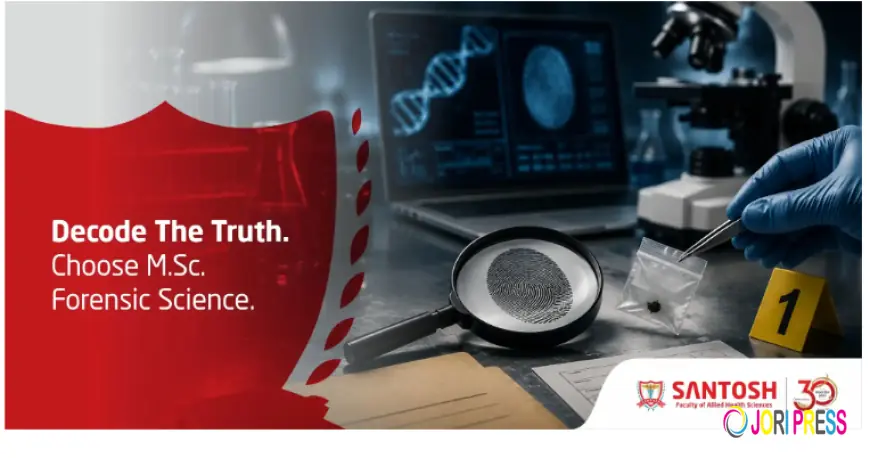
Is M.Sc. Forensic Science Your Next Move?
Is M.Sc. Forensic Science Your Next Move?
1. Where Science Meets Justice
A fingerprint on a glass. DNA trace from a crime scene. A hard drive wiped but not erased. A document forged, but only to an untrained eye. In each of these situations, the difference between a conviction and an acquittal — between justice served and a case unsolved — often comes down to one person: the forensic scientist.
Forensic science is not what you see on TV. It is slower, more rigorous, and far more intellectually demanding than any crime drama suggests. It is the application of chemistry, biology, physics, digital technology, and law — all converging on a single question: what does the evidence actually say?
The M.Sc. Forensic Science programme at Santosh Deemed to be University, Ghaziabad is designed to answer that question seriously — with advanced laboratory training, instrumental analysis, crime scene investigation methodology, digital forensics, and legal-ethical grounding. If you have a science background and want a postgraduate career that is genuinely unlike anything else in healthcare or research, this is worth your full attention.
2. What is M.Sc. Forensic Science?
The M.Sc. in Forensic Science is a 2-year (4-semester) postgraduate degree built on a CBCS (Choice Based Credit System) curriculum, offered at Santosh Deemed to be University, Ghaziabad in regular, full-time mode. It is designed for science graduates who want to move into forensic investigation, criminalistics, medico-legal analysis, digital evidence examination, or forensic research.
The programme integrates investigative procedures, laboratory-based analysis, instrumental techniques, and legal-ethical considerations — preparing graduates not just to perform forensic tests, but to interpret findings, write expert reports, and function within real judicial and law-enforcement environments. The curriculum follows standard operating procedures and admissibility requirements consistent with accredited forensic practice in India.
At a time when Indian courts are increasingly relying on scientific evidence, and when cybercrime, drug trafficking, and forensic fraud cases are rising sharply, the demand for trained forensic scientists has never been more real — or more urgent.
|
India currently has fewer than 30 Central Forensic Science Laboratories (CFSLs) and State FSLs combined, serving a population of 1.4 billion. The gap between forensic science demand and trained professional supply is one of the most significant in the entire healthcare and justice ecosystem — and it creates strong career opportunities for well-qualified graduates. |
3. Course Overview at a Glance
|
Course Detail |
Information |
|
Programme Name |
M.Sc. Forensic Science |
|
Offered By |
Santosh Deemed to be University, Ghaziabad |
|
Programme Level |
Postgraduate Degree |
|
Duration |
2 Years (4 Semesters) — CBCS-Based Curriculum |
|
Mode of Study |
Regular / Full-Time |
|
Annual Fee |
Rs. 1,50,000/- |
|
Eligibility |
Bachelor's degree in Science / Engineering / Pharmacy / Medicine or any Science stream graduate with minimum 50% at graduation |
|
Admission Process |
Direct Admission — admission.santosh.ac.in |
|
Core Training Areas |
Criminalistics, Forensic Biology, Forensic Chemistry, Toxicology, Digital & Cyber Forensics, Document Examination, Fingerprinting, Medico-Legal Investigations, Expert Reporting |
4. Eligibility Criteria
|
Eligibility Parameter |
Requirement |
|
Minimum Education |
Bachelor's degree in Science, Engineering, Pharmacy, or Medicine from a recognised university |
|
Also Eligible |
Any graduate from a science stream |
|
Minimum Marks |
50% aggregate at graduation level |
|
NEET Requirement |
Not required |
|
Admission Mode |
Direct Admission — visit admission.santosh.ac.in |
Note: The wide eligibility range — covering graduates from science, pharmacy, engineering, and medicine — makes this programme accessible to students from diverse backgrounds who share a serious interest in forensic investigation and applied science. Candidates are advised to confirm current requirements at the time of application.
5. Course Curriculum — Semester by Semester
| Semester | Focus Areas |
|---|---|
| 1st | Introduces students to the fundamental principles of forensic science, crime investigation processes, ethical practice, and basic documentation and evidence-handling skills. |
| 2nd | Builds analytical competence through laboratory-based examination of physical, biological, and chemical evidence, along with medico-legal interpretation and research fundamentals. |
| 3rd | Advances students into specialized forensic domains, emphasizing instrumental analysis, pattern and identity examination, digital evidence handling, and applied investigative reasoning. |
| 4th | Focuses on expert-level forensic interpretation, integration of multidisciplinary evidence, and independent research leading to professional and academic readiness. |
6. Career Opportunities & Salary
|
Career Role |
What You Do & Where |
|
Forensic Scientist / Forensic Analyst |
Scientific examination of physical, biological, chemical, and digital evidence in government or private forensic laboratories for criminal investigations |
|
Crime Scene Investigation Officer |
Crime scene documentation, evidence collection, reconstruction, and coordination with law-enforcement agencies |
|
Questioned Document & Fingerprint Examiner |
Analyse handwriting, signatures, ink, paper, and fingerprint evidence — working with courts, law enforcement, and investigative agencies |
|
Digital & Cyber Forensics Analyst |
Work in cybercrime cells, IT forensics units, and digital evidence labs — recovering, analysing, and presenting digital evidence from devices and networks |
|
Medico-Legal & Toxicology Lab Professional |
Support medico-legal investigations involving toxicology, drug analysis, forensic chemistry, and biological evidence in hospitals, labs, and regulatory settings |
|
Forensic Research / Academia |
Pursue M.Phil./PhD and contribute to forensic science research, faculty positions, or policy and standards development |
Salary overview for M.Sc. Forensic Science graduates in India:
|
Experience Level |
Average Monthly Salary (India) |
|
Fresher — Government / Private Lab |
Rs. 22,000 – Rs. 35,000 |
|
Mid-Level (2–4 years) |
Rs. 38,000 – Rs. 58,000 |
|
Senior Forensic Scientist (5+ years) |
Rs. 60,000 – Rs. 90,000+ |
|
Specialist / Expert Witness / Research Lead |
Rs. 80,000 – Rs. 1,30,000+ |
Government forensic science laboratory positions — under CFSLs, state FSLs, CBI, and narcotics agencies — offer structured pay scales, job security, and career progression. Private roles in digital forensics and cybercrime investigation are among the fastest-growing and best-compensated in the field. International career opportunities exist in forensic labs, Interpol-linked agencies, and multinational investigative organisations.
|
Career tip: Digital and cyber forensics is the fastest-growing sub-discipline within forensic science globally. M.Sc. Forensic Science graduates who develop strong capabilities in digital evidence analysis, network forensics, and cybercrime investigation are among the most in-demand professionals in both law enforcement and the private sector. |
Frequently Asked Questions (FAQs)
Q1. Is forensic science a good career in India?
Yes — and the timing is particularly good. India is actively expanding its forensic infrastructure, with new state forensic science labs being established and increasing judicial reliance on scientific evidence. The Forensic Science Laboratories Amendment Bill and national crime investigation reforms are driving demand for trained forensic professionals. The supply of well-trained graduates is still significantly below demand.
Q2. Who is eligible to apply for M.Sc. Forensic Science?
Any graduate from a science stream — including B.Sc. in Chemistry, Biology, Physics, Forensic Science, Microbiology, Biotechnology, B.Pharm, MBBS, BDS, or B.E./B.Tech. in relevant engineering disciplines — with a minimum of 50% aggregate at graduation level is eligible. The programme is intentionally open to a wide science background.
Q3. What is the scope of M.Sc. Forensic Science for government jobs?
Government career pathways include Central Forensic Science Laboratories (CFSLs), State Forensic Science Laboratories, CBI, Narcotics Control Bureau, Income Tax Investigation, Central Customs, and various state police forensic units. Entry into these roles typically involves national or state-level competitive examinations after the M.Sc. degree.
Q4. Does M.Sc. Forensic Science include digital forensics and cybercrime?
Yes. The programme's third semester specifically covers digital evidence handling, forensic computing, and cybercrime investigation methodology. This makes the degree relevant for both traditional forensic roles and the growing demand for digital and cyber forensics professionals in police cybercrime cells, IT forensics units, and corporate investigation teams.
Q5. Can I pursue a PhD after M.Sc. Forensic Science?
Yes. The M.Sc. Forensic Science degree provides a strong foundation for doctoral-level specialisation in forensic chemistry, forensic biology, digital forensics, toxicology, or criminalistics. Santosh Deemed to be University supports doctoral research, and graduates may also pursue PhD programmes at other universities in India and internationally.
Q6. What is the fee and how do I apply?
The annual fee is Rs. 1,50,000/-. Apply online at admission.santosh.ac.in or contact the admissions office at 0120-4933350 / 7838554401. Admission is direct — seats are offered on a first-come, first-served basis, so early application is recommended.
What's Your Reaction?
 Like
0
Like
0
 Dislike
0
Dislike
0
 Love
0
Love
0
 Funny
0
Funny
0
 Angry
0
Angry
0
 Sad
0
Sad
0
 Wow
0
Wow
0