









































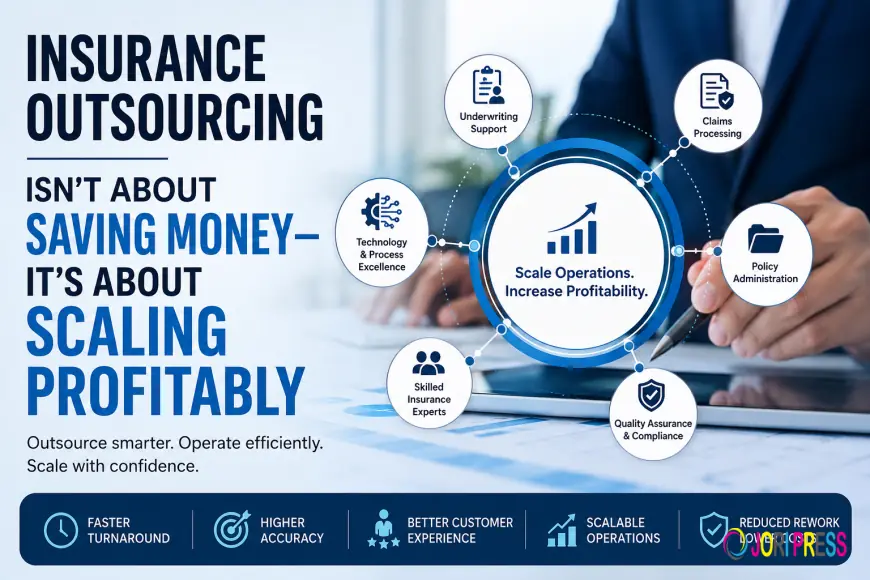
Insurance Outsourcing Isn't About Saving Money—It's About Scaling Profitably
The insurance industry is under more pressure today than ever before. Rising claim volumes, underwriting backlogs, stricter regulatory requirements, and increasing customer expectations have made it difficult for insurers to grow without expanding operational costs. At the same time, finding experienced insurance professionals has become increasingly challenging, making it harder to maintain service quality while scaling operations.
The insurance industry is under more pressure today than ever before. Rising claim volumes, underwriting backlogs, stricter regulatory requirements, and increasing customer expectations have made it difficult for insurers to grow without expanding operational costs. At the same time, finding experienced insurance professionals has become increasingly challenging, making it harder to maintain service quality while scaling operations.
For years, insurance outsourcing was viewed primarily as a way to reduce labor costs. Today, that perspective has changed. Leading insurers, MGAs, brokers, and TPAs are outsourcing not simply to save money but to build scalable, efficient, and profitable operations. Modern insurance outsourcing enables organizations to improve operational efficiency, accelerate turnaround times, enhance service quality, and allow internal teams to focus on strategic business decisions rather than repetitive administrative tasks.
The Traditional View of Insurance Outsourcing
Historically, insurance companies outsourced operational tasks because it reduced staffing costs. Administrative work such as policy processing, document indexing, and data entry was often transferred to external service providers where labor costs were lower.
While cost savings remain an important benefit, insurers have realized that reducing expenses alone does not solve their biggest operational challenges. Many organizations continue to struggle with:
- Increasing policy volumes
- Claims surges after catastrophic events
- Hiring and retaining skilled insurance professionals
- Complex regulatory compliance requirements
- Operational inefficiencies
- Delayed customer service
These issues directly impact profitability. A company may lower payroll expenses, but if claims processing slows down, underwriting quality suffers, or customer satisfaction declines, the financial consequences can quickly outweigh the initial savings.
Profitability Depends on Operational Efficiency
Insurance profitability is influenced by much more than premium revenue. Every delayed approval, incomplete file, processing error, or unnecessary touchpoint adds operational costs and reduces productivity.
Modern insurers are therefore focusing on improving key operational metrics, including:
- Faster turnaround times
- Higher processing accuracy
- Increased workforce productivity
- Better customer experience
- Stronger compliance management
- Scalable operations
Insurance outsourcing supports these objectives by allowing trained insurance professionals to manage structured operational workflows while in-house teams focus on underwriting decisions, risk assessment, client relationships, and business growth.
Why Scaling Is More Important Than Cost Cutting
Business growth naturally creates operational complexity. As insurers expand into new markets, launch new products, or acquire more customers, workloads increase significantly.
Hiring additional employees is often a slow and expensive process. Recruitment, onboarding, training, and compliance preparation require considerable time before new hires become fully productive. During peak seasons or catastrophe events, internal teams may become overwhelmed, resulting in processing delays and declining service quality.
An experienced insurance outsourcing partner provides immediate operational capacity without the long hiring cycle. Instead of rapidly expanding internal teams, insurers can scale operations with trained insurance professionals who already understand industry workflows and service-level expectations.
This flexibility allows organizations to respond quickly to changing business demands while maintaining operational consistency.
Insurance Functions That Can Be Outsourced
Modern insurance outsourcing extends well beyond basic administrative support. Today, many knowledge-intensive insurance processes can be successfully outsourced while insurers maintain complete control over strategic decision-making.
Underwriting Support
Underwriters often spend valuable time on administrative work instead of evaluating risks.
Insurance outsourcing partners can support underwriting teams through:
- Submission review
- Data validation
- Document indexing
- APS management
- Renewal preparation
- Quote support
By handling these repetitive processes, outsourcing partners allow underwriters to focus on risk analysis and policy decisions.
Claims Processing Support
Claims departments frequently experience sudden workload increases, particularly after natural disasters or large-scale events.
Outsourced claims teams can assist with:
- Claims documentation review
- File preparation
- Completeness verification
- Fraud indicator flagging
- Quality checks
This additional support helps insurers reduce claim turnaround times while maintaining accuracy and consistency throughout the claims lifecycle.
Policy Administration
Policy servicing includes numerous routine activities that consume significant operational resources every day.
Common outsourced policy administration functions include:
- Policy issuance
- Endorsements
- Renewals
- Reinstatements
- Cancellations
- Documentation management
Delegating these repetitive tasks allows internal staff to concentrate on customer engagement, complex policy issues, and relationship management.
Quality Assurance and Compliance
Quality control is essential in insurance operations, particularly in highly regulated markets.
Insurance outsourcing providers often perform:
- File quality reviews
- Standard operating procedure (SOP) compliance checks
- Documentation verification
- Internal audit preparation
- Regulatory reporting support
These quality assurance processes help reduce operational errors while improving consistency across insurance operations.
Reducing Rework Improves Profitability
One of the most overlooked costs in insurance operations is rework.
Incomplete documentation, incorrect data entry, missing information, or processing errors often require files to be reviewed multiple times before completion. Every additional review consumes valuable employee time, increases operating costs, delays customer service, and reduces productivity.
Experienced insurance outsourcing providers implement structured quality control processes before files move to the next stage.
This results in several operational benefits:
- Earlier error identification
- Improved documentation quality
- Reduced processing delays
- Lower operational costs
- Faster business decisions
In many cases, reducing rework delivers greater long-term financial value than reducing labor costs alone.
Faster Turnaround Creates Competitive Advantage
Today's insurance customers expect faster responses when purchasing policies, requesting endorsements, or filing claims.
Long processing times can negatively impact customer satisfaction, retention, and overall business reputation.
Insurance outsourcing improves turnaround time by:
- Increasing operational capacity
- Running parallel workflows
- Managing workload fluctuations
- Monitoring service-level agreements (SLAs)
- Accelerating document processing
Instead of maintaining oversized permanent teams, insurers gain flexible operational support that scales according to business demand.
Technology and Process Excellence Drive Better Results
Modern insurance outsourcing combines experienced professionals with standardized processes and advanced technology.
Leading insurance KPO providers typically use:
- Workflow management systems
- Performance dashboards
- Quality monitoring tools
- AI-assisted document processing
- Secure information management
- Process automation
These technologies provide greater visibility into operational performance while helping insurers monitor turnaround time, productivity, quality scores, and SLA compliance in real time.
Choosing the Right Insurance Outsourcing Partner
Not all outsourcing providers offer the same level of expertise.
The most successful insurance organizations partner with providers that possess deep insurance domain knowledge rather than generic business process outsourcing experience.
When selecting an insurance outsourcing partner, companies should evaluate:
- Insurance industry expertise
- Regulatory compliance knowledge
- Quality assurance frameworks
- Information security standards
- SLA management capabilities
- Transparent reporting
- Operational scalability
- Continuous process improvement
A reliable insurance KPO partner acts as an extension of the insurer's internal operations, contributing to long-term operational success rather than simply providing additional manpower.
The Future of Insurance Outsourcing
Insurance outsourcing continues to evolve beyond traditional labor savings.
Forward-thinking insurers increasingly view outsourcing as a strategic operating model that enables sustainable growth while maintaining quality, compliance, and customer satisfaction.
Emerging trends shaping the future include:
- AI-supported insurance operations
- Hybrid workforce models
- Intelligent process automation
- Real-time operational dashboards
- Predictive workload management
- Stronger governance and cybersecurity practices
As digital transformation accelerates, insurance outsourcing will play an even greater role in helping insurers build agile, resilient, and future-ready operations.
Conclusion
Insurance outsourcing is no longer just a cost-saving initiative. It has become a strategic growth strategy that enables insurers to improve efficiency, increase scalability, and strengthen profitability.
By outsourcing operational functions such as underwriting support, claims processing, policy administration, and quality assurance, insurers can reduce processing delays, improve accuracy, enhance compliance, and allow internal teams to focus on high-value business activities.
Organizations that view outsourcing as a long-term operational partnership rather than a short-term cost-cutting exercise are better positioned to adapt to changing market conditions and deliver superior customer experiences. With the right insurance KPO partner, insurers can scale confidently, operate more efficiently, and achieve sustainable, profitable growth.
What's Your Reaction?
 Like
0
Like
0
 Dislike
0
Dislike
0
 Love
0
Love
0
 Funny
0
Funny
0
 Angry
0
Angry
0
 Sad
0
Sad
0
 Wow
0
Wow
0