






































What Is Driving the Adoption of Industrial Heat Pumps Across India's Manufacturing Sector?
Discover why industrial heat pumps are gaining popularity in India's manufacturing sector through energy savings, waste heat recovery and sustainable heating.
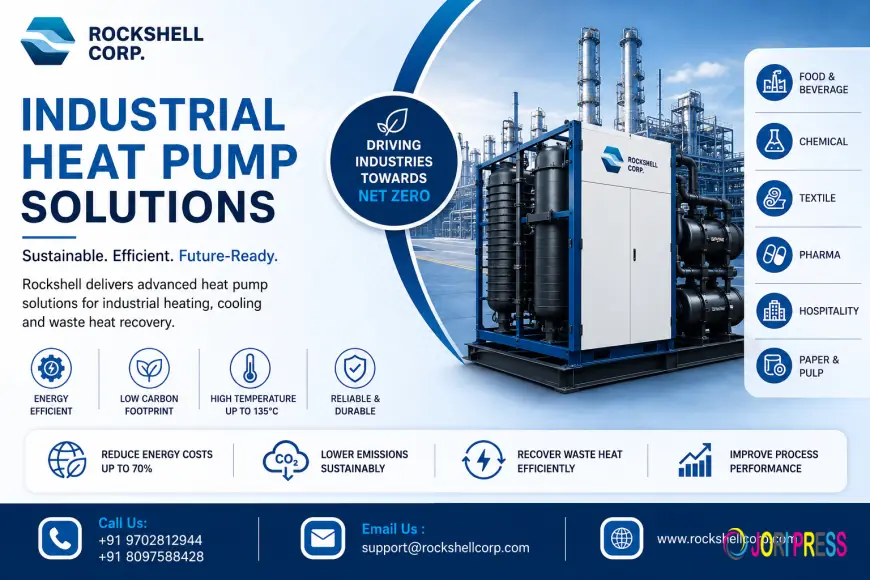
India's manufacturing sector is increasingly focusing on energy efficiency, lower operating costs, and sustainable production. In this changing landscape, the industrial heat pump in India is gaining attention as an effective solution for meeting industrial heating requirements while reducing energy consumption. By recovering waste heat and upgrading it to useful temperatures, industrial heat pumps help manufacturers improve thermal efficiency and reduce their dependence on conventional fossil-fuel-based heating systems.
From food processing and pharmaceuticals to chemicals, textiles, and paper manufacturing, industries are exploring advanced heating technologies. With growing interest in decarbonisation and energy optimisation, industrial heat pumps are becoming an important part of India's evolving industrial energy strategy.
1. Rising Energy Costs and the Need for Greater Efficiency
Energy is a major operational expense for manufacturing facilities. Traditional boilers and fuel-based heating systems often consume significant amounts of electricity, coal, or natural gas, depending on the application. Consequently, rising energy costs encourage manufacturers to explore more efficient alternatives.
Industrial heat pumps transfer heat from available sources rather than relying entirely on direct fuel combustion. They can recover waste heat from industrial processes, cooling systems, and exhaust streams and upgrade it for reuse in applications such as water heating, drying, and process heating.
As a result, businesses can improve overall energy utilisation and potentially lower operating expenses. The actual savings depend on the heat source, required output temperature, operating hours, and system design.
2. Sustainability Goals and Lower Carbon Emissions
Indian manufacturers are under increasing pressure to improve environmental performance and reduce their carbon footprint. As companies work towards sustainability targets, energy-efficient technologies are becoming an important consideration in plant upgrades and new industrial projects.
An industrial heat pump can support these efforts by reducing fuel consumption and making better use of otherwise wasted thermal energy. When powered by lower-carbon electricity, these systems can also contribute to reduced operational emissions compared with conventional fossil-fuel heating.
Moreover, integrating waste heat recovery with industrial heating can help facilities reduce energy losses without compromising essential production requirements. This makes heat pumps a practical option for businesses looking to balance sustainability objectives with operational performance.
3. Advancements in High-Temperature Heat Pump Technology
One of the biggest factors driving adoption is the development of high-temperature heat pumps that can meet more demanding industrial heating requirements. Earlier systems were primarily suitable for lower-temperature applications. However, modern technologies can supply higher-temperature hot water and process steam, making them relevant to a broader range of manufacturing operations.
These systems can support applications such as textile dyeing, chemical processing, pharmaceutical production, food processing, and paper drying. Depending on the technology and configuration, they can also help manufacturers recover waste heat from cooling systems, wastewater, and other process streams.
Rockshell Corp offers industrial heating solutions, including high-temperature heat pumps and steam heat pumps, designed for demanding industrial applications. Its solutions can help businesses explore energy-efficient alternatives to conventional heating equipment while aligning system performance with specific process requirements.
4. Government Initiatives and the Shift Towards Industrial Electrification
India's broader focus on energy efficiency, industrial modernisation, and emissions reduction is encouraging manufacturers to reassess their heating infrastructure. Businesses are increasingly evaluating technologies that can support long-term sustainability goals while maintaining production reliability.
Industrial electrification is an important part of this transition. By replacing or supplementing fossil-fuel-based boilers with suitable electric heating technologies, manufacturers can reduce direct fuel consumption. However, the overall environmental benefit also depends on the electricity source and the efficiency of the installed system.
Additionally, integrating an industrial heat pump into an existing facility requires careful planning. Manufacturers must evaluate temperature requirements, available waste heat, electricity tariffs, installation costs, and expected payback periods. A detailed feasibility study helps determine whether the technology offers practical and financial benefits for a particular production process.
Conclusion
The growing adoption of the industrial heat pump in India is driven by rising energy costs, sustainability commitments, improved high-temperature technology, and the need for efficient industrial heating. By recovering waste heat and converting it into useful thermal energy, these systems offer manufacturers an opportunity to improve energy utilisation while reducing reliance on conventional fuel-based heating.
For businesses exploring this transition, Rockshell Corp provides high-temperature and steam heat pump solutions tailored to industrial heating requirements.
What's Your Reaction?
 Like
0
Like
0
 Dislike
0
Dislike
0
 Love
0
Love
0
 Funny
0
Funny
0
 Angry
0
Angry
0
 Sad
0
Sad
0
 Wow
0
Wow
0