








































Bauer Bodoni: How to Decide Between an In-House Marketer, a Freelancer, and an Agency
Choosing the right marketing setup depends on your workload, skills, management capacity, and goals. This guide compares in-house marketers, freelancers, agencies, and hybrid models to help businesses build a practical marketing structure.
Choosing between an in-house marketer, a freelancer, and a marketing agency is one of the first serious marketing decisions a growing business makes, and one of the easiest to get wrong. Bauer Bodoni meets owners who hired in the wrong order: a full-time marketer with no strategy to execute, a freelancer expected to behave like a department, or an agency engaged before the owner knew what they wanted. Each option works in the right situation and fails predictably in the wrong one. This article sets out what each choice gives you, the trade-offs nobody mentions in sales calls, and five questions that settle the decision.
bauerbodoni.com
Start With the Work, Not the Job Title
Most owners start by asking whether to hire someone or hire an agency. A better first question: what marketing work actually needs doing each month? List it honestly: always-on execution, specialist tasks that spike and fade, and strategic decisions about where to focus.
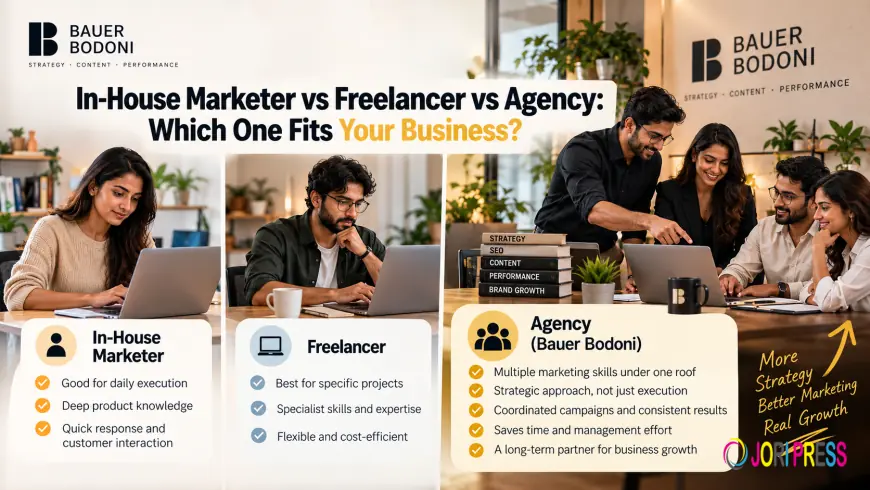
The three options map to different kinds of work. An in-house marketer suits always-on execution and deep product knowledge. A freelancer suits defined tasks with a clear end. An agency suits breadth: several skills under one roof with the process to coordinate them.
Write the list before speaking to any candidate or agency. Mark which tasks repeat weekly, which need rare expertise, and which decisions you have been avoiding. That one page becomes your brief.
The Honest Case for an In-House Marketer
An in-house marketer lives inside your business, learns the product, and can publish or reply the same day. For daily customer conversation, social management, and review responses, that immersion is hard to replicate from outside.
The trade-off is breadth. One person rarely covers strategy, copywriting, design, advertising, SEO, and analytics professionally. You also take on management: priorities, reviews, development. If you cannot do that, the role drifts within months.
There is also the single-point-of-failure risk. When your only marketer is on leave or resigns, the whole function pauses. Plan for it with documented processes, shared account access, and a standing relationship with a freelancer or agency for cover.
The Honest Case for a Freelancer
Freelancers sell depth in a defined area. A strong freelance media buyer, SEO specialist, or copywriter can beat a generalist team on their home turf, and you pay only for work you need. For project-shaped needs like a website rebuild or a three-month ad test, this is often the most efficient choice.
The trade-off is context and continuity. A freelancer juggles several clients, so your urgency is one among many; if one disappears mid-project, you inherit half-finished work. Define the deliverable precisely and keep all accounts in your name from day one.
Vetting matters more than negotiation. Ask for two recent examples of the exact work you need, speak to one past client, and start with a small paid trial. One who resists a trial or cannot explain their process plainly is telling you something.
The Honest Case for an Agency
An agency gives you a team and a process: strategists, writers, designers, and media specialists with coordination built in. Good agencies bring pattern recognition too: they have seen what works for businesses like yours and what reliably fails.
The trade-offs are real. Agencies need onboarding time, and your account shares attention with other clients, so responsiveness depends on structure, not promises. Agencies are also only as good as the brief: vague goals produce vague work, no matter who executes.
Judge agencies on process, not portfolios alone. Ask who exactly works on your account, how reporting works, what the first 30 days look like, and how they handle strategic disagreement. One that cannot describe its process will not bring clarity to your marketing.
Five Questions That Settle the Decision for Most Businesses
Work through these five questions in order. Most owners find the answer obvious by the third.
-
Continuous or project-shaped? Daily execution points in-house; a defined project points to a freelancer; ongoing multi-skill work points to an agency or hybrid.
-
One skill or five? One deep skill means hiring the freelancer. Five at once means a team: an agency, or an in-house lead supported by freelancers.
-
Who manages the marketer? Without an experienced manager, both drift. If you cannot manage marketing, an agency's account management has real value.
-
How fast must it produce? Freelancers start fastest. Agencies need onboarding, then move with a full team. In-house hiring is slowest after recruitment and ramp-up.
-
What if the person leaves? Knowledge walks out unless you enforce documentation. Agencies retain institutional memory across staff changes.
The Hybrid Setup Most Growing Businesses Land On
Many growing businesses end up hybrid: an in-house person owns brand voice and daily execution while freelancers or an agency cover specialist work. It works because it matches the workload audit: always-on work stays inside, specialist work goes outside.
The risk is coordination: each party can assume someone else owns the strategy. Name one owner of the overall plan, in writing, with a regular review rhythm. Whether they sit inside your company or at the agency, everyone must know who it is.
Mistakes That Make Every Option Fail
The most common failure is unrelated to the hiring model: no definition of success. Start every engagement with one or two measurable outcomes and a review date. Without that, every option looks like it is failing within three months.
The second is expecting strategy from an executor. A junior hire or task freelancer executes the plan you give them; they will not invent a good one. If you need someone to decide what to do, hire for that explicitly.
The third is impatience with the wrong clock. Brand and search compound over quarters; paid campaigns judge in weeks. Constant restarts are the costliest marketing mistake, afflicting in-house teams, freelancers, and agencies equally.
Frequently Asked Questions
How long should I give a new marketing hire or agency before judging results?
Judge the process early and the outcomes on the channel's own timeline. Paid campaigns deserve six to eight weeks; content and search need two full quarters; a new hire needs a 90-day ramp with milestones.
Can a freelancer handle my full marketing strategy?
A few can, but most are executors. If you are hiring a freelancer for strategy, vet for it: ask how they set direction for a similar business, not just which tasks they completed.
Should a small business hire in-house first or start with an agency?
Start from the workload audit. Daily, customer-facing work usually means hiring in-house first. Several skills at once, with no one to manage a team, usually means an agency delivers more in the first year.
What should be written down before engaging a freelancer or agency?
The measurable outcomes, the review date, who owns the accounts and files, the communication rhythm, and the exit terms. Five lines of clarity prevent most disputes.
Conclusion
There is no universally right answer, only the right one for your workload, management capacity, and timeline. Audit the work, match the hiring model to it, define success in writing, and name one owner of the plan. Bauer Bodoni helps businesses think through exactly this decision: mapping the real workload, choosing the fitting model, and setting up the engagement to produce measurable results. The right structure, chosen deliberately, beats the perfect hire chosen by habit.
What's Your Reaction?
 Like
0
Like
0
 Dislike
0
Dislike
0
 Love
0
Love
0
 Funny
0
Funny
0
 Angry
0
Angry
0
 Sad
0
Sad
0
 Wow
0
Wow
0