


































How to Choose the Right IIM Course for Your Career Goals
Discover how to choose the right IIM course based on your career goals, skills, interests, experience, course duration, and professional aspirations.
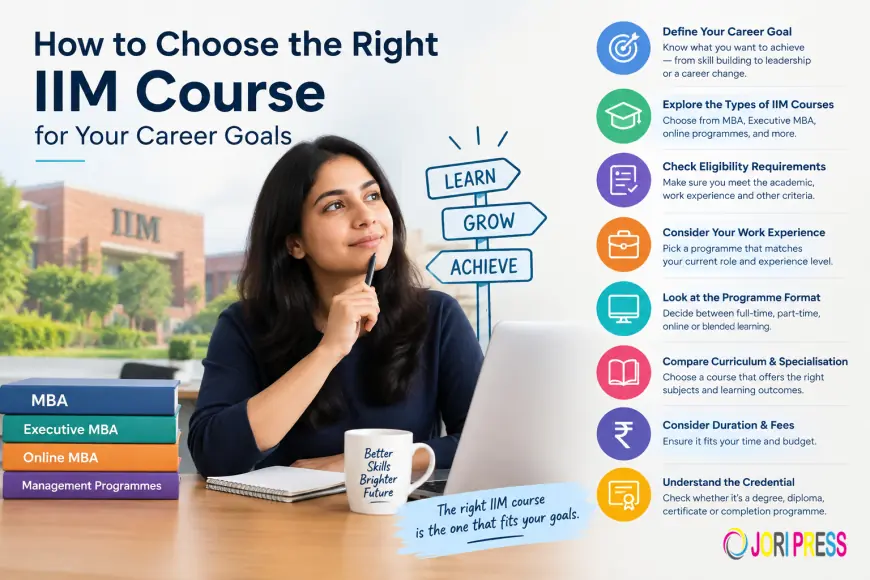
Choosing an IIM course is not simply about selecting a programme because it is offered by a well-known management institute. IIMs offer programmes for different types of learners, including students, working professionals, managers, entrepreneurs, and experienced executives. Each programme can have a different purpose, duration, eligibility criteria, learning format, and outcome.
For this reason, it is useful to understand your own career goals before deciding which IIM course may be suitable for you.
Start With Your Career Goal
The first step is to identify what you want to achieve through the programme.
Someone at the beginning of their career may be looking for broad management education, while a professional with several years of experience may want to develop leadership or specialised business skills. Similarly, someone planning a career change may need a programme that provides knowledge in a completely different area.
Think about whether your goal is to:
- Build a foundation in management
- Move into a managerial role
- Develop leadership skills
- Change your career path
- Gain knowledge in a specific business area
- Strengthen your existing professional skills
- Start or grow a business
Once the objective is clear, it becomes easier to narrow down the available IIM programmes.
Understand the Different Types of IIM Courses
IIMs offer more than the traditional two-year MBA. Depending on the institute, students and professionals may find MBA or PGP programmes, Executive MBA programmes, online programmes, and executive education courses.
A regular MBA or PGP is generally designed for candidates seeking comprehensive management education and typically follows a full-time format.
Executive programmes are generally aimed at professionals with prior work experience. They may focus on management, leadership, strategy, finance, marketing, analytics, or other areas.
Online and blended programmes can be considered by learners who want to continue working or studying while pursuing management education.
Understanding these differences is important because the programme name alone does not tell you everything about its structure or purpose.
Check the Eligibility Requirements
Eligibility is one of the first practical factors to consider when exploring IIM courses.
Different programmes can have different requirements related to academic qualifications, entrance examinations, work experience, or other criteria. The regular MBA route generally has a different admission process from many executive and specialised programmes.
CAT is commonly associated with admission to the flagship MBA programmes at IIMs, but not every IIM programme follows the same admission route.
Before shortlisting a course, check the latest eligibility criteria directly from the respective IIM. This can help you avoid spending time on programmes for which you do not meet the requirements.
Consider Your Work Experience
Work experience can influence which type of IIM programme makes sense for you.
Fresh graduates and professionals with limited experience may look at programmes designed for early-career candidates. Professionals who have already spent several years in the workplace may find executive or specialised programmes more relevant to their situation.
Your current role should also be considered. For example, a marketing professional interested in moving into a leadership position may look for management or strategy-focused learning, while someone working in technology may be interested in analytics, artificial intelligence, or digital business.
The aim should be to find a programme that connects your existing experience with the skills you want to develop.
Look at the Programme Format
The format of an IIM course can have a major impact on your decision.
A full-time residential programme requires a different level of commitment compared with an online or weekend programme. Working professionals may prefer a flexible format that allows them to continue their current employment.
Before applying, check whether the programme is:
- Full-time or part-time
- Online or campus-based
- Fully online or blended
- Weekend-based or conducted on weekdays
- Structured around live classes or recorded content
Also consider the expected study time outside scheduled classes. An online course can still require regular assignments, projects, and assessments.
Compare the Curriculum and Specialisation
The curriculum should match what you want to learn.
If you are looking for broad business knowledge, a general management programme may be appropriate. If you already know the area you want to develop, a specialised course could be more relevant.
Look at the subjects covered, teaching methods, projects, case studies, and learning outcomes. Do not choose a programme only because its title sounds relevant. Read the detailed curriculum and understand what you will actually study.
This is particularly important when comparing programmes from different IIMs, as similar-sounding courses can have very different structures.
Consider Duration and Fees
Time and cost are practical considerations that should not be overlooked.
Some IIM programmes may run for a few weeks or months, while others can continue for a year or longer. A longer programme may involve a deeper curriculum, but it also requires a greater time commitment.
Similarly, programme fees can vary significantly. Consider the complete cost, including any applicable campus, examination, travel, or other charges, rather than comparing only the headline fee.
The right programme should fit realistically into both your schedule and budget.
Understand the Credential
Before enrolling, understand exactly what credential the programme provides.
An IIM course may lead to a degree, diploma, certificate, or programme completion credential, depending on the programme. These are not interchangeable.
If your objective requires a particular type of qualification, verify what the programme awards and understand its scope. This distinction is especially important when comparing an MBA with an executive education or certificate programme.
Make Your Decision Based on Fit
There is no single IIM course that is suitable for everyone. The right choice depends on your education, work experience, career plans, available time, budget, and preferred learning format.
Instead of starting with the question, “Which IIM is the best?”, it can be more useful to ask, “Which programme fits what I want to do next?”
Once you understand your career goal and compare programmes on eligibility, curriculum, format, duration, fees, and credential, you can make a more informed decision.
IIMs offer a wide range of management education options, and taking the time to understand those options can help you find a programme that aligns with your current needs and future career direction.
What's Your Reaction?
 Like
0
Like
0
 Dislike
0
Dislike
0
 Love
0
Love
0
 Funny
0
Funny
0
 Angry
0
Angry
0
 Sad
0
Sad
0
 Wow
0
Wow
0