






































How GCMS Testing Labs Help in Residual Solvent Analysis
GCMS Residual Solvent Analysis ensures accurate detection of solvents. Discover how testing labs improve safety, compliance, and product quality.

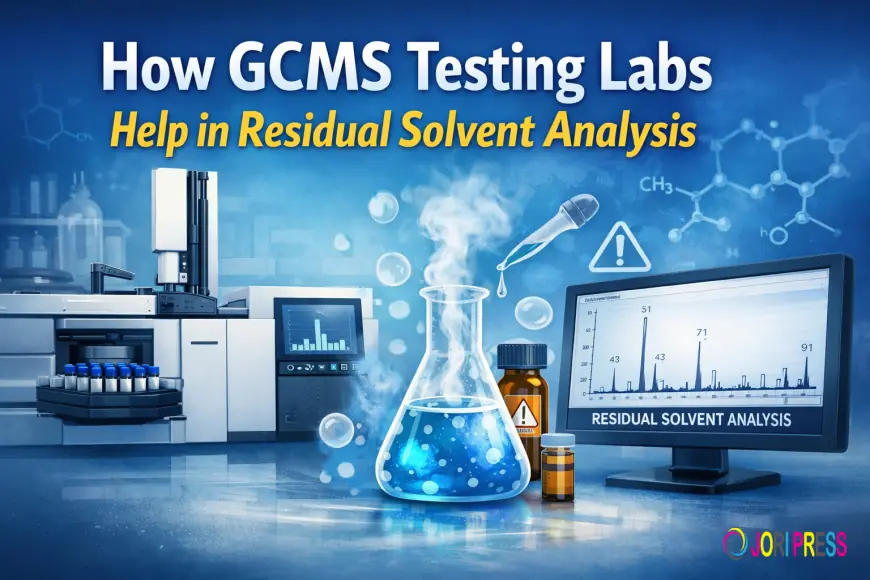
Residual solvent analysis is one of the most critical aspects of product safety and quality assurance, especially in industries like pharmaceuticals, food processing, cosmetics, and specialty chemicals. Even trace amounts of solvents left behind during manufacturing can affect human health, product stability, and regulatory compliance.
This is where GCMS (Gas Chromatography–Mass Spectrometry) testing labs become essential. Their advanced analytical capabilities allow businesses to detect, identify, and quantify residual solvents with exceptional accuracy—even at extremely low concentrations.
Let’s explore this topic in depth.
Understanding Residual Solvents
Residual solvents are volatile organic chemicals used during manufacturing processes such as:
-
Extraction of active ingredients
-
Chemical synthesis
-
Cleaning of equipment
-
Purification and crystallization
These solvents are not intended to remain in the final product, but complete removal is often difficult. As a result, trace levels may persist.
Classification of Residual Solvents
Regulatory bodies classify residual solvents based on toxicity:
-
Class 1 (Highly Toxic): Should be avoided (e.g., benzene)
-
Class 2 (Moderately Toxic): Limited use with strict limits
-
Class 3 (Low Toxicity): Considered safer but still regulated
Strict guidelines define permissible exposure limits to ensure consumer safety.
What Makes GCMS Ideal for Residual Solvent Analysis?
GCMS combines two powerful analytical techniques:
1. Gas Chromatography (GC)
-
Separates volatile compounds in a mixture
-
Works based on boiling point and polarity differences
2. Mass Spectrometry (MS)
-
Identifies compounds by their molecular structure
-
Provides a unique “mass fingerprint” for each substance
Why This Combination Matters
Residual solvent analysis requires:
-
High sensitivity
-
Accurate identification
-
Ability to handle complex mixtures
GCMS excels in all these areas, making it the preferred method worldwide.
Step-by-Step Process Used by GCMS Testing Labs
1. Sample Collection and Preparation
The process begins with proper sampling to avoid contamination or loss of volatile solvents.
Common Techniques:
-
Headspace Sampling (HS-GC): The most widely used method. It isolates volatile solvents from the sample without direct contact, ensuring accuracy.
-
Direct Injection: Used for liquid samples with higher solvent concentrations.
-
Solid Phase Microextraction (SPME): Advanced technique for ultra-trace detection.
2. Injection into the GC System
The prepared sample is introduced into the gas chromatograph, where:
-
It is vaporized
-
Carried by an inert gas (like helium) through a column
3. Separation of Compounds
Inside the GC column:
-
Compounds separate based on their chemical properties
-
Each solvent exits (elutes) at a different time (retention time)
This separation is crucial because multiple solvents may be present in a single sample.
4. Detection via Mass Spectrometry
As compounds exit the GC column:
-
They enter the mass spectrometer
-
Molecules are ionized and broken into fragments
-
The instrument detects these fragments and generates a mass spectrum
Each compound produces a unique spectral pattern, enabling precise identification—even in complex mixtures.
5. Quantification of Residual Solvents
The system measures:
-
Peak area or intensity
-
Concentration of each solvent
These values are compared against:
-
Calibration standards
-
Regulatory limits
The final report includes:
-
Identified solvents
-
Their concentrations
-
Compliance status
Advantages of GCMS Testing Labs in Residual Solvent Analysis
✔ Ultra-High Sensitivity
GCMS can detect solvents at parts-per-million (ppm) or even parts-per-billion (ppb) levels.
✔ Exceptional Accuracy
Mass spectral data ensures correct identification, reducing false positives or misinterpretation.
✔ Multi-Component Analysis
Simultaneously analyzes multiple solvents in a single run.
✔ Regulatory Acceptance
Globally recognized by regulatory authorities for compliance testing.
✔ Reproducibility
Consistent and reliable results across repeated tests.
Regulatory Standards for Residual Solvents
GCMS testing labs follow strict international guidelines, such as:
-
ICH Q3C Guidelines – Defines acceptable solvent limits
-
USP <467> – Standard method for pharmaceutical products
-
EP (European Pharmacopoeia) – European standards
-
FDA Regulations – U.S. compliance requirements
These standards ensure that products are safe for human use and meet global quality benchmarks.
Industry Applications of GCMS Residual Solvent Testing
Pharmaceuticals
-
Detect solvents in APIs and finished drugs
-
Ensure patient safety and regulatory approval
Food & Beverages
-
Identify contamination from packaging or processing
-
Maintain food safety standards
Cosmetics & Personal Care
-
Ensure products are free from harmful solvent residues
-
Protect skin and consumer health
Chemicals & Polymers
-
Verify product purity
-
Improve performance and stability
Risks of Ignoring Residual Solvent Testing
Failing to properly analyze residual solvents can result in:
-
Health hazards (toxicity, carcinogenic effects)
-
Product recalls
-
Legal and regulatory penalties
-
Loss of consumer trust
-
Export restrictions
This makes GCMS testing not just important—but essential.
How to Choose the Right GCMS Testing Lab
When selecting a GCMS testing lab, consider:
Accreditation
-
ISO/IEC 17025 certification ensures technical competence
Advanced Instrumentation
-
Modern GCMS systems improve accuracy and detection limits
Expertise
-
Experienced analysts can interpret complex results correctly
Turnaround Time
-
Faster reporting helps in quicker decision-making
Compliance Support
-
Labs that understand regulatory requirements add extra value
Future Trends in GCMS Testing
The field of GCMS analysis is evolving rapidly:
-
Automation and AI-based data analysis
-
Faster and more sensitive detectors
-
Green analytical chemistry (eco-friendly solvents)
-
Integration with laboratory information systems (LIMS)
These advancements will further enhance the efficiency and reliability of residual solvent testing.
Conclusion
GCMS testing labs play a pivotal role in ensuring product safety, quality, and compliance through precise residual solvent analysis. Their ability to detect even the smallest traces of harmful solvents makes them indispensable across industries.
As regulatory standards tighten and consumer awareness grows, the demand for accurate and reliable testing will continue to rise. Investing in GCMS-based analysis is not just a regulatory requirement—it’s a commitment to safety, quality, and trust.
What's Your Reaction?
 Like
0
Like
0
 Dislike
0
Dislike
0
 Love
0
Love
0
 Funny
0
Funny
0
 Angry
0
Angry
0
 Sad
0
Sad
0
 Wow
0
Wow
0