








































How Betting Tools Help Explain Odds and Probability?
Learn how betting tools explain football odds, implied probability, bookmaker margin, expected value and Kelly staking with practical examples from NaijaScore9.

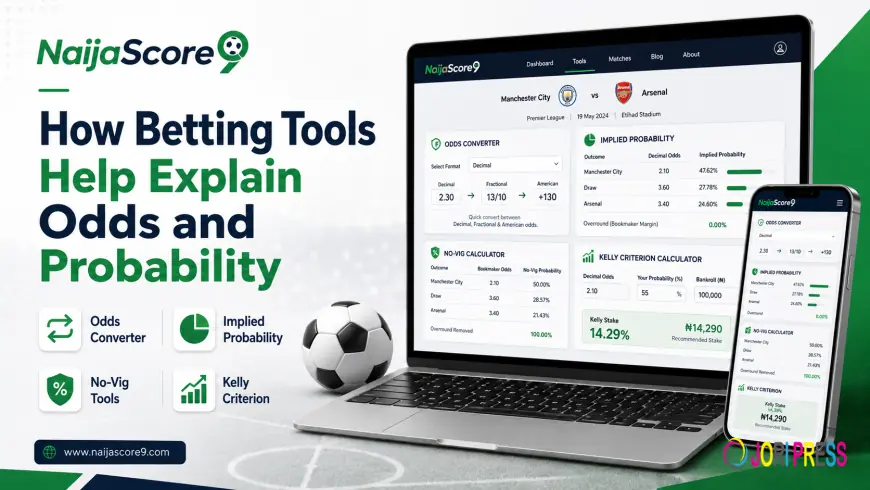
Football betting odds are often viewed simply as numbers that determine how much a winning bet might return. In reality, those numbers contain considerably more information.
Odds represent the market's assessment of an outcome, include a bookmaker margin and can be converted into implied probabilities. When compared properly, they can also help users evaluate whether one price is more attractive than another.
For people who are unfamiliar with the mathematics behind betting markets, however, calculating all of this manually can become confusing.
That is where betting tools become useful.
Calculators such as odds converters, implied probability calculators, no-vig tools and Kelly Criterion calculators do not predict football results. Instead, they help users understand what betting odds mean and how probability relates to price.
For Nigerian football fans interested in understanding betting markets more clearly, the betting tools available on NaijaScore9 can help turn complicated calculations into information that is easier to interpret.
Odds Are More Than Potential Payouts
Suppose a bookmaker offers decimal odds of 2.00 on a football outcome.
Many users immediately interpret this as:
A ₦1,000 stake could return ₦2,000 if the bet wins.
That is correct, but the odds also communicate something else.
Decimal odds of 2.00 correspond to an implied probability of approximately 50%.
So instead of viewing 2.00 only as a potential payout, users can also interpret it as a market price associated with roughly a 50% implied chance.
This probability perspective makes football odds considerably easier to analyse.
How an Implied Probability Calculator Helps
An implied probability calculator converts betting odds into percentages.
For decimal odds, the calculation is:
Implied Probability = (1 ÷ Decimal Odds) × 100
Consider these examples:
| Decimal Odds | Approx. Implied Probability |
|---|---|
| 1.25 | 80% |
| 1.50 | 66.7% |
| 2.00 | 50% |
| 2.50 | 40% |
| 4.00 | 25% |
This immediately makes different prices easier to understand.
A team priced at 1.50 is being treated as a much stronger favourite than one priced at 2.50.
However, implied probability should not automatically be interpreted as the true probability of an outcome. Bookmaker prices contain a margin, and markets can move as new information becomes available.
The calculator explains what the odds imply—it does not guarantee that the implied assessment is correct.
Odds Converters Make Different Formats Easier to Compare
Football odds are displayed differently around the world.
The three most common formats are:
-
decimal;
-
fractional;
-
American.
For example, approximately equivalent prices may appear as:
Decimal: 2.00
Fractional: 1/1
American: +100
Someone accustomed to decimal prices might find fractional or American odds less intuitive.
An odds converter solves this problem instantly.
This is particularly useful when comparing betting information from international football websites, tipsters, bookmakers or statistical services that may use different odds formats.
Instead of learning several conversion formulas, users can convert every price into the format they understand best.
Understanding Bookmaker Margin With No-Vig Tools
One of the most important concepts in betting is that bookmaker probabilities usually add up to more than 100%.
Consider a simplified football market:
-
Home Win: 2.00
-
Draw: 3.50
-
Away Win: 4.00
Their approximate implied probabilities are:
-
Home: 50%
-
Draw: 28.6%
-
Away: 25%
Together, they equal approximately 103.6%.
Why more than 100%?
Because bookmakers generally build a margin into their prices.
A no-vig calculator can adjust these probabilities to remove the margin mathematically and provide an estimate of the underlying market probabilities.
This helps users understand an important distinction:
Displayed odds are not necessarily identical to fair odds.
The bookmaker's margin affects the prices being offered.
Probability Helps Explain Why Low Odds Are Not Automatically Better
A common mistake is assuming that lower odds are safer and therefore better.
Consider two hypothetical selections:
Selection A: 1.40
Selection B: 2.50
Selection A has an implied probability of approximately 71.4%.
Selection B has an implied probability of 40%.
The first outcome is clearly considered more likely.
But that does not automatically mean it represents a better betting opportunity.
The relevant question is whether the bookmaker's price fairly reflects the actual probability.
Suppose your analysis suggests Selection A has a 65% chance of winning.
The bookmaker price is implying 71.4%.
In that scenario, the price may be less attractive than it initially appears.
Meanwhile, if Selection B is priced at 2.50 but your own carefully developed estimate suggests a 46% probability, the relationship between probability and price may deserve closer examination.
Betting tools help users recognise this distinction between likelihood and value.
Expected Value Tools Add Another Layer
Expected value, often shortened to EV, attempts to evaluate a bet across repeated theoretical outcomes rather than focusing only on whether one individual bet wins.
This concept is important because even a well-priced selection can lose.
Imagine an outcome with a genuine 50% chance of occurring.
Over a single match, it either happens or it does not.
Over many comparable situations, however, probability becomes more meaningful.
An expected value calculator combines the estimated probability with the potential profit and loss to show whether a bet may theoretically offer positive or negative value.
The calculation can be useful, but there is an important limitation:
your probability estimate must be realistic.
If the estimated probability is wrong, the expected-value calculation can also be misleading.
Kelly Criterion Tools Help Explain Stake Sizing
The Kelly Criterion takes probability analysis one step further.
Instead of asking only whether a price may represent value, it considers how large a theoretical stake should be relative to a bankroll.
A Kelly calculator generally uses:
-
available odds;
-
estimated probability;
-
bankroll.
If the user's estimated probability is higher than the probability implied by the bookmaker's odds, the formula may calculate a theoretical percentage of the bankroll to risk.
However, Kelly calculations can produce aggressive staking recommendations when probability estimates are inaccurate.
This is one reason some users who understand the methodology prefer fractional approaches such as half-Kelly or quarter-Kelly.
The important lesson is not that one staking formula guarantees success. It is that stake size should relate to risk and probability, rather than emotion.
Betting Tools Can Help Compare Bookmakers
Different bookmakers frequently offer different odds on the same football outcome.
For example:
Bookmaker A: 1.80
Bookmaker B: 1.88
Bookmaker C: 1.95
The selection is identical.
The price is not.
For a ₦10,000 stake, the total potential returns would be:
-
1.80 → ₦18,000
-
1.88 → ₦18,800
-
1.95 → ₦19,500
Comparing odds therefore matters.
Tools that convert odds into probability can also reveal how significantly the market assessment changes between prices.
Odds of 1.80 imply roughly 55.6%.
Odds of 1.95 imply approximately 51.3%.
That makes the difference easier to interpret than simply looking at two decimal numbers.
Betting Tools Work Best Alongside Football Analysis
Mathematics alone cannot determine what will happen in a football match.
Before deciding whether a market price makes sense, users may also need to consider:
-
recent form;
-
opponent quality;
-
injuries;
-
suspensions;
-
expected line-ups;
-
home and away performance;
-
scoring patterns;
-
fixture congestion;
-
tactical changes.
For example, a price may initially appear attractive based on historical statistics.
But if the team's first-choice goalkeeper and leading striker are unavailable, the underlying probability could change significantly.
This is why tools are most useful when combined with match research rather than used in isolation.
Users can explore football analysis and available match probabilities through the NaijaScore9 football prediction section and then use relevant calculators to better understand how those probabilities compare with betting odds.
What Betting Tools Cannot Do
It is equally important to understand the limitations.
A calculator cannot know whether:
-
a player will receive a red card;
-
a penalty will be missed;
-
a goalkeeper will make an unusual error;
-
an injury will occur early in the match;
-
a manager will unexpectedly change tactics.
Betting tools calculate numbers from the information entered.
They do not remove uncertainty from football.
This is why claims that a calculator or betting system can guarantee profit should be treated cautiously.
Which Betting Tools Are Most Useful?
Different tools answer different questions.
Use an odds converter when you need to compare odds formats.
Use an implied probability calculator when you want to understand the probability represented by a price.
Use a no-vig calculator when you want to examine bookmaker margin and estimate adjusted market probabilities.
Use an expected value calculator when comparing your probability estimate against a price.
Use a Kelly Criterion calculator when exploring probability-based bankroll management.
None replaces football analysis. Each simply makes a particular part of betting mathematics easier to understand.
Use Probability as Information, Not a Promise
Perhaps the most important lesson betting tools provide is that probability is not certainty.
If an outcome has a 70% probability, it still has approximately a 30% probability of not occurring.
A 60% prediction can lose.
An underdog with a 25% probability can win.
This is not evidence that probability analysis is useless. It is exactly how probability works.
Good betting analysis should therefore focus on ranges of possible outcomes rather than treating predictions as guarantees.
Final Thoughts
Betting tools help make football odds easier to understand by translating prices into useful mathematical information.
An odds converter clarifies different formats. An implied probability calculator shows what percentage a price represents. No-vig tools help explain bookmaker margins, while expected-value and Kelly calculators demonstrate how probability can influence price evaluation and stake sizing.
Their real value is educational.
Rather than viewing betting odds as arbitrary numbers, users can begin to understand the relationship between odds, probability, bookmaker margin and risk.
That does not make football predictable, and it certainly does not remove the possibility of losing.
But it can help users evaluate betting markets with greater context, ask better questions and make more informed decisions before placing a bet.
What's Your Reaction?
 Like
0
Like
0
 Dislike
0
Dislike
0
 Love
0
Love
0
 Funny
0
Funny
0
 Angry
0
Angry
0
 Sad
0
Sad
0
 Wow
0
Wow
0