






































CAESAR II Training: Build Expertise in Pipe Stress Engineering
Join Caesar II Training to learn piping stress analysis, system modeling, load calculations, and industry practices with expert guidance for career growth.

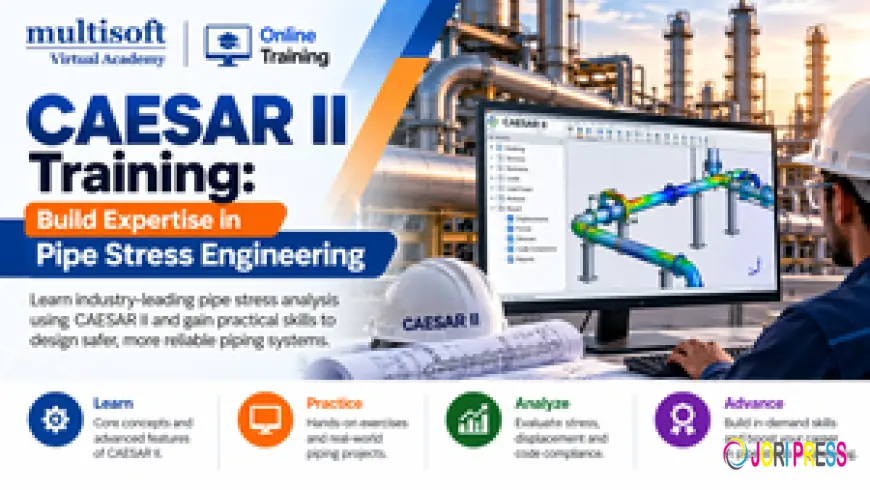
Industrial piping systems play a vital role in transporting fluids, gases, steam, and chemicals across manufacturing facilities, refineries, power plants, and processing units. These systems operate under different pressures, temperatures, and environmental conditions, making structural integrity a critical engineering requirement. Even small design errors can lead to excessive stress, equipment damage, unexpected downtime, or costly maintenance activities.
Piping engineers use specialized engineering tools to evaluate these challenges before systems are installed or modified. CAESAR II is one such tool, helping engineers analyze piping flexibility, calculate stresses, evaluate support loads, and investigate the effects of different operating conditions.
CAESAR II Training provides professionals with an opportunity to understand the software's capabilities and apply piping stress analysis principles to engineering projects. By combining theoretical knowledge with practical modeling exercises, learners can develop skills relevant to piping design, mechanical engineering, plant engineering, and industrial project execution.
This article explains the fundamentals of CAESAR II, its important features, essential training topics, practical applications, and the professional opportunities associated with piping stress analysis.
What Is CAESAR II and How Does It Work?
CAESAR II is engineering software developed by Hexagon for analyzing piping systems under different loading conditions. It helps engineers evaluate whether a piping arrangement can accommodate expected operating movements and withstand the stresses generated by pressure, temperature, weight, and external forces.
The software allows users to create piping models, define materials and operating conditions, establish restraints, and perform stress calculations. Engineers can review calculated stresses, displacements, support reactions, and other analysis results to assess system performance.
For example, consider a high-temperature pipeline installed inside a refinery. When the pipeline heats up, the pipe material expands. The amount of movement depends on its material properties, temperature change, length, geometry, and restraint arrangement.
If the piping system cannot accommodate this movement, significant forces may develop at anchors, supports, bends, and connected equipment. CAESAR II enables engineers to model these conditions and evaluate the resulting behavior.
The software supports static and dynamic analysis methods, with the applicable approach determined by the engineering problem, project requirements, and relevant design standards.
Why Do Engineers Need CAESAR II Training?
Piping stress analysis requires an understanding of engineering principles, material behavior, piping layouts, support arrangements, and design requirements. Training helps professionals connect these concepts with practical software applications.
Understand Piping Flexibility and Stress
Piping systems must accommodate movement caused by temperature changes and other operating conditions. Engineers need to understand how flexibility, geometry, and restraint locations influence stress distribution.
CAESAR II training introduces learners to these principles and explains how they affect the design and performance of piping systems.
Evaluate Thermal Expansion and Contraction
Temperature variations can cause piping materials to expand or contract. Engineers must assess whether the piping arrangement can accommodate these movements without exceeding applicable design limits.
Through training, learners can explore thermal load cases, displacement calculations, flexibility considerations, and the effects of support configurations.
Improve Equipment Protection
Piping systems connect to pumps, compressors, turbines, heat exchangers, and other equipment. Excessive forces or moments at equipment connections may create operational or reliability concerns.
Stress analysis helps engineers evaluate these loads against applicable equipment criteria and manufacturer requirements.
Support Engineering Design Verification
Piping analysis helps identify locations that require further investigation. These may include highly stressed sections, excessive displacement, unsuitable restraint arrangements, or unexpected support reactions.
Training develops the ability to interpret these results and understand when design changes or additional engineering checks may be necessary.
Strengthen Technical Competence
Professionals who understand CAESAR II can contribute to piping design reviews, stress analysis assignments, engineering documentation, and plant modification projects.
Developing software proficiency alongside mechanical engineering fundamentals can support long-term professional growth.
Essential Modules in a CAESAR II Training Course
A comprehensive course should cover the complete analysis process, from preparing a piping model to interpreting results and documenting engineering findings.
1. Fundamentals of Pipe Stress Analysis
Learners should first understand the basic principles of piping stress analysis and the reasons different loads affect piping systems.
Important concepts include:
- Stress and strain in piping materials
- Sustained, thermal, and occasional loading
- Piping flexibility and displacement
- Material properties and allowable stresses
- Design codes and engineering requirements
- Load combinations and acceptance criteria
These concepts help learners understand the engineering decisions behind software calculations.
2. Piping Model Development
Accurate modeling is essential for reliable analysis. The model should represent the piping arrangement and relevant physical properties with sufficient accuracy for the intended engineering assessment.
Training may include node numbering, pipe dimensions, component geometry, bends, tees, reducers, material assignments, and model connectivity.
Learners should also understand how changes in pipe routing and component arrangements can influence system flexibility.
3. Material Properties and Boundary Conditions
Material characteristics influence how a piping system responds to operating conditions. Engineers must select appropriate material data and define the relevant temperature and pressure conditions.
Training may cover elastic properties, thermal expansion coefficients, material specifications, and boundary conditions.
The correct inputs must be based on reliable project information rather than assumptions that have not been verified.
4. Pipe Supports and Restraint Modeling
Supports and restraints determine how a piping system moves and transfers loads to surrounding structures.
A CAESAR II course may cover guides, line stops, anchors, directional restraints, and other supported restraint definitions.
Learners should examine how different support arrangements affect displacement, stress distribution, and support reactions. The model should reflect the intended physical installation as closely as practical.
5. Load Cases and Combinations
Piping systems can experience several types of loading throughout their service life.
These may include pipe and fluid weight, internal pressure, thermal expansion, wind, seismic loading, and other project-specific conditions.
Training explains how engineers define appropriate load cases and combinations according to the applicable design code and project requirements.
Understanding load cases is important because the governing condition for one part of a piping system may differ from that of another.
6. Static Pipe Stress Analysis
Static analysis evaluates piping behavior under specified static or equivalent-static loading conditions.
Learners can study stress summaries, displacement results, restraint loads, and other calculated values. They should understand how to compare results with relevant acceptance criteria and identify areas that need further attention.
The goal is to make informed engineering decisions rather than simply generate a software report.
7. Dynamic Analysis and Vibration Considerations
Some piping systems require additional evaluation because of vibration, transient loading, or other dynamic effects.
Depending on the course scope, training may introduce modal analysis, harmonic analysis, response spectrum analysis, and time-history analysis.
These methods address different engineering problems and should be selected based on the nature of the excitation, system characteristics, and applicable requirements.
Dynamic analysis is particularly relevant when investigating vibration-related concerns or evaluating specified transient events.
8. Results Interpretation and Engineering Reports
Analysis results must be interpreted and communicated clearly to support design decisions.
Training may include stress summaries, displacement plots, support reactions, load reports, and stress isometric drawings.
Learners should understand how to identify critical locations, review governing load cases, document assumptions, and communicate findings to other engineering disciplines.
Advanced CAESAR II Applications
After developing a strong foundation, engineers can explore specialized analysis areas that support complex industrial projects.
Expansion Joint Analysis
Expansion joints are used in selected piping arrangements to accommodate movement and manage system flexibility. Their behavior depends on joint geometry, stiffness, installation conditions, and operating requirements.
CAESAR II can model expansion joints to investigate their influence on piping movements and loads. Engineers must ensure that the model represents the actual component and that the analysis reflects the relevant design requirements.
Nozzle Loads and Connected Equipment
Piping forces and moments can affect equipment connections. Engineers need to assess these loads using applicable equipment limits, project criteria, and manufacturer guidance.
Training can introduce the relationship between piping flexibility, restraint arrangements, and loads transferred to connected equipment.
Such assessments are important when piping connects to sensitive rotating equipment or other components with defined allowable connection loads.
Wind and Seismic Loading
Environmental conditions can influence piping integrity, particularly in facilities subject to specific wind or seismic design requirements.
Engineers must establish appropriate loading parameters and combinations based on the project's design basis. Training can explain how these conditions are represented in the model and how their effects are evaluated.
The exact methodology depends on the applicable code, project specifications, and analysis objectives.
Stress Isometrics and Technical Documentation
Stress isometric drawings help engineers communicate piping geometry, analysis information, and selected results.
Learning how to generate and review appropriate reports can improve coordination among piping designers, stress engineers, structural engineers, and project teams.
Clear documentation also helps reviewers understand the model assumptions, loading conditions, and engineering conclusions.
Industry Applications of CAESAR II
CAESAR II is relevant to industrial environments where piping performance and structural integrity are important.
Oil and gas: Engineers analyze piping systems used in production facilities, refineries, gas processing plants, and related infrastructure.
Petrochemical industries: Stress analysis supports piping arrangements that operate under demanding temperature, pressure, and process conditions.
Power generation: Steam lines, utility piping, and other high-temperature systems may require careful assessment of thermal expansion and support loads.
Chemical manufacturing: Engineers evaluate piping systems carrying process fluids and other materials under specified operating conditions.
Engineering, procurement, and construction projects: Piping stress analysis supports design verification, equipment coordination, and technical reviews during project development.
Plant maintenance and modifications: Existing piping systems may require reassessment when operating conditions change, equipment is replaced, or layouts are modified.
Each application requires appropriate engineering judgment, accurate input data, and compliance with applicable codes and project specifications.
Who Should Learn CAESAR II?
CAESAR II training can benefit professionals involved in piping systems, mechanical design, and industrial engineering.
- Piping stress engineers: Develop skills in model preparation, stress calculations, and results interpretation.
- Mechanical engineers: Improve their understanding of piping behavior under different operating conditions.
- Piping designers: Learn how routing and support arrangements influence flexibility and stress analysis.
- Plant design engineers: Understand how stress results affect equipment interfaces and structural coordination.
- Engineering consultants: Develop knowledge relevant to piping assessments, design reviews, and technical documentation.
- Engineering graduates: Build foundational skills before progressing to advanced pipe stress analysis assignments.
A background in mechanical engineering, piping design, or related technical disciplines is beneficial. Beginners should start with engineering fundamentals before moving into advanced analysis techniques.
Career Opportunities After CAESAR II Training
CAESAR II Training Course knowledge can support professionals seeking roles in piping engineering, plant design, mechanical analysis, and industrial consulting.
Potential roles include:
- Pipe Stress Analysis Engineer
- Piping Stress Engineer
- Mechanical Design Engineer
- Piping Design Engineer
- Piping Engineering Consultant
- Plant Engineering Specialist
- Stress Analysis Specialist
- Mechanical Project Engineer
The responsibilities vary according to the employer, project complexity, and professional experience. Entry-level positions may involve model preparation and report support, while experienced engineers may conduct complex analyses and technical reviews.
Employers may also require knowledge of piping codes, engineering drawings, material properties, structural behavior, and related design tools.
A training course can strengthen technical preparation, but professional advancement also depends on practical experience, engineering qualifications, and demonstrated analytical ability.
How to Choose the Best CAESAR II Training Program
Selecting an appropriate course requires careful consideration of your learning goals and intended application.
Review the Course Content
Check whether the syllabus covers modeling, material properties, restraints, load cases, static analysis, and result interpretation.
Advanced learners should check for relevant topics such as dynamic analysis, expansion joints, equipment loads, and specialized piping applications.
Prioritize Practical Learning
Hands-on exercises help learners understand how software inputs influence engineering results.
Look for opportunities to develop piping models, apply operating conditions, review stress results, and investigate different support arrangements in a suitable training environment.
Verify the Software Version
Software interfaces and capabilities may change between releases. Confirm the version used in the course and whether the training material matches your project requirements.
Evaluate the Training Approach
A useful course should explain the engineering reasoning behind each step, not simply demonstrate software commands.
Consider trainer expertise, opportunities to ask technical questions, the depth of practical exercises, and the availability of learning support.
Align the Course With Your Career Goals
Beginners may benefit from a foundation in piping stress analysis, while experienced engineers may prefer advanced topics relevant to their current assignments.
Choosing a course based on your objectives can make the learning experience more effective.
Best Practices for Developing CAESAR II Skills
Consistent practice is essential for developing confidence in pipe stress analysis.
Begin by revising basic mechanics, material properties, thermal expansion, and piping design principles. These concepts make it easier to understand the results produced by the software.
Next, practice creating simple piping models and defining appropriate boundary conditions. Progress to more complex arrangements involving bends, supports, operating temperatures, and multiple load cases.
Review each analysis result carefully. Understand why a stress value is high, why a support reaction develops, or why a piping segment experiences significant displacement. Where results appear unexpected, examine the model inputs and assumptions before drawing conclusions.
As your skills improve, explore specialized analysis methods and study the applicable design codes. Maintain clear records of your modeling assumptions and engineering decisions.
This approach helps build practical knowledge that can be applied to piping design, troubleshooting, and engineering project work.
Conclusion
CAESAR II plays an important role in modern piping engineering by helping professionals evaluate stresses, thermal movements, support reactions, and other factors that affect piping system performance. Developing expertise through CAESAR II Training can help engineers strengthen their understanding of pipe stress analysis, engineering codes, static and dynamic loading, and technical reporting. A course that combines engineering fundamentals with practical software exercises can support professional development across oil and gas, petrochemical, power generation, and industrial engineering projects. For structured learning and professional guidance, Multisoft Virtual Academy offers CAESAR II training designed to help learners develop relevant piping stress analysis skills and improve their readiness for engineering assignments. With consistent practice, accurate modeling, and a strong understanding of applicable standards, professionals can build a solid foundation for contributing to reliable piping design and analysis.
What's Your Reaction?
 Like
0
Like
0
 Dislike
0
Dislike
0
 Love
0
Love
0
 Funny
0
Funny
0
 Angry
0
Angry
0
 Sad
0
Sad
0
 Wow
0
Wow
0








