









































Global Asphalt Market Future Demand Drivers and Growth
Explore future demand drivers shaping the global asphalt market, from infrastructure investment and urbanization to sustainability and technology trends.

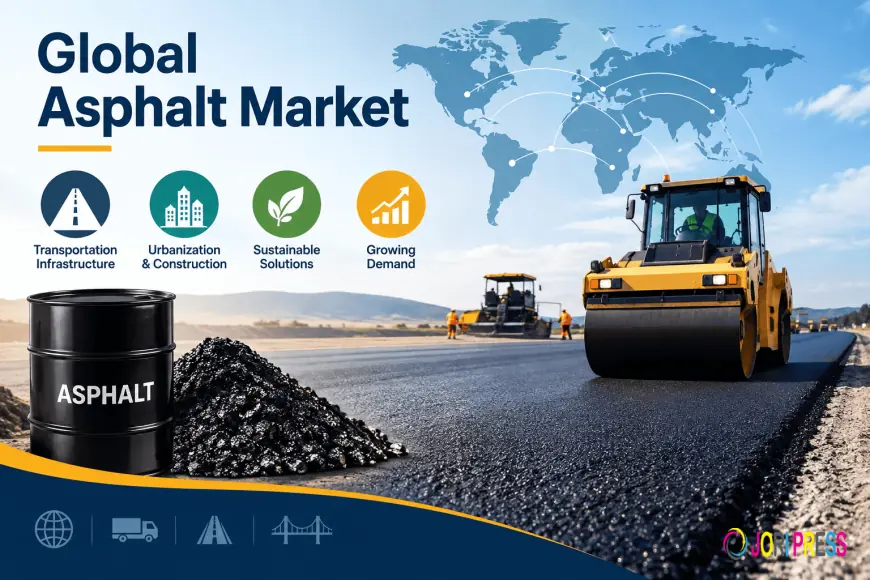
The Global asphalt market is entering a period of steady transformation as governments, infrastructure developers, construction companies, and industrial users respond to expanding transportation networks and growing urban populations. The market was valued at approximately USD 245 billion in 2025 and is projected to reach USD 336 billion by 2032, representing a CAGR of 4.60% during 2026–2032. Road construction and maintenance remain major demand centers, while roofing, industrial applications, recycling, and sustainable production methods are creating additional opportunities. As infrastructure spending increases across developed and emerging economies, asphalt is expected to remain an important material for supporting long-term economic and urban development.
Global Asphalt Market Investment Advantages Are Strengthening
Investment in the asphalt industry can benefit from the continued requirement for road construction, rehabilitation, airport infrastructure, commercial development, and urban expansion. Unlike materials used only in specific construction applications, asphalt serves a broad infrastructure purpose and is continuously required for new projects as well as maintenance and resurfacing.
The global asphalt market is also supported by government-backed infrastructure programs. Public investment in highways, transportation corridors, bridges, urban roads, and regional connectivity creates recurring requirements for paving materials. This provides businesses across production, distribution, contracting, equipment, and related services with opportunities to participate in expanding infrastructure ecosystems.
The market's projected movement from USD 245 billion in 2025 to USD 336 billion by 2032 further demonstrates the potential available to companies that can respond effectively to changing construction requirements.
Why Global Asphalt Market Demand Will Support Future Growth
Future demand will be strongly connected with urbanization and population growth. As cities expand, transportation infrastructure must develop alongside residential, commercial, and industrial areas. New roads need paving, while existing roads require resurfacing, rehabilitation, and regular maintenance.
Asia Pacific is particularly important to future asphalt market growth because of rapid urbanization and significant transportation infrastructure investment. The region is projected to be the fastest-growing regional market between 2026 and 2032, with a forecast CAGR of 5.8%. China and India are among the markets contributing to this momentum through infrastructure development and expanding transportation networks.
The expansion of electric vehicle infrastructure can also indirectly support asphalt demand. Charging stations, access roads, parking areas, and supporting transportation infrastructure all require durable paved surfaces. Consequently, changes in mobility and transportation systems can create additional applications for asphalt over the long term.
Enhancing Search Visibility Through Asphalt Market Trends
Asphalt market trends are increasingly centered on sustainability, recycling, energy efficiency, and digitalization. These trends are changing how producers and contractors approach material production, project planning, transportation, and road construction.
Warm mix asphalt is one important technological development. The technology can reduce energy consumption during mixing while supporting more efficient production. At the same time, recycled asphalt pavement is becoming increasingly important as governments and construction companies seek to reduce material waste and improve resource efficiency.
Digital technologies are also contributing to operational improvements. Better project-management systems, logistics monitoring, material-quality tracking, and data-driven planning can help companies improve efficiency and reduce unnecessary costs. As these technologies become more widely adopted, businesses that combine asphalt expertise with digital capabilities may be better positioned to respond to changing market expectations.
Global Asphalt Market Demand and Benefits Across Applications
Demand within the global asphalt market extends beyond traditional road paving. Paving remains the dominant application because highways, streets, urban roads, parking areas, and transportation infrastructure require substantial volumes of asphalt. The report estimates that paving accounted for approximately 70% of the market in 2025.
Roofing represents another important growth opportunity. Increasing construction activity, urbanization, and greater emphasis on energy-efficient buildings are supporting demand for asphalt-based roofing materials. The roofing segment is projected to grow at a faster pace than several established applications through 2032.
Industrial petroleum asphalt is also expected to gain importance. Its use across industrial applications, roofing, and airport runway construction creates opportunities beyond conventional road projects. This diversification can help support overall market resilience as demand develops across different end-use sectors.
Lifestyle Benefits from the Global Asphalt Market
Although asphalt is primarily viewed as an infrastructure material, its impact extends directly into everyday life. Reliable roads make commuting easier, improve access to workplaces and educational institutions, and support the movement of essential goods. Smooth and durable paved surfaces can also contribute to better transportation efficiency and connectivity between urban and rural areas.
The benefits become particularly visible as cities grow. Well-maintained roads can support expanding residential neighborhoods, commercial centers, logistics hubs, and public transportation networks. Better road connectivity can reduce travel difficulties while helping businesses reach customers and suppliers more efficiently.
For consumers, these improvements translate into greater mobility and improved access to services. For businesses, they create more reliable transportation routes and distribution networks. This connection between asphalt investment and everyday mobility is an important factor supporting long-term demand.
Infrastructure Development Will Shape Global Asphalt Market Growth
Infrastructure development is expected to remain one of the strongest foundations for future asphalt demand. Developed markets require ongoing road maintenance and modernization, while developing economies continue to build new transportation networks.
North America currently represents the largest regional market, supported by its established infrastructure base and continued government investment. Meanwhile, Asia Pacific offers significant future growth potential because of rapid urban development and infrastructure expansion.
Government initiatives also influence the direction of the market. Infrastructure programs in the United States, Europe, India, and Australia demonstrate how public policy can support road construction and encourage more sustainable infrastructure practices. These initiatives can create long-term project pipelines for asphalt producers, contractors, and related businesses.
At the same time, market participants must manage challenges such as crude oil price volatility, environmental regulations, production costs, and supply-chain disruptions. Since asphalt production is closely connected with petroleum-related inputs, changes in crude oil prices can influence production economics and final pricing. Companies that improve operational efficiency and adopt sustainable production approaches may therefore gain an advantage.
Future Technology Will Enhance the Global Asphalt Market
Technology is expected to become increasingly important in determining competitiveness. Sustainable asphalt production, recycling technologies, warm mix solutions, automated installation processes, and digital supply-chain management can help companies respond to environmental and cost pressures.
The transition toward more sustainable infrastructure is especially significant. Governments and infrastructure developers are increasingly interested in solutions that reduce emissions, conserve resources, and extend pavement life. This creates an opportunity for asphalt producers to develop products that combine durability with environmental performance.
Recycling is another area with substantial potential. Greater use of reclaimed asphalt can reduce dependence on virgin materials while supporting circular construction practices. As regulations and sustainability objectives become more influential, recycled and lower-impact asphalt solutions could become increasingly important to future procurement decisions.
Wrapping Up
The future outlook for the global asphalt market remains positive, supported by infrastructure investment, urbanization, transportation expansion, roofing demand, technological innovation, and sustainability initiatives. With the market projected to increase from USD 245 billion in 2025 to USD 336 billion by 2032, the sector offers meaningful opportunities for producers, contractors, investors, technology providers, and infrastructure businesses.
Buying or investing now can be strategically attractive for businesses that expect infrastructure development and maintenance requirements to remain strong over the coming years. However, success will depend on understanding regional demand, raw-material costs, application-specific opportunities, regulatory developments, and emerging technologies. Companies that prepare early and align their strategies with sustainable infrastructure and evolving customer requirements can strengthen their position as future asphalt demand expands.
Who We Are
About 6Wresearch
6Wresearch is a commercial strategy and growth advisory firm founded in 2011 and headquartered in New Delhi, India, with partners across Southeast Asia and the Middle East & Africa. The firm has delivered over 20,000 commercial engagements for over 2,000 organizations, including Fortune 500 companies, government agencies, and multilateral institutions such as the World Bank and the Asian Development Bank. Backed by proprietary market research and advanced analytics, 6Wresearch combines sector expertise with data-driven intelligence to help organizations navigate market complexity and drive sustainable growth. These capabilities explain why organizations trust 6Wresearch Global Market Research & Consulting Firm for reliable commercial insights and confident decision-making.
Our Proprietary Platform: 6W Export GTM
6W Export GTM is 6Wresearch's proprietary trade intelligence and go-to-market platform, built on UN Comtrade data and enhanced with 6Wresearch's in-house analytical and simulation models, including system dynamics-based forecasting. Unlike broad, sector-level market sizing tools, 6W Export GTM operates at the individual product level down to specific HS codes and micro-segments to identify precise, actionable export opportunities by country and product pair, including markets where trade currently does not exist. This granular, simulation-driven approach allows 6W Export GTM to surface opportunities that sector-wide analysis typically misses, positioning it among a small number of platforms globally offering this depth of product-and-country-specific export intelligence.
What's Your Reaction?
 Like
0
Like
0
 Dislike
0
Dislike
0
 Love
0
Love
0
 Funny
0
Funny
0
 Angry
0
Angry
0
 Sad
0
Sad
0
 Wow
0
Wow
0