







































Data-Driven Appraiser Panel Management: The AMC Competitive Edge Most Operators Are Leaving on the Table
Data-Driven Appraiser Panel Management — focuses on performance scoring, automated credential tracking, and coverage mapping as a lender retention differentiator. The angle of "panel management as competitive strategy" rather than admin function is genuinely underwritten in AMC content right now.

How performance scoring, automated credential tracking, and coverage mapping are replacing gut-feel panel decisions, and what it means for lender retention
Ask most AMC operations managers how they decide which appraiser gets assigned to an order, and the honest answer usually sounds like experience, geography, and whoever is available. That is not a bad answer. But in 2026, it is increasingly an incomplete one and lenders are starting to notice the difference between AMCs that manage panels reactively and those that do it with actual data.
Appraiser panel management has always been one of the most operationally complex parts of running an AMC. You are coordinating hundreds, sometimes thousands, of independent contractors across multiple states, property types, and product lines, each with their own license status, E&O coverage, workload capacity, performance history, and geographic competency. Managing that at volume, without a systematic approach, means you are constantly making decisions based on incomplete information.
The AMCs pulling ahead with lenders right now are the ones that replaced that reactive model with something much more structured. Here is what that actually looks like.
The Problem with “Good Appraiser” as a Selection Criterion
Most AMCs maintain panel notes about appraisers who are reliable, who tend to come back with revisions, and who know a particular market well. That institutional knowledge is valuable. The problem is that it does not scale, is not auditable, and evaporates when the coordinator who holds it leaves the company.
When a lender asks an AMC how appraiser assignments are made, “our coordinators use their experience and judgment” is a risk statement, not a quality statement. It signals that assignment decisions are personal rather than process-driven, which means they are also inconsistent, potentially biased, and impossible to document for a regulatory examination.
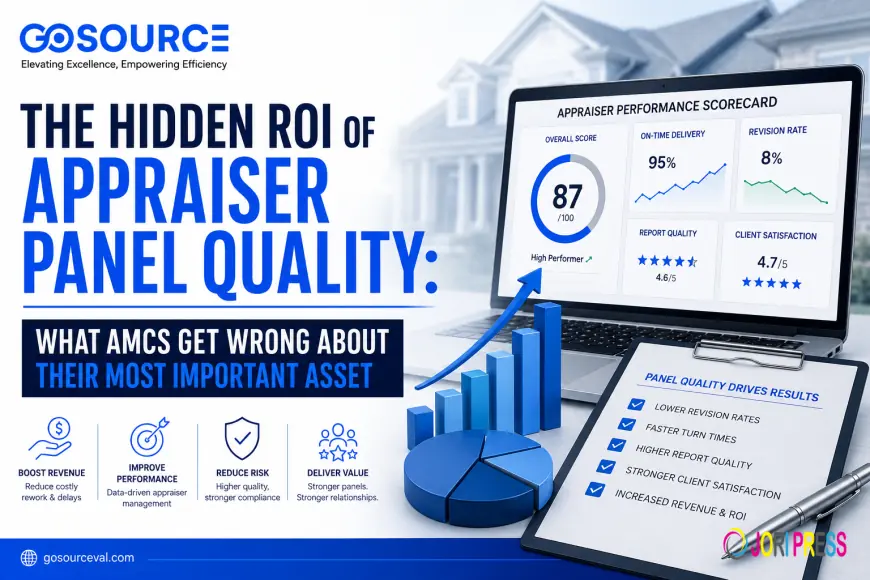
Modern panel management replaces subjective coordinator knowledge with objective, continuous performance data. Turn time from acceptance to delivery, revision rates, client feedback scores, and workload capacity are tracked automatically and weighted into an overall performance score that drives assignment priority. High-performing appraisers receive more orders. Appraisers with consistent revision patterns or declining turn times are flagged for review before they become a lender complaint.
The shift sounds simple. The operational difference is significant.
Credential Tracking as a Compliance Function, Not an Admin Task
One of the most common compliance failures in AMC panel management is an expired license or lapsed E&O coverage that nobody caught until a file was already in process. It is an embarrassing problem, and it happens more often than most AMC operators would like to admit because manual tracking of license renewals and insurance expirations across hundreds of appraisers is genuinely difficult to do without automation.
Automated credential tracking changes that equation entirely. License expiration alerts at 90, 60, and 30 days, automatic suspension from assignment queues when credentials lapse, and continuous verification against state regulatory databases give AMC compliance teams visibility they simply cannot maintain manually at scale.
Automated credential tracking allows AMCs to manage panels of 100 or more appraisers without dedicated administrative staff with automated alerts before license and insurance expiration, geographic visualization of panel density and coverage gaps, and automatic exclusion from assignment when maximum workload is reached.
For lenders, this is not a nice-to-have. It is a risk management expectation. An AMC that cannot demonstrate systematic credential monitoring is creating loan-level compliance exposure that sophisticated lenders are no longer willing to absorb.
Coverage Mapping: Seeing the Gaps Before They Become Turn-Time Problems
Most AMC panel management conversations focus on individual appraiser performance. But there is a geographic dimension to panel quality that often goes unexamined until a difficult market creates a real problem.
Coverage gaps in markets where panel density is thin, where geographic competency is questionable, or where capacity regularly runs short during volume surges are predictable in advance when you are looking at the right data. Panel coverage visualization tools map appraiser locations, license coverage areas, and recent order volume by geography, making it possible to identify markets that need recruitment attention before they create turn-time failures.
This matters especially as hybrid appraisal volume grows. A key driver behind hybrid appraisal adoption is the ongoing shortage of licensed appraisers, which has historically led to longer turn times during high-volume periods and AMCs that are managing panel coverage proactively are better positioned to absorb volume increases without service degradation.
AMCs that are actively recruiting into underserved markets and tracking their panel density in those areas are the ones that can credibly tell lenders they will not have a coverage problem when rates shift, and volume picks up.
What Lenders Are Actually Asking About Panel Management
The lender conversation around appraiser panel management has gotten more specific in 2026. It is no longer enough to say you have a large national panel. Lenders are asking how the panel is maintained, how performance is monitored, how assignment decisions are made, and what the process is for removing an underperforming appraiser.
Assignment decisions logged with reasoning, geographic proximity, workload, performance, and all communications captured with timestamps create an unbroken chain of custody that satisfies regulatory examination requirements. That kind of documentation is what lenders increasingly expect to see as part of an AMC due diligence conversation.
For AMCs that are still running panel management through spreadsheets and coordinator notes, that conversation is going to get harder. The good news is that structured panel management is an operational problem with an operational solution, and for AMCs that do not have the internal infrastructure to build it from scratch, working with a specialized AMC management solutions partner provides the process architecture, staffing, and documentation workflows needed to compete at a higher level without a complete internal overhaul.
Performance-Based Assignment Is an Appraiser Retention Tool, Too
There is a dimension of data-driven panel management that often gets overlooked in the lender-focused conversation: it is also better for the appraisers on your panel.
When assignment decisions are based on performance data rather than coordinator relationships, the best appraisers get the most work. That is a meaningful incentive that directly rewards quality and reliability. AMCs that can demonstrate to appraisers that high-performance leads to higher order volume and that the system is consistent and transparent build stronger panel relationships than AMCs where assignment feels arbitrary or relationship dependent.
In a market where appraiser capacity is a genuine constraint in many regions, being an AMC that appraisers want to work with is a competitive advantage that shows directly in your turn times and panel depth.
The Bottom Line
Appraiser panel management used to be an internal operational function that lenders trusted AMCs to handle without much scrutiny. That era is over. As lenders demand more visibility, as regulatory examination of AMC operations becomes more detailed, and as the volume of appraisals per coordinator continues to grow, the AMCs that can demonstrate systematic, data-driven panel governance are the ones that will hold and grow lender relationships. The ones still running on institutional knowledge and coordinator judgment will find that gap is becoming harder to close.
FAQ
What is appraiser panel management in an AMC?
Appraiser panel management refers to the processes an AMC uses to recruit, credential, assign, monitor, and manage the independent appraisers it works with. This includes license and E&O tracking, performance measurement, geographic coverage analysis, and assignment logic, all of which directly impact appraisal quality, turn times, and compliance.
How does data-driven panel management improve AMC operations?
By replacing subjective coordinator judgment with objective performance metrics, turn times, revision rates, client feedback, and data-driven panel management, consistent, auditable assignment decisions are created. It also enables proactive credential monitoring and coverage gap identification before they create compliance or service failures.
What credentials should AMCs be tracking for their appraiser panel?
At minimum, AMCs should be tracking state license status and expiration dates, E&O insurance coverage and expiration, geographic coverage areas, and active workload capacity. Automated systems can monitor all of these continuously and generate alerts before any credential lapses.
How does panel management affect lender relationships?
Lenders increasingly scrutinize how AMCs manage their appraiser panels as part of vendor due diligence. AMCs that can demonstrate documented, systematic assignment processes with audit trails and performance data are more defensible for partners than those relying on informal coordinator knowledge.
Can smaller AMCs implement data-driven panel management?
Yes, especially through outsourced AMC management solutions that provide the process infrastructure without requiring a large internal technology build. Purpose-built AMC software platforms also make systematic panel management accessible at a range of operational scales.
What's Your Reaction?
 Like
0
Like
0
 Dislike
0
Dislike
0
 Love
0
Love
0
 Funny
0
Funny
0
 Angry
0
Angry
0
 Sad
0
Sad
0
 Wow
0
Wow
0