









































Common Quotex Trading Mistakes to Avoid
Avoid common Quotex trading mistakes such as overtrading, chasing losses, poor risk control, and emotional decisions with this beginner-friendly guide.

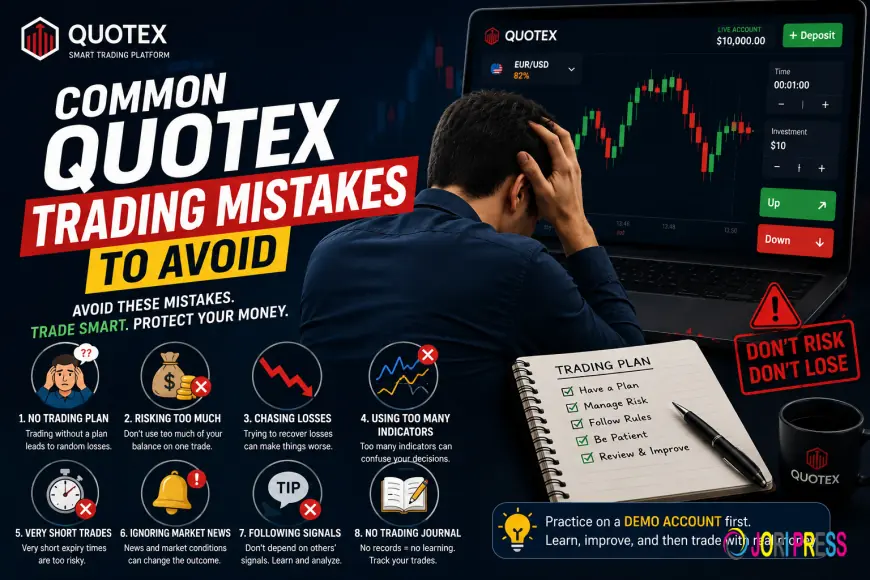
Quotex trading may appear straightforward, but predicting whether an asset’s price will move up or down involves significant financial risk. Many beginners lose money not only because of market movements, but also because they trade emotionally, risk too much and enter positions without clear rules.
Understanding the following common mistakes can help beginners make more disciplined decisions. However, no strategy or indicator can guarantee successful results.
Trading Without a Clear Plan
One of the biggest mistakes is placing trades without a written plan. A proper trading plan should define the assets you will monitor, entry conditions, expiry time, trade amount and daily stopping limit.
Entering trades simply because the price is moving quickly often leads to random decisions. Quotex’s educational content also identifies the lack of a clear trading plan as a factor that can affect trading consistency.
Before starting, write down your rules and test them on a demo account.
Risking Too Much on One Trade
Using a large percentage of your account balance on a single trade can quickly lead to major losses. Even a setup that looks strong can produce an unexpected result.
Use a small and consistent trade amount rather than increasing your position because you feel confident. Never trade with money needed for rent, education, household bills or other essential expenses.
Quotex’s money-management guidance highlights excessive risk, chasing losses and trading without a plan as common reasons beginners lose their deposits.
Chasing Previous Losses
After losing a trade, some beginners immediately place another position to recover the money. This is known as chasing losses and usually involves emotional rather than analytical decision-making.
Avoid doubling the amount after every unsuccessful trade. Strategies such as Martingale can produce rapidly increasing losses when several trades fail consecutively.
Set a maximum daily loss limit and stop trading when that amount is reached. Quotex has described a risk-management tool designed to let users set a daily loss limit and pause trading after reaching it.
Using Too Many Indicators
Adding several indicators to one chart does not necessarily improve accuracy. It can make the chart confusing and produce conflicting signals.
Beginners should start with one or two simple tools, such as support and resistance, a moving average or RSI. Understand what each indicator measures before including it in a strategy.
Indicators should support your analysis, not be treated as guaranteed signals.
Choosing Extremely Short Expiry Times
Very short trades can be highly unpredictable. A small and temporary price movement near the expiry point can change the result.
Choose an expiry time that matches your chart timeframe and trading strategy. Do not select a one-minute expiry simply because it provides a faster result.
Test different expiry settings with virtual funds before considering real-money trades.
Ignoring Market Conditions
A strategy that performs well in a trending market may fail when prices move sideways. Beginners often apply the same setup in every market condition without checking volatility, economic news or the overall trend.
Before entering a trade, determine whether the market is trending, ranging or unusually volatile. Avoid trading when you cannot clearly understand the price movement.
Depending on Social Media Signals
Telegram groups, influencers and online signal providers may promise accurate signals or guaranteed returns. Following such claims without independent analysis can expose you to losses and scams.
Do not place a trade only because someone online says the price will rise or fall. Learn to analyse charts independently and verify every claim carefully.
Failing to Keep a Trading Journal
Without records, it is difficult to identify repeated mistakes. Maintain a journal containing the asset, entry reason, direction, expiry time, result and whether you followed your strategy.
Reviewing this information can help you understand which decisions were disciplined and which were based on emotion.
Important Warning for Indian Users
The Reserve Bank of India’s Alert List, updated on November 19, 2025, includes Quotex among entities that are not authorised to deal in forex under FEMA or operate an authorised electronic trading platform for forex transactions. Indian users should understand the applicable rules and regulatory risks before depositing funds.
Avoiding common Quotex trading mistakes does not remove the possibility of loss. Practise on a demo account, use clear rules, control your risk and never consider trading a guaranteed source of income.
What's Your Reaction?
 Like
0
Like
0
 Dislike
0
Dislike
0
 Love
0
Love
0
 Funny
0
Funny
0
 Angry
0
Angry
0
 Sad
0
Sad
0
 Wow
0
Wow
0