










































Common Accounting Mistakes Small Business Owners Should Avoid
Starting and running a small business involves learning many different skills. An owner may understand their industry extremely well but have limited experience with bookkeeping, tax, payroll or financial reporting.

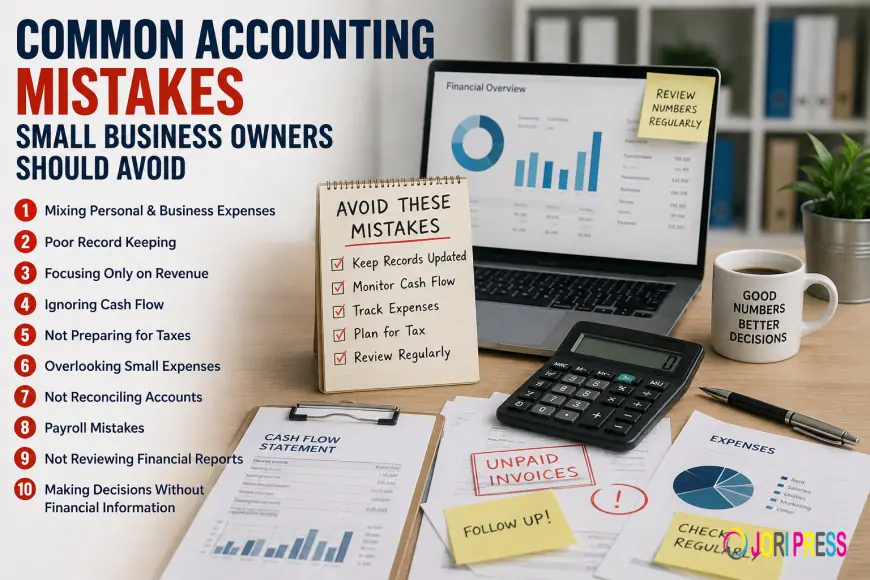
# Common Accounting Mistakes Small Business Owners Should Avoid
Starting and running a small business involves learning many different skills.
An owner may understand their industry extremely well but have limited experience with bookkeeping, tax, payroll or financial reporting.
That is completely normal.
However, accounting mistakes can become expensive when they continue unnoticed.
The good news is that many common problems can be reduced with simple processes and regular financial reviews.
## 1. Leaving Bookkeeping Until the Last Minute
One of the most common mistakes is treating bookkeeping as a year-end task.
Transactions accumulate throughout the year, and eventually the business owner has to work through months of bank statements, invoices and receipts.
This creates unnecessary pressure.
More importantly, it means the owner has little useful financial information during the year.
Regular bookkeeping provides a much clearer picture of business performance and makes it easier to identify unusual costs, missing income or cash-flow issues.
## 2. Mixing Personal and Business Spending
Small business owners sometimes use business accounts for personal purchases or personal accounts for business expenses.
This can make records more difficult to understand.
Separating personal and business finances creates cleaner bookkeeping and makes it easier to determine the actual financial performance of the business.
It also makes conversations with an accountant much more straightforward.
## 3. Focusing Only on Revenue
Revenue is an important performance indicator, but it should never be the only one.
A business can increase sales while becoming less profitable.
For example, prices may remain unchanged while supplier costs increase.
Staffing expenses may rise.
Marketing expenditure may increase.
The business may therefore generate more revenue but retain less profit.
Business owners should look at margins and overall profitability alongside sales.
## 4. Ignoring Small Recurring Expenses
Large purchases naturally attract attention.
Small recurring expenses often do not.
A collection of software subscriptions, service contracts and minor monthly costs can gradually become a substantial annual expense.
Reviewing recurring expenditure periodically can identify services that are no longer needed or costs that have increased without being noticed.
## 5. Not Keeping Proper Records
Good accounting depends on good underlying records.
Businesses should retain appropriate evidence for income and expenses and maintain their records consistently.
Trying to reconstruct transactions months later is more difficult than recording them properly at the time.
A well-organised digital filing system can also make it easier to locate supporting documents when they are needed.
## 6. Forgetting About Cash Flow
A profitable business can still experience cash-flow problems.
If customers take a long time to pay while suppliers and employees need to be paid promptly, the business can experience financial pressure.
Monitoring outstanding invoices and upcoming commitments is therefore essential.
A simple cash-flow forecast can help owners identify periods where available funds may become tight.
## 7. Not Preparing for Tax Liabilities
Tax should form part of financial planning rather than appearing as an unexpected bill.
Businesses should understand their reporting and payment responsibilities and consider future liabilities when managing available cash.
The exact requirements depend on the business structure and circumstances.
Where there is uncertainty, an accountant or appropriate tax professional can help clarify the position.
## 8. Assuming Every Expense Is Automatically Deductible
Business owners sometimes assume that any expense connected loosely with their work will automatically receive favourable tax treatment.
That is not necessarily the case.
The tax treatment of expenses can depend on their purpose, nature and circumstances.
Rather than relying on assumptions or advice found on social media, businesses should obtain appropriate professional guidance when an expense is unclear.
## 9. Treating Payroll as Just Another Payment
Payroll involves more than transferring salaries to employees.
Businesses with employees need appropriate payroll processes and must meet their relevant reporting and employment-related obligations.
Errors can cause administrative problems and create additional work.
Payroll should therefore be reviewed as part of the wider financial system.
## 10. Not Reconciling Accounts Regularly
Bank reconciliation is an important accounting control.
The purpose is to compare recorded transactions with actual bank activity and identify differences.
Without regular reconciliation, errors can remain hidden.
A payment may have been recorded incorrectly, a transaction may be missing or an item may have been duplicated.
Regular checks make these problems easier to identify.
## 11. Making Major Decisions Without Financial Information
Business owners often make decisions based on opportunity.
A new employee could increase capacity.
A new location could generate additional revenue.
New equipment could improve productivity.
But before making a major investment, the financial implications should be considered.
Questions might include:
* What will the investment cost?
* What ongoing expenses will it create?
* How much additional revenue is expected?
* How quickly could the investment pay back?
* What happens if growth is slower than expected?
* Will the business have sufficient cash?
Financial information can turn a hopeful idea into a properly assessed business decision.
## 12. Relying Entirely on Accounting Software
Accounting software has transformed bookkeeping.
Automated bank feeds, digital invoices and reporting tools can save substantial time.
But software is only as useful as the information entered into it.
If transactions are incorrectly categorised, accounts can still be wrong even when the software is functioning perfectly.
Business owners should therefore review their accounting system regularly rather than assuming automation eliminates the need for oversight.
## 13. Not Reviewing Management Information
Annual accounts are important, but they describe the business's historical performance.
Many owners also benefit from regular management information.
Monthly or quarterly reporting can show whether revenue, costs and margins are moving in the expected direction.
This makes it easier to respond to changes before they become significant.
## 14. Ignoring Outstanding Customer Payments
An invoice that has been issued is not the same as money in the bank.
Businesses should monitor outstanding amounts and understand how long customers typically take to pay.
If overdue invoices become a regular problem, the business may need to review its invoicing process, payment terms and credit-control procedures.
Improving collections can have a direct effect on cash flow.
## 15. Trying to Do Everything Alone
Small business owners naturally try to control costs.
Managing some financial administration personally can be perfectly reasonable.
But there is a point where financial complexity starts consuming time that could be spent running the business.
An accountant can provide support with bookkeeping, accounts, tax, payroll, reporting, forecasting and financial planning depending on the business's needs.
Professional support does not necessarily mean handing over every financial responsibility.
It can simply mean having an experienced person review the numbers and help identify issues that the owner may not have noticed.
## Build Simple Systems
Avoiding accounting mistakes does not require an extremely complicated financial system.
A small business can start with a few consistent habits:
**Record transactions regularly.**
**Keep business and personal finances separate.**
**Store supporting documents properly.**
**Review income and expenses each month.**
**Monitor outstanding invoices.**
**Plan for tax and other major commitments.**
**Reconcile accounts.**
**Review cash flow.**
**Compare actual results with expectations.**
These habits create a much stronger financial foundation.
## Accounting Should Support the Business
Accounting is sometimes viewed as paperwork that exists primarily for compliance.
It is much more useful than that.
Good financial information helps an owner understand what is happening inside the business.
It can show where money is being made, where costs are increasing and whether the business has the capacity to invest in its next stage of development.
The objective is not to eliminate every financial uncertainty.
No business can do that.
The objective is to make decisions with reliable information and identify potential problems early.
For small businesses, that can be the difference between simply keeping financial records and genuinely understanding the business behind the numbers.
What's Your Reaction?
 Like
0
Like
0
 Dislike
0
Dislike
0
 Love
0
Love
0
 Funny
0
Funny
0
 Angry
0
Angry
0
 Sad
0
Sad
0
 Wow
0
Wow
0