









































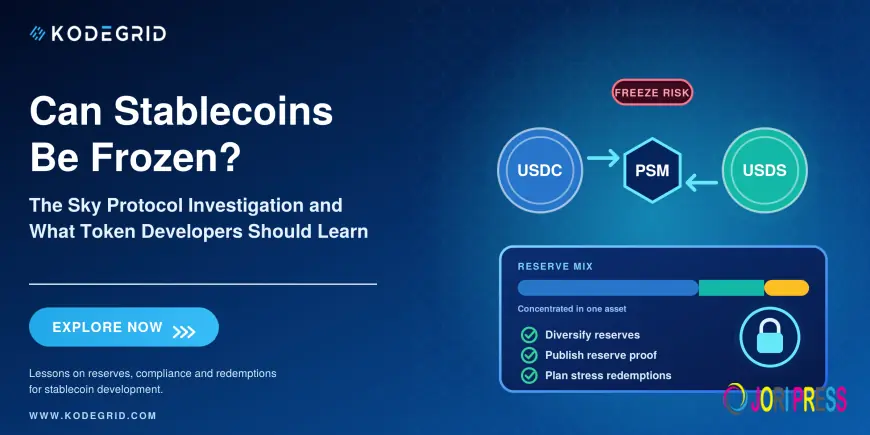
Can Stablecoins Be Frozen? The Sky Protocol Investigation and What Token Developers Should Learn
Stablecoins are supposed to be the boring part of crypto: a token that stays worth one dollar. But a new investigation shows how complicated that promise can get once real reserves, real regulators and open DeFi markets collide.
On November 19, 2026, blockchain risk firm Inca Digital reported that about $518 million in transactions linked to illicit-related wallets passed through the Peg Stability Module (PSM) of Sky, the protocol behind the USDS and DAI stablecoins. The report, shared with CoinDesk, raises questions about reserve management, compliance and what happens when a decentralised stablecoin depends on a centralised asset.
For anyone involved in stablecoin development, it is a useful case study. Here is what was reported, what is disputed and what builders can learn.
What the Investigation Found
The PSM lets users swap Circle's USDC for Sky's USDS or DAI at a fixed one-to-one rate. It is designed to keep the stablecoins close to one dollar.
According to the reporting:
- Inca Digital identified about $518 million in PSM transactions across 422 wallets linked to illicit activity, sanctioned entities or addresses blacklisted by Circle and Tether
- About $101.9 million was attributed to North Korea-linked wallets, including some tied to the February 2025 Bybit theft
- Around 95% of the flagged transactions reached the PSM through third-party trading aggregators, not through Sky's own website
- The central concern is that Sky's PSM holds billions of dollars of USDC, which backs part of the USDS and DAI supply
What Sky Disputes
It is important to read this fairly. The Sky Frontier Foundation rejected the idea that the activity was a breach of its protocol. It said most of the flagged value occurred between 2021 and mid-2024 and pointed out that illicit-linked wallet activity is not the same as directly traced stolen funds. Reports also noted that the $518 million is a historical figure, not current exposure or confirmed losses, and that it is a small share of the protocol's total lifetime volume. A separate review by compliance firm Nominis confirmed the Bybit link but did not verify the full dataset.
Markets still reacted: the SKY governance token fell sharply on the news.
So, Can Stablecoins Be Frozen?
It depends on how the stablecoin is built.
Centralised, fiat-backed stablecoins such as USDC and USDT are issued by companies that can blacklist addresses. Their contracts include controls that let the issuer block transfers from specific wallets. This is by design, and it helps with sanctions and law enforcement.
Decentralised, crypto-backed stablecoins have no issuer who can freeze a wallet directly. But the Sky case shows the catch: when such a system holds a freezable asset like USDC in its reserves, the freeze risk does not disappear. It moves. Inca warned that a court-ordered freeze affecting the pooled USDC could disrupt redemptions for ordinary holders, even if their own wallets did nothing wrong.
In short, a stablecoin is only as freeze-resistant as the weakest asset behind it.
What Token Developers Should Learn
1. Map Your Reserve Dependencies
List every asset that backs your stablecoin, who controls it, and whether it can be frozen, paused or seized. Model what happens if one reserve asset becomes inaccessible. Then publish a plan.
2. Avoid Single Points of Failure
Reports noted that Sky's USDC reserve sits in a single Ethereum address. Whatever the exact setup, the lesson is general: diversify custody, use multi-signature controls and avoid concentrating reserves in one place or one asset.
3. Build Reserve Transparency Into the Product
Public dashboards, regular attestations and on-chain proof of reserves help users judge risk. Clear reporting also protects your reputation when headlines arrive.
4. Design Compliance Into the Contracts
In open DeFi, users can reach your contracts through aggregators and never see your website. Front-end warnings are not enough. Consider contract-level controls such as:
- Per-wallet and per-period limits on swap modules
- Circuit breakers that pause a module under unusual activity
- Screening of flagged addresses where your legal advice supports it
- Gated or tiered access for very large transactions
Every control is a trade-off between openness and risk, so decide it deliberately and explain it publicly.
5. Plan Redemption Mechanics for Stress
Redemption rules decide whether a stablecoin survives a bad day. Define how redemptions work if a reserve asset is delayed, how queues or fees behave and how you prevent a rush for the exit. Test these scenarios before launch.
6. Be Clear About Emergency Powers
Who can freeze, pause or upgrade? Document it, protect those keys with multi-signature wallets and timelocks and publish the governance process. Users should never be surprised by your own admin powers.
7. Treat Security as Continuous
Stablecoin security covers more than code. Combine audits, monitoring, incident playbooks and regular reviews of third-party dependencies. Strong crypto token security means asking what happens when something outside your contracts changes.
8. Get Regional Legal Advice
Stablecoin rules are evolving worldwide, including reserve, redemption and compliance requirements in places such as the United States. Speak to a qualified legal adviser before you design or launch.
A Quick Stablecoin Design Checklist
- Document reserves, custodians and freeze exposure
- Diversify reserve assets and custody
- Publish transparent reserve reporting
- Add contract-level limits, circuit breakers and monitoring
- Define redemption rules under stress
- Protect admin powers with multi-signature wallets and timelocks
- Audit contracts and review third-party risks regularly
- Confirm legal requirements for each market
Building a Stablecoin the Right Way
A stablecoin touches smart contracts, reserves, compliance and market structure all at once, so mistakes are expensive and public. A reliable crypto token development company can help you design the token logic, risk controls and testing plan, then prepare the project for audits and launch. If you are planning a stablecoin or any payment token, professional crypto token development services can help you build safeguards in from day one. Most stablecoins follow the ERC-20 standard, so an experienced ERC20 token development company can also help with the core contract, while good token development covers the risk controls around it.
Conclusion
The Sky investigation does not prove wrongdoing by the protocol, and Sky disputes how the numbers are framed. But it highlights a real design challenge: a decentralised stablecoin can still inherit centralised risk through its reserves. The takeaway for stablecoin development is simple. Know your dependencies, spread your risk, make reserves visible, build controls into the contracts and plan redemptions for the worst day, not the best one.
If you want expert help, work with an experienced crypto token development company that treats reserve risk, compliance and security as core design questions.
Sources
- CoinDesk report on Inca Digital's investigation (November 19, 2026)
- Reports from FinanceFeeds, Cryptonews and CoinCodex on the Sky Frontier Foundation's response and the SKY token reaction
This article is for general information only. It is not financial, legal or investment advice.
What's Your Reaction?
 Like
1
 Dislike
0
 Love
0
 Funny
0
 Angry
0
 Sad
0
 Wow
1