




































Web Development Course: Front-End vs Back-End — What Should Beginners Learn First?
Not sure where to start in a web development course? Compare front-end vs back-end, see a beginner learning order, and find Moople centres across Kolkata.
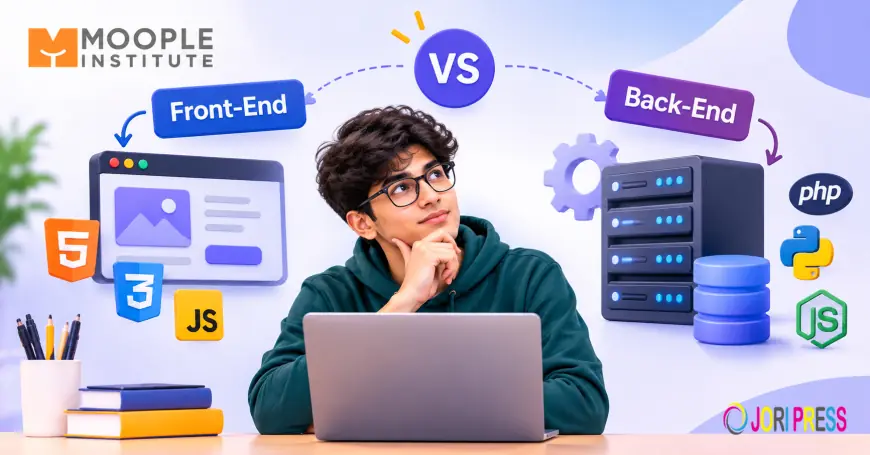
If you’re comparing a web development course and wondering whether to begin with front-end or back-end, start with front-end. HTML, CSS and JavaScript give you something visible within your first week, and that early feedback keeps most beginners going. Back-end comes next, once you understand what a browser actually asks a server for. Here is the difference between the two, a sensible learning order, and how to choose a program in Kolkata.
Front-End vs Back-End in Plain Terms
Front-end is everything a visitor sees and touches: layouts, buttons, menus, animations. Back-end is the hidden machinery that stores accounts, processes orders and serves data.
|
Front-End |
Back-End |
|
|
Focus |
Interface and experience |
Logic, data, security |
|
Core skills |
HTML, CSS, JavaScript |
A server language (Node.js, PHP, Python), databases, APIs |
|
Feedback |
Instant, in the browser |
Slower, tested through requests and logs |
|
Beginner difficulty |
Gentler start |
Steeper |
Why Front-End Usually Comes First
-
Visible progress. Change a colour in CSS, refresh, and see it. That loop teaches faster than most lectures.
-
JavaScript carries over. You need it for interactivity anyway, and through Node.js it also runs on the server, so one language takes you into back-end.
-
An early portfolio. A responsive personal site or landing page can go in front of employers or freelance clients while you’re still learning.
Front-end also builds design sense: spacing, typography, mobile layouts. Developers who skip this stage often build things that work but feel awkward to use.
When Back-End First Can Make Sense
If you already enjoy logic puzzles or have written Python at school, starting with server-side concepts is fine. Still learn basic HTML alongside it. You can’t test a back-end without something to send data to.
A Sensible Order for a Web Development Full Course
-
HTML and CSS: structure, forms, Flexbox, Grid, responsive layouts.
-
JavaScript fundamentals: variables, functions, DOM manipulation, fetch requests.
-
Git and GitHub: Save your work in tracked snapshots from day one, so you can undo mistakes and share projects with others.
-
A back-end language: Node.js with Express, or PHP, whichever your course uses.
-
Databases: SQL basics (such as MySQL) and designing simple tables.
-
A complete project: a login system, CRUD app or small store, deployed online.
Finish one stack before looking at another. Hopping between languages is the most common reason beginners stall.
Choosing a Web Development Course in Kolkata
Look past the syllabus list. Ask whether you’ll build real projects, get feedback on your code, and finish with a deployed portfolio. Travel time matters too, because a centre you can reach comfortably is one you’ll actually attend.
Moople Institute has centres in Chowringhee, Jodhpur Park, New Alipore and Sealdah in Kolkata. It also has centres in Baguiati, Barasat, Sonarpur, Serampore, Chandannagar and Berhampore. Course availability can differ by centre, so check the centres page and confirm the current syllabus before enrolling.
FAQs
1. Should I learn front-end or back-end first?
Front-end, for most beginners. The results are visible, the JavaScript carries over, and you can build a portfolio sooner.
2. Can I join a web development course with no coding background?
Yes. A well-structured course begins at HTML and CSS and assumes no prior experience.
3. How long does it take to learn web development?
It depends on how many hours you practise each week and how the course is structured. Ask the institute for its actual schedule rather than trusting a universal number.
4. Do I need to be good at maths?
Not for front-end. Basic logical thinking is enough to start, and back-end work builds on it gradually.
5. Is front-end or back-end better paid?
It varies by role, company and skill level. Knowing both gives you more options than specialising too early.
6. Can I learn web development alongside college?
Many students do, by practising a little every day. Ask your nearest centre about batch timings.
Conclusion
Start with front-end, add JavaScript, then move into back-end with a real project to tie it together. That order builds confidence before complexity. If you’re ready to begin a structured web development course in Kolkata, explore Moople Institute’s web design course and speak to your nearest centre about the next step.
What's Your Reaction?
 Like
0
 Dislike
0
 Love
0
 Funny
0
 Angry
0
 Sad
0
 Wow
0