







































What Are the Biggest Challenges for Most Businesses When Going Online?
Discover the biggest challenges businesses face when going online, from building an online presence and gaining customer trust to choosing the right marketing strategy and technology.
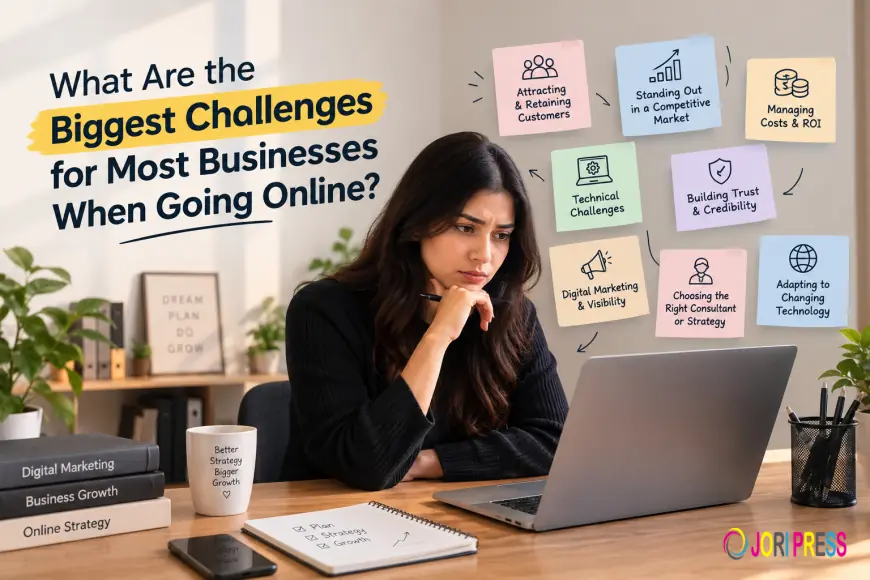
Taking a business online may look simple from the outside. You create a website, open social media accounts, start advertising and wait for customers. In reality, building a successful online business requires much more than simply having a digital presence.
Businesses need to rethink how they attract customers, communicate their value, build trust, manage enquiries and measure growth. The biggest challenge is often not technology itself, but understanding how different parts of the business need to work together.
1. Building an Online Presence That Actually Works
Creating a website, social media profile or Google Business Profile is only the beginning. Simply being visible online does not guarantee that customers will find or choose your business.
A strong online presence should clearly answer a few basic questions:
- What does your business offer?
- Who is it for?
- Why should customers choose you?
- Can they trust you?
- What should they do next?
If these answers are unclear, even high website traffic may not result in meaningful enquiries or sales. The objective should be to create a connected customer experience rather than simply being present on multiple platforms.
2. Understanding Your Online Customers
Customer behaviour can change when a business moves online. Customers can compare several companies within seconds, read reviews, check prices and research alternatives before making a decision.
This makes understanding customer demand extremely important. Businesses should know what their customers are searching for, what problems they want solved, what information they need before buying and what objections may stop them from making a purchase.
Without this understanding, businesses can spend significant amounts on marketing while attracting the wrong audience. A successful online business should therefore begin with customer demand rather than simply choosing a platform or marketing tool.
3. Building Trust Before Asking Customers to Buy
Trust is one of the most important elements of doing business online. Unlike a physical store, an online customer may never meet the business owner or visit a physical location before making a decision.
Businesses can build credibility through clear information, professional website design, genuine reviews, useful content, transparent processes, secure payment options and easy communication.
A common mistake is to focus heavily on generating traffic before improving the customer experience. Thousands of visitors will not help much if those visitors do not feel confident enough to enquire or purchase.
Before increasing marketing spend, businesses should ask: Would a first-time visitor feel confident doing business with us?
4. Standing Out in a Competitive Online Market
Going online can significantly increase competition. A local business may suddenly find itself competing with national brands and established digital companies.
Simply copying competitors is unlikely to create a strong market position. Businesses need to understand their target audience, value proposition, expertise, pricing position and customer experience.
The challenge is not always the number of competitors. It is often the inability to clearly communicate why customers should pay attention to your business. A clear and differentiated position can be more useful than simply increasing advertising spend.
5. Choosing the Right Marketing Strategy
Another major challenge is deciding where and how to market the business. Many companies try everything at once—social media, advertising, blogs, influencers and email marketing—without knowing which activities are actually contributing to growth.
A practical marketing strategy should define:
- Who you want to reach
- What message matters to them
- Which channels they use
- What action you want them to take
- How results will be measured
The right approach depends on the business. A local service company may rely heavily on search visibility, while a startup may focus on content, partnerships or performance-based campaigns. The objective is not to be everywhere, but to be where the right customers are most likely to make decisions.
6. Creating a Clear Marketing Plan
A marketing plan connects business objectives with day-to-day marketing activities. Without one, businesses can easily become reactive—changing their messaging, increasing advertising or copying competitors whenever results slow down.
A useful plan should cover the target audience, core offer, marketing channels, content priorities, lead-generation process, budget, conversion goals and key performance indicators.
The plan does not need to be complicated. What matters is understanding how marketing activity contributes to business growth and knowing where leads come from, how much they cost and how many eventually become customers.
7. Using Technology Without Creating More Complexity
Digital transformation does not mean adopting every new technology available. Businesses sometimes invest in software before clearly identifying the problem they want to solve.
Technology should support specific business objectives such as customer acquisition, communication, sales, reporting or operations.
For smaller businesses, digital transformation can begin with practical improvements such as a better website, customer relationship management, online payments, marketing automation, analytics and digital customer support.
The goal should be greater efficiency and a better customer experience. Technology without strategy can create additional complexity instead of helping the business grow.
8. Knowing When to Seek Expert Guidance
Going online can expose problems that already exist within a business. Marketing may generate leads while the sales process fails to convert them. A website may receive visitors but fail to communicate the value of the offer.
This is where a business growth consultant can add value by looking at the bigger picture. Instead of focusing on one campaign or platform, a consultant can examine positioning, customer acquisition, conversion and business systems together.
For startups, this may involve clarifying positioning and growth priorities. For established organisations, it may involve identifying areas where digital transformation is creating friction.
Final Thoughts
The biggest challenge of taking a business online is not creating a website or social media account. It is building a connected system for growth.
A sustainable online business needs to move customers through a clear journey:
Demand → Visibility → Trust → Enquiry → Conversion → Customer Experience → Retention
If one stage is weak, growth can become difficult. Strong marketing cannot permanently fix poor conversion, and technology cannot replace a clear business strategy.
The goal is not simply to take your business online. The goal is to build a business that can attract, convert and retain customers while creating sustainable growth in the digital environment.
What's Your Reaction?
 Like
0
Like
0
 Dislike
0
Dislike
0
 Love
0
Love
0
 Funny
0
Funny
0
 Angry
0
Angry
0
 Sad
0
Sad
0
 Wow
0
Wow
0