








































Web to Print Store Pricing: Setup, Hosting and the Hidden Costs
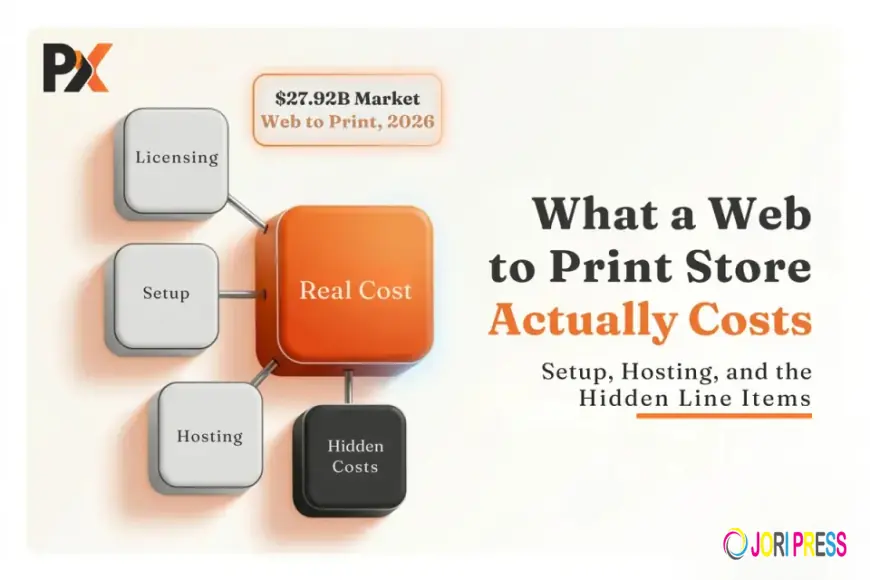
Launching a web to print store can help print businesses sell customized products online, automate orders, and reach customers beyond their physical locations. However, the total cost is not limited to the initial software or storefront setup.
Businesses also need to consider hosting, customization, integrations, payment processing, maintenance, design tools, and other ongoing expenses.
Understanding these costs upfront makes it easier to build a realistic budget and choose the right platform.
1. Initial Web-to-Print Store Setup: The first expense is usually the setup of the online storefront and customization system.
Depending on the platform, setup may include:
- Storefront configuration
- Product catalog setup
- Product templates
- Online product designer
- Pricing rules
- Customer accounts
- Checkout configuration
- Payment setup
- Shipping settings
- Branding and domain configuration
The complexity of the catalog and customization requirements can significantly affect initial implementation costs.
2. Web-to-Print Software Costs: Web-to-print platforms may use different pricing models, including:
- Monthly or annual subscriptions
- One-time licensing
- Per-user pricing
- Per-order or transaction-based pricing
- Enterprise/custom pricing
Before selecting a platform, businesses should understand exactly what is included in the base plan and which features require additional charges.
3. Hosting Costs: Hosting is another important consideration. A web to print store may need to handle large product catalogs, customer-generated artwork, high-resolution images, design previews, and significant order traffic.
Hosting costs can depend on:
- Server resources
- Storage
- Bandwidth
- Database requirements
- Traffic volume
- Backup requirements
- Security features
Cloud-based platforms may include hosting within the subscription, while self-hosted solutions may require businesses to manage infrastructure separately.
4. Online Product Designer Costs: One of the defining features of a web-to-print store is the ability to customize products online. Depending on the platform, additional costs may apply for:
- Product design tools
- Advanced customization features
- 3D visualization
- Template libraries
- Variable data support
- Artwork validation
- Print-ready file generation
Businesses should determine whether these features are included or billed separately.
5. Integration Costs: A web-to-print store often needs to communicate with other business systems. Common integrations include:
- eCommerce platforms
- ERP or Print MIS systems
- CRM platforms
- Payment gateways
- Shipping providers
- Supplier catalogs
- Accounting systems
- Production equipment
Pre-built integrations can reduce implementation costs, while custom API development can increase both initial and ongoing expenses.
6. Payment and Transaction Fees: Every online order can carry payment-related costs. Depending on the payment provider, businesses may pay transaction fees, processing fees, or other charges. These costs may appear small individually but can become significant as order volume increases. They should therefore be included when calculating the actual cost of operating the store.
7. Maintenance and Updates: A web-to-print store requires ongoing maintenance. Potential expenses include:
- Software updates
- Security monitoring
- Bug fixes
- Product catalog updates
- Integration maintenance
- Server management
- Technical support
Businesses should clarify whether maintenance and support are included in their software subscription.
8. Hidden Costs to Watch: Some costs are easy to overlook during initial planning.
Product Data Management: Large catalogs require ongoing updates to product information, images, pricing, and specifications.
Artwork Storage: Customer-uploaded artwork can require significant storage, particularly for high-resolution files.
Custom Development: Unique workflows or features may require additional development beyond standard platform capabilities.
Training: Employees may need training to manage products, templates, orders, and customer support.
Marketing: Launching the storefront does not automatically generate traffic. Businesses may need budgets for SEO, paid advertising, email marketing, and social media.
Customer Support: Customized products can generate more questions about artwork, specifications, proofs, and delivery. Support resources should be included in the operating budget.
How to Calculate the Real Cost
Instead of looking only at the software subscription, consider the total cost of ownership (TCO):
Software + Setup + Hosting + Integrations + Payment Fees + Maintenance + Support + Marketing = Total Cost
This gives businesses a more realistic picture of what the store will cost over time.
How to Control Web-to-Print Costs
Businesses can reduce unnecessary expenses by:
- Starting with their highest-demand products.
- Using pre-built integrations where possible.
- Choosing a platform with hosting included when appropriate.
- Automating product and inventory updates.
- Using reusable product templates.
- Clearly defining required features before development.
- Comparing total ownership costs rather than subscription prices alone.
The cheapest platform is not always the most cost-effective if it requires significant custom development or manual administration.
Final Thoughts
The cost of a web to print store goes well beyond the initial storefront setup. Hosting, design tools, integrations, payment processing, maintenance, storage, support, and marketing can all influence the final investment.
A careful cost analysis should consider both upfront expenses and recurring operational costs. By understanding these factors before implementation, print businesses can select a solution that fits their budget while still providing the automation and customization capabilities needed to grow online sales.
What's Your Reaction?
 Like
0
Like
0
 Dislike
0
Dislike
0
 Love
0
Love
0
 Funny
0
Funny
0
 Angry
0
Angry
0
 Sad
0
Sad
0
 Wow
0
Wow
0