





































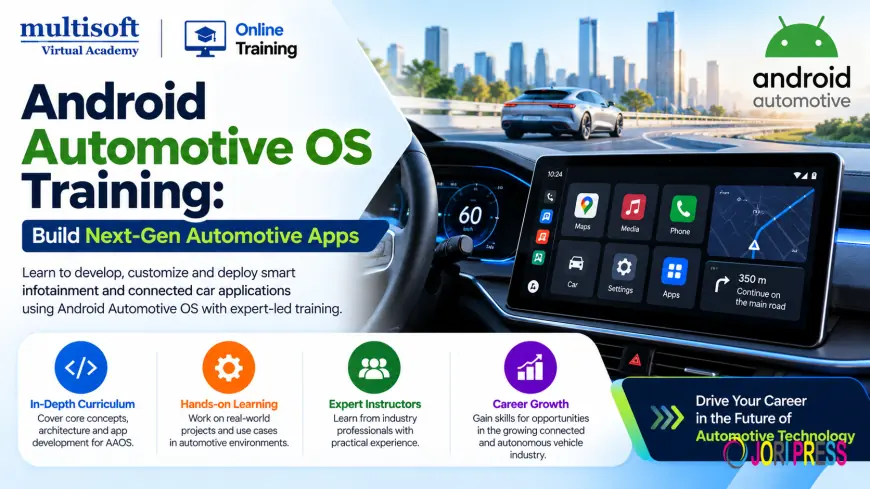
Android Automotive OS Training: Build Next-Gen Automotive Apps
Learn Android Automotive OS Training to develop in-vehicle applications, explore automotive software concepts, and gain practical skills for connected vehicle technologies.

The automotive industry is moving toward software-defined vehicles, connected infotainment systems, and intelligent in-car digital experiences. Modern vehicles increasingly rely on software to deliver navigation, media streaming, voice interaction, vehicle information, and personalized driver experiences. This transformation is creating new opportunities for software developers and automotive engineers who understand embedded Android technologies.
Android Automotive OS Training helps professionals understand how to develop, configure, test, and optimize applications for Android-based infotainment systems installed directly in vehicles. Unlike conventional mobile application development, automotive software development involves specialized system architecture, vehicle hardware integration, driver-distraction requirements, and automotive-specific testing procedures.
Android Automotive OS (AAOS) is built on the Android Open Source Project and runs on the vehicle's own computing hardware. It supports in-vehicle infotainment and can serve as a foundation for broader digital cockpit experiences.
For Android developers, embedded software engineers, automotive technology specialists, and professionals exploring connected mobility, learning AAOS can provide a foundation for working on next-generation vehicle software. This article explores its architecture, development tools, important training topics, practical applications, and emerging career opportunities.
What Is Android Automotive OS?
Android Automotive OS is an Android-based operating system designed to run natively on compatible vehicle hardware. It provides a platform for automotive manufacturers and technology teams to build customized infotainment experiences and integrate selected vehicle functions.
Depending on the vehicle architecture and implementation, AAOS can support media playback, navigation, vehicle settings, connectivity, and other in-car applications.
It is important to distinguish AAOS from Android Auto. Android Auto projects supported experiences from a connected smartphone onto a compatible vehicle display. AAOS runs directly on the vehicle's computing platform. Some AAOS vehicles also include Google services, while others use customized software configurations.
This distinction influences application architecture, system integration, deployment, testing, and access to vehicle-specific capabilities.
Why Is Android Automotive OS Training Important?
Automotive software must meet requirements that differ from those of conventional mobile applications. Developers need to consider display layouts, user interaction while driving, hardware differences, system performance, and compatibility with automotive platforms.
Understand Automotive Android Architecture
Training introduces learners to the architecture of Android-based infotainment systems, including application components, Android framework services, hardware abstraction, and automotive-specific services.
Understanding these layers helps developers investigate application behavior and recognize where software interacts with the underlying vehicle platform.
Develop Vehicle-Ready Applications
Automotive applications must be designed for the driving environment. Large touchscreens, voice interaction, steering-wheel controls, and multiple displays can influence the user experience.
Training helps developers understand how to adapt application behavior to automotive requirements rather than simply transferring a smartphone interface into a vehicle.
Explore Vehicle-System Integration
AAOS can interact with vehicle-specific services and hardware through supported interfaces and system configurations.
Learning these concepts helps professionals understand the relationship between infotainment applications, vehicle properties, hardware abstraction layers, and manufacturer-specific implementations.
Improve Testing and Debugging Skills
Automotive software must be evaluated across relevant configurations and operating conditions. Developers may need to investigate startup behavior, application lifecycle issues, display compatibility, connectivity, and performance.
Training can introduce emulator-based testing, debugging workflows, log analysis, and systematic problem-solving techniques.
Core Modules Covered in Android Automotive OS Training
A structured training program should progress from Android development fundamentals to automotive-specific architecture and application integration.
1. Android Development Fundamentals
Learners should understand the Android application lifecycle, services, permissions, application components, and development environment.
Depending on the course, topics may include Kotlin or Java, Android Studio, Gradle, application packaging, debugging, and version control.
These fundamentals provide the foundation for understanding automotive application development.
2. Android Automotive OS Architecture
The architecture module introduces the major software layers involved in an AAOS implementation.
Topics may include:
- Android application and framework layers
- Automotive-specific system services
- Vehicle hardware abstraction concepts
- In-vehicle infotainment architecture
- System permissions and privileged applications
- Communication between software components
The exact architecture depends on the platform version and manufacturer implementation. Learners should understand the distinction between standard Android functionality and vehicle-specific capabilities.
3. Android for Cars App Library
The Android for Cars App Library provides a templated framework for supported application categories, helping developers build interfaces designed for use in vehicles.
Training may cover CarAppService, sessions, screens, templates, application lifecycle management, and supported navigation or media-related experiences.
Google's developer documentation explains how the library can support applications for Android Auto and Android Automotive OS Course through a host-based architecture.
Learners should also understand that not every Android application category can use the same framework. The appropriate implementation depends on the application's purpose and supported platform requirements.
4. In-Vehicle Infotainment Application Development
In-vehicle infotainment systems provide access to media, navigation, communication, and other digital services.
Training may cover application structure, media playback, user interaction, display adaptation, lifecycle management, and supported connectivity features.
Developers should consider how applications behave when the vehicle starts, changes operating states, loses connectivity, or switches between displays.
5. Vehicle Property Integration
AAOS implementations may expose vehicle-specific information through supported automotive interfaces.
Depending on permissions and platform configuration, this can include selected information about vehicle conditions, energy systems, or other vehicle properties.
Advanced training may introduce the Vehicle HAL, property definitions, access permissions, and the relationship between Android services and vehicle hardware.
Access to sensitive vehicle properties is restricted and depends on the system configuration and permissions granted. Production implementations must follow the applicable manufacturer and platform requirements.
6. Automotive User Interface Design
An effective in-car interface should minimize unnecessary driver interaction and present information clearly.
Training may cover automotive design principles, display adaptation, interaction patterns, accessibility, and the use of supported templates.
Developers must consider driver-distraction requirements when determining which features and interactions are appropriate while a vehicle is moving. Application distribution also depends on meeting applicable Google Play requirements.
7. Testing and Debugging
Testing is essential for identifying functional issues and verifying application behavior across different environments.
A training course may introduce Android Automotive OS emulators, Android Studio debugging tools, Android Debug Bridge (ADB), log analysis, and application performance testing.
Practical exercises can help learners investigate crashes, permission errors, lifecycle problems, and differences between emulator configurations.
8. Deployment and Application Compatibility
Automotive applications may require platform-specific configurations, supported application categories, manifest declarations, and appropriate release tracks.
Training should explain the importance of validating application compatibility before deployment.
Learners should also understand that Google Play eligibility, vehicle compatibility, and manufacturer-specific restrictions can influence how applications are distributed and used.
Advanced AAOS Development: Vehicle HAL and System Services
Professionals pursuing embedded Android or platform engineering roles may need deeper knowledge of automotive system architecture.
Vehicle Hardware Abstraction Layer
The Vehicle HAL provides an abstraction between Android automotive services and vehicle-specific hardware implementations.
Depending on the architecture, this layer supports communication involving defined vehicle properties and related automotive functionality.
Advanced learning may cover property configuration, data types, access permissions, service communication, and the importance of validating hardware-specific behavior.
Automotive System Services
AAOS includes automotive-specific framework services that support interactions between the operating system and vehicle-related components.
Understanding these services helps developers distinguish application-level behavior from system-level functionality.
Learners working on platform customization may also study system permissions, service configuration, debugging procedures, and interactions with hardware abstraction components.
Embedded Android and Platform Customization
Some automotive projects require more than application development. Platform teams may customize the Android operating system, configure system images, integrate hardware components, and adapt software to specific vehicle requirements.
These responsibilities generally require deeper knowledge of Android internals, build systems, embedded Linux concepts, hardware interfaces, and the Android Open Source Project.
The appropriate learning path depends on whether the goal is application development, platform integration, or embedded operating system engineering.
Android Automotive OS and Software-Defined Vehicles
Software-defined vehicles increasingly use software platforms to support digital features, system updates, and connected services.
AAOS can provide a foundation for in-vehicle infotainment and, within suitable architectures, broader digital cockpit experiences. The Android Open Source Project also documents automotive platform developments related to software-defined vehicles.
Over-the-Air Software Updates
Over-the-air updates can allow supported vehicle software components to receive updates without requiring conventional manual installation procedures.
However, update mechanisms depend on the vehicle architecture, security design, manufacturer policies, and deployment infrastructure.
Developers should understand that reliable automotive updates require validation, compatibility checks, secure delivery, and appropriate recovery strategies.
Connected Vehicle Experiences
Connected vehicle applications can combine cloud services, navigation information, media, and selected vehicle data.
Training can introduce the architectural considerations involved in connecting applications to remote services, managing network interruptions, and protecting sensitive information.
AI and Intelligent In-Car Experiences
AI technologies can support selected automotive experiences, including voice interaction, information retrieval, personalization, and other software features.
Developers must evaluate these capabilities against system resources, privacy requirements, driver-distraction constraints, and vehicle safety considerations.
AI integration should support the intended driving experience without introducing unnecessary complexity or distracting interactions.
Who Should Enroll in Android Automotive OS Training?
AAOS training can benefit professionals working across Android development, embedded systems, and automotive technology.
Android application developers: Expand existing mobile development knowledge into automotive application development.
Automotive software engineers: Understand the Android-based infotainment environment and its system integration requirements.
Embedded systems developers: Explore automotive Android architecture, hardware interfaces, and platform customization.
Infotainment engineers: Develop knowledge relevant to media, navigation, connectivity, and in-vehicle user experiences.
System integration engineers: Learn how applications and system services interact with automotive platform components.
QA and automation engineers: Build knowledge of emulator-based testing, application compatibility, debugging, and validation workflows.
Engineering graduates: Establish a foundation for learning Android development and progressing toward automotive software specialization.
Prior Android development experience is useful for advanced courses. Beginners can start with Kotlin or Java, Android application fundamentals, and basic embedded systems concepts.
Career Opportunities After Android Automotive OS Training
AAOS expertise can be relevant to automotive manufacturers, technology suppliers, engineering service providers, and companies developing connected vehicle solutions.
Potential roles include:
- Android Automotive OS Developer
- Automotive Android Application Developer
- Embedded Android Engineer
- Automotive Infotainment Engineer
- Android Platform Integration Engineer
- Automotive Software Test Engineer
- Vehicle Connectivity Software Engineer
- Automotive Systems Engineer
Application developers generally focus on supported in-car experiences, while platform engineers may work with system services, hardware abstraction, operating system customization, and device integration.
Testing professionals may specialize in compatibility, reliability, automation, and performance validation.
Employers may also expect knowledge of Kotlin or Java, Android internals, C++, embedded Linux, automotive communication concepts, or relevant development tools.
Completing a course does not guarantee employment. Practical projects, technical problem-solving, and experience with suitable development environments remain important.
How to Choose the Right Android Automotive OS Training Program
Selecting the right course requires a clear understanding of your professional objectives.
Review the Curriculum
Check whether the program focuses on application development, the Android for Cars App Library, vehicle integration, platform customization, or testing.
An application developer may not need the same depth of operating system knowledge as an embedded platform engineer.
Prioritize Practical Projects
Hands-on exercises can help learners understand how automotive applications behave in realistic development environments.
Look for opportunities to create an application, run it in an AAOS emulator, investigate lifecycle behavior, and test relevant automotive-specific features.
Check Platform and Tool Versions
Development tools and automotive APIs evolve over time. Confirm which Android platform version, Android Studio environment, and libraries are covered by the course.
Evaluate Trainer Expertise
Choose training that explains both software implementation and the engineering considerations behind automotive platform behavior.
Practical demonstrations, debugging exercises, and opportunities to discuss technical questions can improve the learning experience.
Understand Application Distribution Requirements
Developers should review current Android for Cars documentation and the applicable application quality requirements before planning a production release.
This is particularly important when developing applications that must comply with supported categories, driving restrictions, and platform compatibility requirements.
Best Practices for Learning AAOS Development
Start with Android development fundamentals before exploring automotive-specific APIs and architecture.
Next, create a small application and test it using the Android Automotive OS emulator. Learn how to inspect logs, investigate application crashes, and evaluate behavior across different display configurations.
Progress to automotive-specific components, supported templates, vehicle services, and integration concepts according to your learning objectives.
When working with vehicle-related interfaces, study permissions and platform restrictions carefully. Do not assume that an application can access every vehicle property or control every vehicle function.
Finally, document your projects and explain the engineering decisions behind them. A portfolio that demonstrates application design, testing, debugging, and integration can help communicate your skills to potential employers.
Conclusion
Android Automotive OS is an important technology for the development of modern in-vehicle infotainment systems and connected automotive experiences. Android Automotive OS Training helps professionals develop knowledge of Android architecture, automotive application development, vehicle integration, testing, and platform-specific requirements. By combining Android programming fundamentals with practical automotive projects, learners can build skills relevant to embedded software, infotainment development, and connected mobility. For structured learning and professional guidance, Multisoft Virtual Academy offers Android Automotive OS training designed to help learners strengthen their understanding of automotive Android technologies and prepare for evolving software development responsibilities. Consistent practice, familiarity with official developer documentation, and a strong understanding of automotive design constraints can provide a valuable foundation for working on next-generation vehicle software.
What's Your Reaction?
 Like
0
Like
0
 Dislike
0
Dislike
0
 Love
0
Love
0
 Funny
0
Funny
0
 Angry
0
Angry
0
 Sad
0
Sad
0
 Wow
0
Wow
0