































What If Your Learning Platform Could Predict Where You’ll Get Stuck?
Discover how AI-powered online learning can predict learning gaps, personalize study paths, and help students overcome challenges before they get stuck.
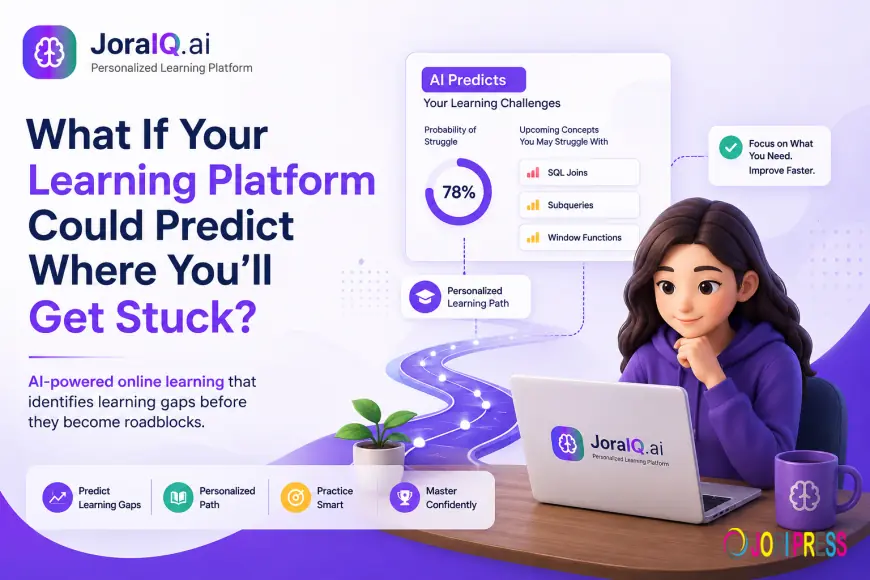
Imagine opening your learning platform and seeing a message:
“You’re likely to struggle with this topic. Let’s practice one concept first.”
That sounds futuristic, but AI is making this type of learning experience increasingly possible.
Traditional online learning usually reacts to performance. You complete a quiz, receive a score, and then move on. But what if technology could identify your learning gaps before they turn into repeated mistakes?
This is where AI-powered online learning is changing the way students learn.
From Tracking Performance to Predicting Learning Gaps
Most learning platforms collect basic information such as quiz scores, completed lessons, and time spent on a topic.
AI can go much further.
By analyzing learning behavior, an intelligent platform can identify patterns such as:
-
Repeated mistakes on similar questions
-
Topics where a student needs significantly more practice
-
Sudden drops in performance
-
Difficulty applying a concept to a new problem
-
Frequent attempts without actual improvement
These signals can help the system understand not only what a student got wrong, but potentially where the student is likely to struggle next.
That changes the learning experience from reactive to proactive.
Why Predicting Struggle Matters
Consider two students who score 60% on the same SQL assessment.
A traditional platform might recommend the same lesson to both.
But their problems could be completely different.
Student A may not understand SQL joins.
Student B may understand joins but struggle to apply them to business scenarios.
Giving both students the same content may not solve either problem effectively.
An AI-driven learning system can analyze their responses and learning patterns to recommend different practice paths.
One student might need a concept explanation.
The other might need scenario-based questions and application practice.
This is the real potential of personalized learning.
How AI Personalized Learning Can Help Schools
The concept becomes even more powerful in schools and colleges.
With AI personalized learning for schools, educators can gain additional insights into how students are progressing across different concepts.
Instead of waiting until a major examination reveals a learning gap, AI can continuously analyze student interactions and highlight areas that may require attention.
For example, if several students repeatedly struggle with the same mathematical concept, educators can identify the pattern and provide targeted intervention.
At an individual level, students can receive different learning activities based on their current level of understanding.
The goal isn't to replace teachers.
It's to give teachers better information about who needs help, with what, and potentially why.
The Future Is Not More Content
Online education has already given learners access to thousands of courses, videos, quizzes, and resources.
But more content doesn't automatically create better learning.
The bigger question is:
Can a learning platform determine what a learner needs next?
That is where AI-powered online learning becomes more interesting.
The future could move from:
Learn → Test → Score
to:
Assess → Detect → Personalize → Practice → Retrain → Master
Instead of simply telling students that they made a mistake, intelligent learning platforms can help turn that mistake into a personalized learning opportunity.
Final Thoughts
The most valuable AI in education may not be the technology that creates the most content.
It may be the technology that understands when a learner is struggling and what kind of support they need next.
If learning platforms can move from measuring yesterday's performance to anticipating tomorrow's challenges, online learning could become significantly more adaptive, proactive, and personalized.
And perhaps the most important question for the future of education won't be:
“What did the student score?”
It will be:
“What is the student likely to struggle with next—and how can we help before they get stuck?”
What's Your Reaction?
 Like
0
Like
0
 Dislike
0
Dislike
0
 Love
0
Love
0
 Funny
0
Funny
0
 Angry
0
Angry
0
 Sad
0
Sad
0
 Wow
0
Wow
0