


































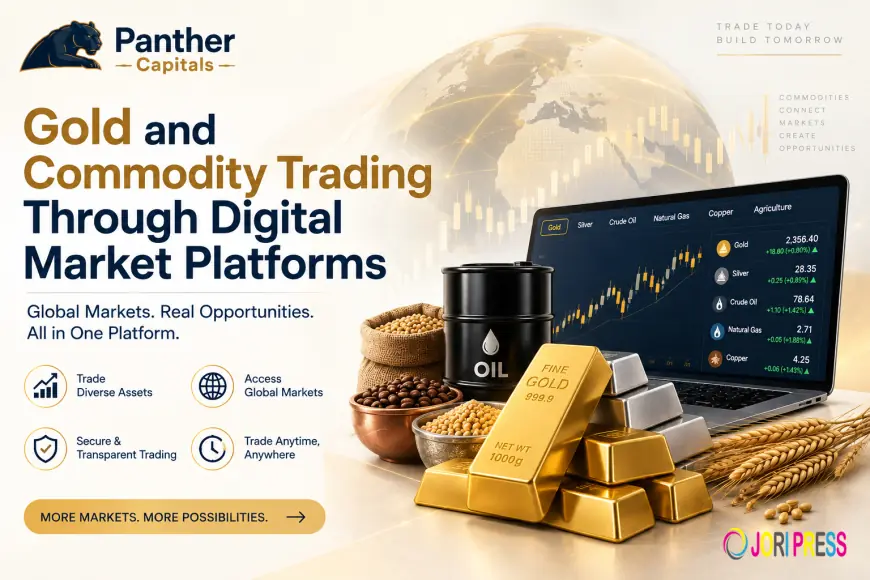
Gold and Commodity Trading Through Digital Market Platforms
At Panther Capitals, we provide digital access to gold and commodity markets with a focus on informed participation. Our approach combines market analysis, trading technology, supply and demand insights, portfolio considerations, and responsible risk management to help traders evaluate opportunities across gold, metals, energy, and other global commodity markets.

Expanding Access to Gold and Commodity Markets
Digital technology has changed how traders participate in financial markets. Gold and commodities can now be monitored and traded through online environments that provide access to market prices, analytical information, and position-management functionality.
At Panther Capitals, we focus on making these markets accessible while keeping informed decision-making at the centre of the trading experience. Gold and commodities provide exposure to different economic forces, making it important to understand what influences each asset before taking a position.
Gold can respond strongly to currencies, monetary policy, inflation expectations, central-bank activity, and geopolitical developments. Other commodities may be more directly influenced by production, consumption, inventories, weather, transportation, and global economic activity.
Understanding these differences helps traders evaluate opportunities according to market conditions rather than treating every commodity in the same way.
Accessing Gold Through Online Markets
Physical gold has traditionally been associated with jewellery, coins, and bars. Financial markets provide another way to participate in gold price movements without approaching gold solely as a physical asset.
Through gold trading online, traders can monitor changing prices and consider positions based on their individual market views. Digital access also makes it easier to assess economic developments while following gold-market movements.
Several factors can influence gold prices, including
-
Interest-rate expectations
-
Inflation and economic data
-
Currency movements
-
Central-bank policies
-
Investment and physical demand
-
Geopolitical developments
-
International market sentiment
No single factor consistently determines gold prices. We believe traders can gain a more complete market perspective by considering several influences together.
Digital access provides convenience, but convenience does not eliminate price risk. Every position should be considered according to personal objectives and tolerance for potential losses.
What Matters in a Gold Trading Experience
A gold trading platform provides the technological environment through which traders access market opportunities, monitor positions, and respond to changing prices.
Technology can influence the overall experience, but traders should look beyond visual design when assessing a platform. Market accessibility, pricing visibility, execution, analytical functionality, and risk-management features can all be important.
We focus on providing an environment where clients can access relevant market information while maintaining control over their trading decisions.
Traders should also consider how platform functionality fits their individual strategies. Someone focused on shorter-term movements may have different requirements from a participant who follows broader economic trends.
Regardless of the approach, technology should support a trading process rather than replace market understanding and disciplined decision-making.
Choosing Technology Around Trading Requirements
There is no universal feature that automatically creates the best gold trading platform for every trader. The appropriate environment depends on individual requirements, market experience, preferred strategies, and risk tolerance.
Important considerations may include ease of access, price information, order functionality, position monitoring, analytical tools, and transparency.
Risk-management capabilities deserve particular attention. Gold can experience substantial volatility when major economic announcements or geopolitical developments change market expectations.
Traders should therefore consider not only how easily a position can be opened but also how effectively exposure can be monitored and managed.
At Panther Capitals, we believe a strong trading experience combines convenient technology with a clear understanding of the underlying market. A platform can provide tools and access, but individual decisions ultimately determine how those resources are used.
Moving Beyond Gold Into Commodities
Gold represents one part of the wider commodity universe. Traders can also encounter markets connected with energy, industrial metals, precious metals, and agricultural resources.
Through commodity market trading, participants can take positions linked to assets whose prices respond to real-world economic conditions.
Energy markets can react to changes in production, inventories, transportation, and international consumption. Industrial metals may be influenced by manufacturing, construction, infrastructure spending, and economic growth.
Agricultural markets introduce additional factors such as rainfall, temperatures, crop conditions, seasonal production, and government policies.
These differences create a diverse trading environment. They also mean traders should understand the characteristics of the specific commodity behind a contract before committing capital.
Understanding Futures and Commodity Contracts
Commodity trading in India commonly involves derivative contracts rather than physically storing the underlying resource. Futures and options provide market participants with ways to gain exposure to commodity price movements under defined contract terms.
Futures contracts specify details such as quantity, expiry, and settlement conditions. Options have different characteristics and provide rights or obligations depending on the type of contract and position.
Contract size and margin requirements can affect the amount of exposure created by a trade. Traders should understand these specifications before entering a position.
Leverage also requires careful attention. It can increase market exposure relative to the capital initially committed, which means both potential gains and losses can be magnified.
We believe understanding the product structure is just as important as forming a view about the future direction of a commodity.
Considering Commodities Within a Portfolio
Investors often consider different asset classes when building portfolios. Stocks, fixed-income instruments, currencies, gold, and commodities can respond differently as economic conditions change.
When investing in commodities, the reason for adding exposure should be clearly established.
Some investors may consider commodities for diversification, while others may have a specific view on inflation, economic growth, energy demand, infrastructure activity, or supply conditions.
Commodity exposure may offer several potential portfolio considerations
-
Participation across different economic sectors
-
Exposure to global supply-and-demand trends
-
Diversification beyond conventional financial assets
-
Access to metals, energy, and agricultural themes
-
Opportunities arising from changing economic cycles
Diversification cannot guarantee returns or prevent losses. Investors should still consider allocation size, market volatility, time horizon, and overall portfolio exposure.
Understanding What Moves Commodity Prices
The commodities market is closely connected with physical economic activity. Production, transportation, consumption, inventories, government policies, currencies, and international events can all affect pricing.
Supply and demand are particularly important.
When consumption rises while production remains limited, available supply may tighten. When production grows faster than consumption, increased availability can create different price conditions.
Unexpected developments can quickly change this relationship. Severe weather may affect agricultural output, geopolitical tensions can interrupt energy supplies, and mining disruptions may influence metals.
Currencies also play an important role because many commodities are internationally priced. Exchange-rate movements can therefore affect purchasing costs and demand across countries.
Understanding these relationships can help traders identify the economic context behind market movements rather than focusing solely on changing prices.
Using Fundamental Analysis for Market Decisions
Fundamental analysis focuses on the economic conditions influencing an asset.
For gold, traders may consider monetary policy, interest rates, inflation, currencies, central-bank activity, and international uncertainty.
Other commodities require more specialised analysis.
Energy traders may monitor production, inventories, consumption, and geopolitical developments. Industrial-metal traders can consider manufacturing and infrastructure activity. Agricultural participants may monitor weather, crop expectations, seasonal conditions, and government policies.
Markets also respond to expectations rather than economic information alone. Prices may move before an anticipated event occurs because participants have already incorporated their expectations into trading decisions.
We use market information as a foundation for structured analysis rather than treating any individual indicator as a guarantee of future direction.
Adding Technical Analysis to the Process
Technical analysis provides another perspective by concentrating on price behaviour.
Traders can examine historical movements to assess trends, momentum, volatility, and potentially important price areas. Moving averages, support and resistance, previous highs and lows, and momentum indicators are among the tools commonly considered.
Timeframes also matter. A commodity may display a broader upward trend while experiencing a shorter-term decline.
Traders should therefore align their analytical timeframe with their intended strategy.
Technical information does not predict prices with certainty. Instead, it can provide a framework for evaluating market behaviour and planning potential entry, exit, and risk scenarios.
Combining relevant fundamental information with price analysis can create a broader market perspective.
Managing Risk Before Entering a Position
Market risk cannot be removed from gold or commodity trading. Prices may move sharply when economic expectations change or unexpected events affect global markets.
We believe risk management should begin before a trade is placed.
Position sizing helps determine how much capital is exposed to an individual market. Traders can also establish conditions that would cause them to reconsider their original analysis.
Leverage requires additional care because relatively small price movements can create larger changes in the value of a leveraged position.
A structured approach can include
-
Defining the reason for the trade
-
Determining appropriate position size
-
Considering potential downside
-
Monitoring total portfolio exposure
-
Establishing possible exit conditions
-
Reviewing changing market information
These steps cannot guarantee a particular result, but they can help traders approach uncertainty more systematically.
Building a Disciplined Digital Trading Approach
At Panther Capitals, we aim to combine digital market access with a responsible approach to gold and commodity participation.
Technology provides traders with faster access to information, analytical functionality, and market opportunities. However, effective participation still depends on understanding the asset, assessing market conditions, controlling exposure, and maintaining discipline.
Gold connects traders with a globally recognised market influenced by monetary conditions, currencies, economic expectations, and investment sentiment. Broader commodities provide exposure to industries shaped by energy consumption, agriculture, manufacturing, infrastructure, production, and international trade.
Each market brings different opportunities and different sources of risk.
We believe traders are better positioned when they understand why they are entering a market rather than reacting only to short-term price movements. By combining accessible technology with analysis, appropriate risk controls, and a clearly defined strategy, clients can build a more structured approach to participating in changing gold and commodity markets.
What's Your Reaction?
 Like
0
Like
0
 Dislike
0
Dislike
0
 Love
0
Love
0
 Funny
0
Funny
0
 Angry
0
Angry
0
 Sad
0
Sad
0
 Wow
0
Wow
0